
Toyin Falola
What constitutes the rule of law is often shaped by the spirit of the law in each society. Whether the law is good or bad, the core principle of the rule of law is strict adherence to that law. As John Austin’s positivist school argues, it doesn’t matter whether the law is just or unjust; the law is the law. This idea reflects the respect and regard for laws, including despotic laws enacted under military regimes in Nigeria. Therefore, respecting the law and maintaining it in its highest form truly embodies the rule of law.
However, this piece focuses not only on the ambiguous tendencies of the rule of law but also on its application within a democratic setting. Understanding what the rule of law is and how it is observed in a democracy is essential for developing a sophisticated society in the 21st century.
Well, the Nigerian democracy and the practice of the rule of law in its systemic manifestations and special convictions are faulted in many unimaginable ways. There is no need to window-dress the system; it is a fundamental issue that calls for a fundamental approach to solving it. Sometimes, people wonder why democratic practices and the observance of principles. The state of the rule of law in Nigeria is so abysmal, and one would think we have not adopted those ideologies well from the colonialists. However, it is more pitiable to realise that long before colonialism, some ethnic groups had practised the observance of the rule of law and also the practice of democracy in their way of doing so. Hence, these practices should be innate rather than looking like the nation is navigating strange waters with them.
In northern Nigeria’s Sokoto Caliphate, the law was supreme, and there were systems to ensure that people followed the legal and political hierarchies. Disobedience to the law in this society was not only a matter of temporal consequences but also eternal punishment. The observance of laws, Quranic principles, and the guidance of hadiths was non-negotiable, and failure to comply would result in serious consequences. This did not mean that there were no flaws in the system, but it meant that the people understood the rule of law, and the African society was not in any way lawless, as narrow-minded foreigners might portray it.
Powers were distributed among various office holders, including the Waziri, the Ulamas, the Emirs, the Qadis, and others who supported the political system. While it might not be democracy, the rule of law was in place. A similar situation exists in the precolonial Oyo Empire, which had a more organized democratic setup with checks and balances and the separation of power among state chieftains and leaders.
The Alaafin was one of the most regulated monarchs in Africa, but still preserved and protected the dignity of his office. The Oyo Mesi, Ogboni, Ilaris, Baale, and other officials demonstrated duties, checks, and balances. The Aare Ona Kankanfo was stationed at the bays and borders of the Oyo Empire to maintain his military strength, and different personalities were further regulated through practice or customs.
The Igbo communities closely resemble the democratic practices of ancient Athens, where the concept of democracy is believed to have originated. The egalitarian nature of Igbo society, their practice of direct democracy, and respect for their understanding of the rule of law demonstrate the practical embodiment of the Nigerian people’s commitment to their original ideals of governance.
Among the over 250 ethnic groups that symbolize Nigeria’s diverse identity, many political and legal spheres emphasize the country’s history with democracy and, most importantly, the observance of the rule of law. It then raises the question of how Nigeria has been doing so poorly with both concepts lately and why there haven’t been any solutions.
The problem the nation faces with successful democracy and the establishment of the rule of law is both innate and passed down through generations. It can be summarized into two issues: despotic political subconscious traits and systemic corruption.
The political landscape of Nigeria exhibits traits of despotism and concern over democratic principles. Over time, freedoms such as the press, respect for laws, judicial independence, civil law enforcement, and checks and balances—elements essential to the rule of law—have been undermined by the clueless leadership of colonialists and the brutal rule of military regimes. These setbacks have pushed the nation 100 steps backward, hindering progress toward democratic leadership and respect for the rule of law.
The colonial leadership, although during which many of the tenets of democracy took their modern roots and styles, was not allowed to perform to its full potential. The press was either promoting white supremacy, and those who advocated for African and Nigerian original ideologies and representations were mostly frowned upon. The cultural and traditional beliefs of Nigerians were disrespected, and law enforcement agents of the time did not hesitate to break the very laws they were supposed to uphold.
After the short democratic government between 1960 and 1966, the military painted the face of Nigerian democracy’s democratic future with brute force, political mindlessness, and totalitarianism. The civilians were restricted from holding office, ouster clauses were enacted to weaken the judiciary, and the press was continually oppressed to ensure the military government’s absolutism.
From the time of General Aguiyi Ironsi’s administration to Sanni Abacha’s dictatorship, hell was regularly unleashed on the principles of democracy and the rule of law. During this period, several journalists were brutalized, assassinated, illegally imprisoned, and murdered. There was also no shortage of political prisoners like M.K.O. Abiola, Olusegun Obasanjo, Yar’Adua, Fela Kuti, Lawan Gwadebe, Rear Admiral Ndubuisi Kanu, Gani Fawehinmi, Falana, Wole Soyinka, and others.
The totalitarian nature of the military government over 35 years of Nigerian independence has left a subconscious mark on the political mindset of Nigerian leaders; as a result, contemporary society sees these influences trampled upon in various ways.
To trace the corrupt practices in the country, Nigeria ranks among the top 10 most corrupt countries in the world, and there is no sign of an end to this menace. Corruption is so ingrained that almost everyone cannot claim to be free of it. From low-income civil servants to the highest-paid public officials, corruption threatens to sink the nation’s boat.
Because of the subconscious despotic political tendencies of the nation and widespread systemic corruption, democracy appears ineffective, and the rule of law seems like just a theoretical checklist in academic syllabi.
Today, civilian governments act like military regimes to silence critics in the ways they can—by exploring the constitution and the hundreds of laws in the country. The arrest and brutalization of journalists like Tade Oludayo, Savannah Omolehin, Agba Jalingo, Desmond Utomwen, 37, and dozens of others.
Omoyele Sowore, Nnamdi Kanu, Sunday Igboho, and similar figures are some of the well-known critics who have been extensively politically persecuted, imprisoned, and deprived of their basic rights despite various court orders against the government’s actions.
The history of Nigerian protests since 1999 also reflects the country’s attitude toward exercising constitutional rights and respecting the rule of law. The world has observed how the government harshly and maliciously cracks down on protesters in Nigeria, indiscriminately firing bullets in the name of dispersing crowds. Since 1999, hundreds of protesters have lost their lives at the hands of the police and law enforcement agencies, and there appears to be little hope of changing these tendencies.
Following the criticisms the Buhari government faced from netizens over its constant nonchalant attitude, he and his harsh government banned Twitter for 222 days until January 13, 2022, when the ban was lifted. This shows one way the Nigerian government’s aggressive approach opposes democracy and the rule of law.
Executive lawlessness and the undermining of the principles of checks and balances are becoming more common. The shameful removal of Hon Justice Walter Onnoghen, the Chief Justice of Nigeria, undermined judicial independence. Before that, Jonathan’s government embarrassed some Justices of the Supreme Court and the Court of Appeal over alleged corruption without following due process of the rule of law.
Earlier this year, the Tinubu administration, like other military-style announcements, declared a takeover of Rivers State governance by declaring a State of Emergency. The governor and legislative bodies were suspended, and a sole administrator was appointed pending what was claimed to be a restoration of peace in the state. Another violation of federalism principles could be observed in the state governments’ ongoing oppression of local government authorities, which continuously deny them their constitutional rights.
The combined despotic attitude ingrained in the subconscious of the country’s leadership and systemic corruption have caused more harm to the nation’s political direction than our continual and deliberate falls from the ladder of democracy and the removal of the rule of law’s protections.
But what is the solution? The solution is citizen awareness to promote the most desired change. This begins with adopting correct electoral values and consistently voting for an ideological government. Afterward, citizens must be dedicated to maintaining the role of political watchdogs at all levels, tiers, and branches of government. It is also crucial for the nation to pursue constitutional reviews that establish criminal negligence for political abuse of power and restrict the scope of immunity clauses.
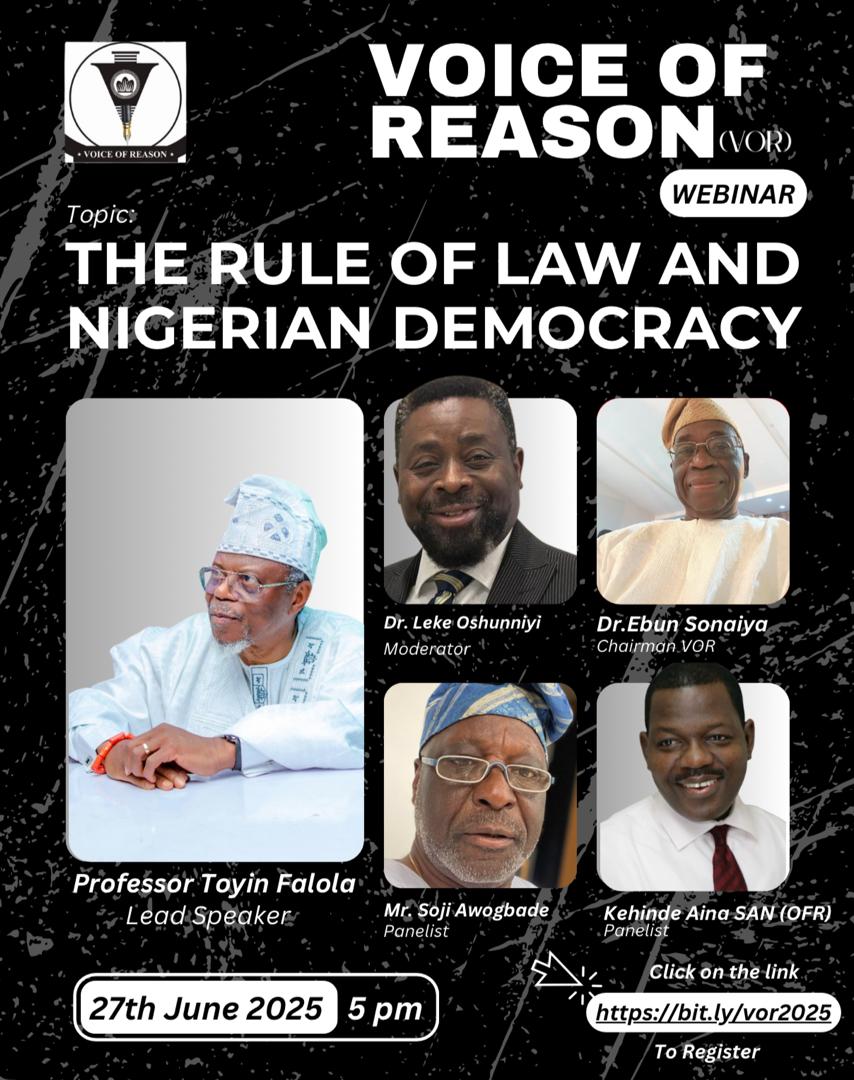
PS: This is a contribution to the discussion on the Rule of Law and Nigerian Democracy by the Voice of Reason on Friday, June 27, 2025.
Your recommendations are weighty and would produce credible and sustainable outcome if implemented. But this would depend on massive advocacy for investment in compulsory and free education at primary level, free and compulsory technical and pre- professial education at secondary level, The free and compulsory education at pry level of old western Nigeria’s Govt. investment alone has blossomed and could be significantly linked to the region as the leading light for peace, progress and successful resistance to undemocratic governance ahead of
other regions of Nigeria..
Your recommendations are weighty and would produce credible and sustainable outcome if implemented. But this would depend on massive advocacy for investment in compulsory and free education at primary level, free and compulsory technical and pre- professial education at secondary level, The free and compulsory education at pry level of old western Nigeria’s Govt. investment alone has blossomed and could be significantly linked to the region as the leading light for peace, progress and successful resistance to undemocratic governance ahead of
other regions of Nigeria..