
Toyin Falola

A PANEL DISCUSSION ON AFRICAN WOMEN IN STEM, PART 1
Africa is at a crossroads where significant moments are defined by the reimagination of power, and redirection of potentials rather than the presence or absence of wealth. African women represent a group that has been silenced for a long time in mainstream discussions. The story of women is buried through patriarchal machinations and neglect from the colonial authorities. Women are integral to the collective future of Africa. Therefore, their achievements must be brought to the surface, studied, and disseminated in vital fields as the rise of the African continent is connected to the elevation of its women in important sectors of science, technology, and medicine.
The exclusion of African women in most conversations on science, technology, and medicine is not due to their inability in these fields. In informal ways, African women have participated in medicine, science, and technology by taking up roles of midwives, agricultural innovators, herbal medicine makers, and water engineers, among others. Even though these roles were not widely recognized and celebrated, they were those that African women dominated, as I have explained in Women’s Roles in Sub-Saharan Africa. The advent of European knowledge and the colonization of Africa stifled and erased these roles, labelled “primitive.” The significance of occurrences as this is not just a detail in history but part of a continual tragedy that continues to reduce the range of the African continent’s capabilities.
The social scene of African societies constructs women’s identity through a patriarchal lens. However, in these social confinements, African women exhibit resistance, adaptation, and innovation as I have stated in Gender, Sexuality, and Mothering in Africa. Recognition is the beginning of transformation. Africa’s modernity must be reconfigured to recognize the importance of women, therefore making a correction to its gendered structures to make the spheres of science, medicine, and technology become inclusive. This allows for equality and the development of capacity through the freedom of talent.
Science and technology form the core of global power in the 21st century. The scene largely excludes women. I have noted how women’s contribution to these fields has been obstructed through systemic barriers like cultural stigma, limited education, institutional sexism, and lack of mentorship in the most expansive volumes ever written, The Palgrave Handbook of African Women’s Studies. To change this narrative, the African educational system must be expanded and begin to adapt the empowerment of women in STEM fields. Policies towards this should be properly implemented to ensure gender equity in learning places like clinics, laboratories, and lecture halls.
In the field of medicine in Africa, I examined the multiple roles played by women as traditional healers and spiritual mediators-cum-environmental custodians in Disease and Medicine in African History. In present times, however, African women are not large enough in the medical field. This begs the questions of what value we place on knowledge and who we entrust to wield it. To properly counter the inadequacies, the continent must continue to invest in modern medical research and diversify financial and human investment into medical knowledge with a focus on women.
In the field of technology, the innovations of precolonial African societies in fields like metallurgy, agriculture, and architecture in places like Zimbabwe, Nigeria, and Sierra Leone have been discussed in one form or another. These innovations involved the coming together of the society; therefore, there was not much room for gender marginalization. The digital age presents such equity. African women would have to receive the same training, have the same freedom to participate, and receive the same equipment as their counterparts to ensure their input. There must be strong digital literacy campaigns targeted at young females to secure their interest in this field, the development of intentional curriculum, and the set of adequate funding to support female-led technology ideas.
For the transformation of Africa, there must be a new perspective to how knowledge is valued, stored, and disseminated. Marginalization of women must cease. The African knowledge in the fields of science, medicine, and technology should not be discarded but integrated into the current frameworks. This indigenous knowledge, especially in the medical field, is stored by the women; hence, they should be allowed to play vital roles in the integration of indigenous and contemporary knowledge. This integration is not to Westernize or Africanize knowledge but to create a balanced or dual approach to education for the contemporary period. This would allow an African healer and a Western doctor to create new ways to secure health. It requires Africa to carry out intellectual research works that put the value of the African healers’ diagnosis under the same scrutiny as the prescriptions of a medical doctor. The approach requires reciprocated respect from both entities and the deep recognition of the knowledge possessed by women in science, technology, and medicine.
Many African female scientists are in the diaspora. As I have stated in The African Diaspora and the Disciplines, African knowledge systems are often transported to the diaspora where they undergo change and are reinvented globally. This brain drain must be transformed to brain circulation, and African countries must start putting in place the networks that would allow their women scientists to return to the homeland and pass on their unique knowledge to the next generation and mentor them. This would become a vital investment in the redevelopment of Africa, with the African woman serving as the major investor. The African thought perspective must be recalibrated to embrace gender parity as its foundational principle. The African women included in science, technology, and medicine must also be part of governance.
In conclusion, the transformation of Africa can only begin through the untapped genius of its human resources. The denial of African women in the fields of science, technology, and medicine is an obstruction to the progress of Africa, and the inclusion of African women in this field is an opportunity to create profound transformation. The future is here, and it awaits the African women in science, technology, and medicine to take charge.
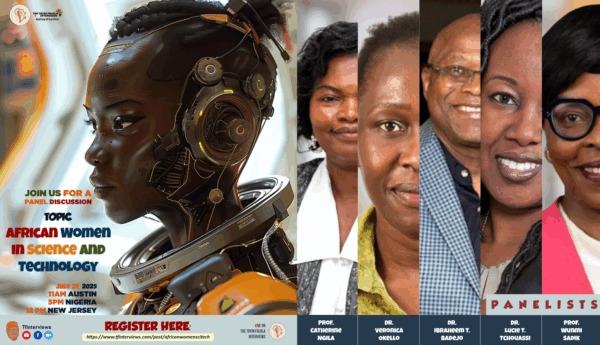
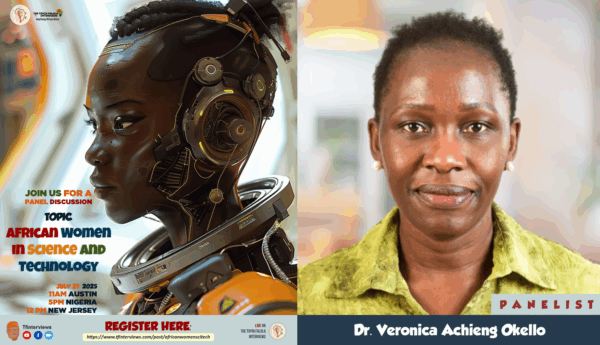
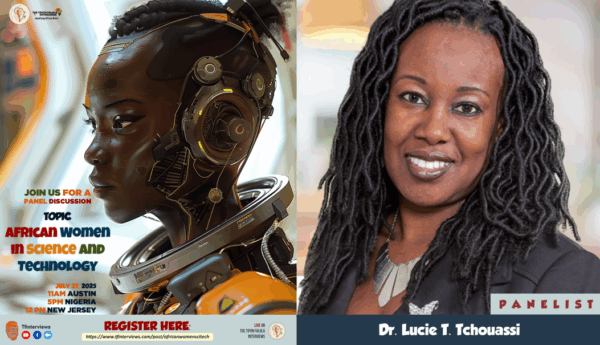
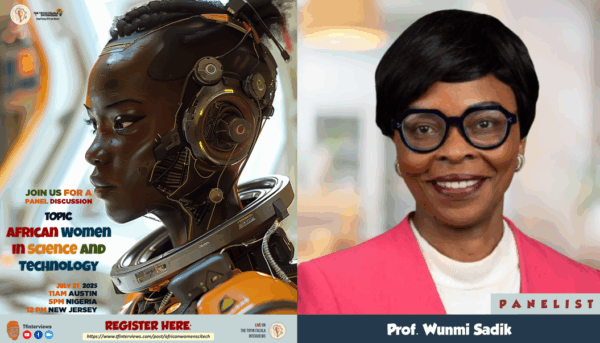
Please join us for a panel discussion with our distinguished panelists, Professors Catherine Ngila, Ibraheem T. Badejo, Veronica Okello, Lucie T. Tchouassi, and Wunmi Sadik who will be sharing their expertise on “African Women in Science and Technology”
Sunday, July 27, 2025
11 AM Austin
12 PM New Jersey
5 PM Nigeria
6 PM South Africa
Register Here:
https://www.tfinterviews.com/post/africanwomenscitech
Join via Zoom:
https://us02web.zoom.us/j/84207007757
Watch on YouTube:
https://youtube.com/@tfinterviews/live
Great Panel
Looking forward to the conversation
A very informative discussion
Thank you Prof TF for hosting this very useful discussion and Prof Sadik for facilitating the panel discussion