
Toyin Falola

A PANEL DISCUSSION ON GLOBAL AFRICA, WOMEN, AND SLAVERY, PART 2

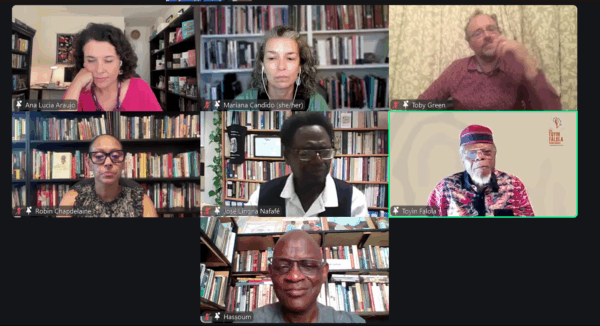
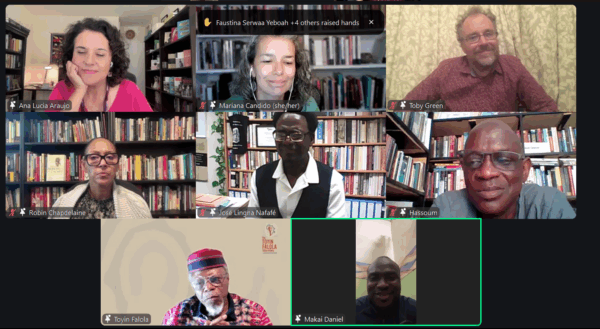
(This is the final report on A Panel Discussion on “Global Africa, Women, and Slavery,” October 5, 2025. For the recording of this successful event, see https://www.youtube.com/watch?v=P9NProqLVAc.)
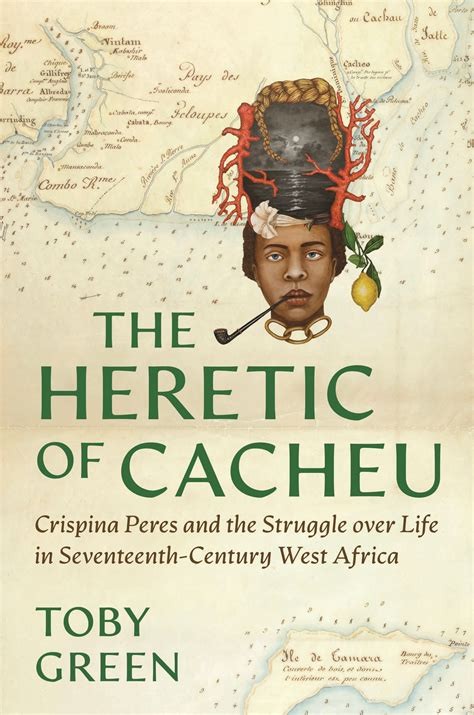
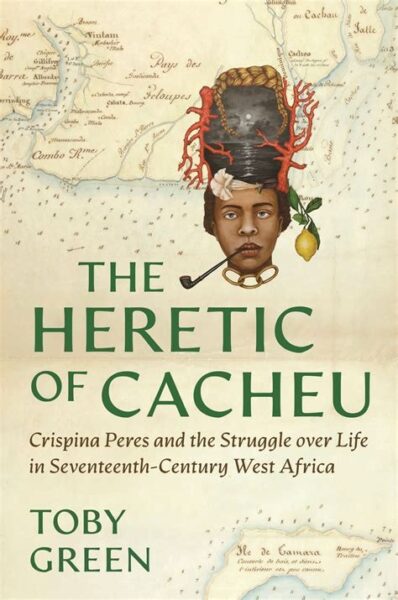
Toby Green’s The Heretic of Cacheu: Struggles over Life in 17th-Century West Africa recasts Atlantic history on its intellectual and moral axis by placing women, specifically African women, in the foreground of Crispina Peres’s life, a 17th-century Cacheu (now Guinea-Bissau) trader. Green lays low the long-prevailing fallacy that African women were passive actors in building the Atlantic world. Born circa 1615, Crispina Peres became one of the most influential people in West Africa’s coastal networks of commerce, extending to Europe and the Americas. Her arrest in 1665 by the Portuguese Inquisition as a heretic, for having visited local healers and practicing African religious practices, is an example of gender, religion, and the relation of power in early modern Africa.

Essentially, Green’s book is a testimony to African women’s agency: economic, political, and religious. She asks the reader to imagine precolonial African societies not as unchanging or bounded, but as textured worlds of negotiation, invention, and endurance. In this respect, it belongs to a body of works (for example, Toyin Falola and Olajumoke Yacob-Haliso, Women in Africa, 2025 is a recent example) that has as its goal the reclamation of lost histories of women whose prominence in trade, statecraft, and spiritual practice is known, or can be inferred from archives, but is often obscured. Crispina is such a significant example: she was an agent, not a victim or a witness. She mediated international trade and local customs in ways that unsettled both patriarchal and colonial orders. Her story makes plain a truth muted in hegemonic Atlantic historiography: that women were the true architects of their communities’ endurance in times of slavery and empire.
For Green, religion is a site where ideas of purity, power, and identity are contested. The Portuguese Inquisition trial of Crispina Peres is a bloodshot window onto an era when Catholic orthodoxy was meeting African epistemologies of the spirit. Her “heresy” was not a mistake but rather another theology —a syncretism of Catholic symbols and African ancestral cosmologies encompassing curing, moral order, and more. Green points out that religious life in early modern West Africa was not homogeneous; it was changing, varied, and intertwined with women’s and men’s everyday experiences in worlds connected.
_in_fortress.jpg/500px-Cacheu_statues_in_fortress.jpg
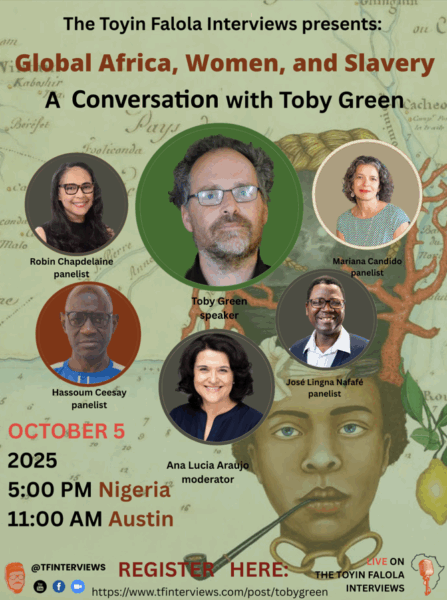
As Professor José Lingna Nafafé warns us, women like Crispina carried Africa’s philosophy, religion, and culture to the Atlantic. They were not just enslaved laborers; they were keepers of knowledge and bearers of ethical knowledge. In Catholic brotherhoods, women spun webs of religious and economic exchange, even, on some occasions, purchasing other individuals’ liberty with their own funds. Religion, in short, was not merely imposed; it was negotiated, reinterpreted, and occasionally turned upside down. Green’s account of Crispina’s spiritual life attests to this syncretic imagination: a woman who prayed with rosaries but also called upon the spirits of the ancestors; who conducted business with Europeans but consulted African healers, the djabakós, for moral and physical advice.
This syncretic religion serves as proof of what Dr. Robin Chapdelaine termed the moral economy of freedom, a moral economy in which African women chose to conceptualize liberty as an ethical responsibility, rather than adopting European individualism. Thus, Crispina’s rebellion was both political and theological; within her religion, to her and to countless others, it was simultaneously a site of oppression and freedom—a moral borderland across which African women reasserted their humanity and redefined religion in their own terms.
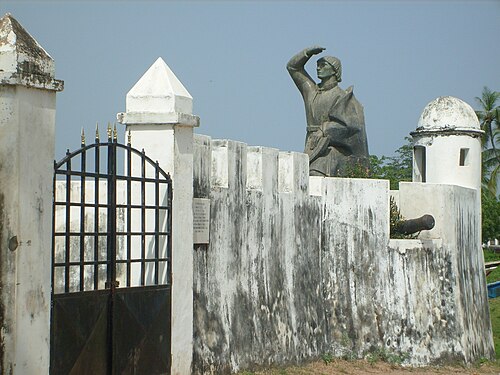
Green places Cacheu in the expanding moral and economic trajectories of the Atlantic slave trade. By the mid-17th century, Chad had become a cosmopolitan port where Portuguese, Africans, and Afro-Portuguese individuals brokered the exchange of commodities, people, and ideas. The town’s “moral geography” was shaped by the violence of the slave trade and the moral conflicts it generated. It is this sort of world that Crispina Peres’s biography manifests itself as a case study of ethical complication, an African woman both embedded within global capitalism and bounded by its hierarchies.
During the session, it was noted that women were not absent from such processes in Africa. As Professor Mariana Candido reminds us, women insinuated themselves into commercial and judicial writings, their actions being on the cutting edge of preserving the economies of port cities such as Cacheu, Luanda, and Whydah. Women not only participated in commerce; they moralized the very frontiers of commerce. They governed households, mediated trade caravans, and served as intermediaries for profit and shared morality. Their authority was precarious anyway, subject to both patriarchal native traditions and European religious censure.
Crispina’s trial is a paean to hypocrisy in European moral rhetoric. While Portuguese merchants were making money out of human bondage, they condemned an African woman to death for seeking the aid of traditional healers. Green allows us to look again at who really represented moral corruption: the executed “heretic,” or the empire that justified large-scale slavery in Christian civilization’s name. It is this tension that defines what Green calls the “struggles over life”: the quotidian conflict between morality and material existence, empire and religion, power and vulnerability.
The book’s strong point is that it keeps its eye on everyday life. In the process of recreating Cacheu’s social world, Green is respectful of the lived realities of individuals who are otherwise reduced to caricatures in slave-trade documentation. He describes a vibrant world in which Africans, Europeans, and Luso-Africans coexisted, interacting through marriage and trade, and in which women, like Crispin, were at the center, not on the margins. They formed kinship and trading relationships, mediated conflicts, and yielded influence that spanned continents.
The works of authors such as Chapdelaine and Nafafé reveal how African women occupied domestic and religious spaces and transformed them into sites of resistance. In the enslavers’ homes, they had direct information regarding the enslaving institutions themselves, and in most cases, they resisted from within. These women converted bondage into covert resistance, giving information, shielding children, and passing on languages and customs that colonialism attempted to destroy. Placing these women front and center, Green’s book is a response to recent feminist scholarship that insists African women’s lives not only contribute to history but form it. Cacheu’s moral universe, its competition, its obligations, and its religious beliefs were sustained by women’s intelligence and sentiment. Even though the Inquisition sought to silence Crispina, her life still lingered in the memory of a society experimenting with the boundaries of tradition and novelty.
The Heretic of Cacheu makes a significant contribution to Atlantic history. Instead of portraying Africa as a passive recipient of European agency, both geographically and ethically, Green shows it to be a co-foundational source of world modernity. The Atlantic world, he insists, came into existence as much in Cacheu and Luanda ports as in Lisbon or Bahia. African women, traders, healers, and priests structured their lives in accordance with colonial predecessor systems of trade, kinship, and belief.
Crispina Peres’s case is one such reimagining. Her trial was as much a local sensation as it was a turning point at which African cosmology confronted European orthodoxy, and at which the testimony of an African woman became perilous to the imperial order. In hers, Green foregrounds how the intellectual and spiritual capital of Africa serves as a fulcrum of the Atlantic world’s moral imagination. In redeeming this vision, Green enters a growing body of scholarship—e.g., Women in Africa by Falola and Yaqub-Haliso—that defends the priority of women’s experiences in African modernity-making. Collectively, these contributions challenge the Eurocentric notion of defining modernization as Westernization and instead propose an “African Atlantic history” centered on indigenous moral economies and gendered agency.
Lastly, The Heretic of Cacheu makes significant contributions to human philosophy, religion, and liberty. It asks hard questions about the composition of history: Who gives heresy leave? Who possesses knowledge that is added to the record? And what are the ethical lessons that can be learned from the lives at the center of empire and soul? Green’s work hums with the same moral urgency as Women in Africa, inviting us to build silenced voices and center women as agents of change in the past. Crispina Peres’ life compels us to think about African women as agential in their own lives—commercial producers, religious interpreters, and guardians of common morality.
Her life bridges continents and centuries, and her story serves as a reminder that the fight for survival in 17th-century Cacheu has its echoes in the battle for representation, dignity, and agency in the 21st century. In her, Green returns the African woman to world history, not as a footnote but as a moral compass—a testimony to the power and beauty of religion and the humanity of power. The Heretic of Cacheu is thus both historical reconstruction and ethical reflection, a reclamation of Africa’s agency in the construction of modernity and a reminder to the world of women like Crispina Peres. In this sense, then, the book is not just about Atlantic history; it is a sobering reminder that the conscience of history remains with those who would not be silenced.