
By Toyin Falola
I am writing this to mark the release of my book, African Politics: An Introduction, which I dedicated to Professor Christopher Isike. This piece explains why. In making South Africa a home, it is not about its infrastructure or development but about friendship. I have had a strong relationship with South Africa since 1994. When Mandela was released and apartheid fell, three of us—Atieno Odhiambo, Sam Nolutshungu, and I—decided to go together to kneel, pray, and touch the soil. I still carry the soil in a bottle in my house. It was a beautiful moment. We were welcomed into the inner chamber of power. We were asked whether we would come to South Africa. We were offered appointments as Vice Chancellors. I refused, as I had refused others. Atieno said he preferred Kenya. Sam accepted and was appointed, but he died before resuming as Vice Chancellor. Today, South Africa has changed! A complete historical transformation will be told later.
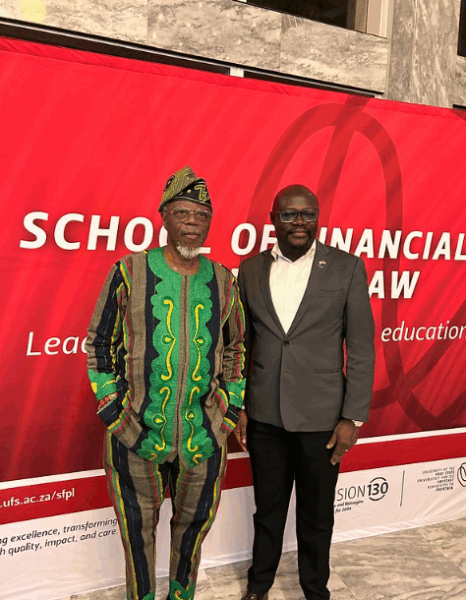
At home, too many friends, then and now. Through Professor Sam Oloruntoba, I knew many people. Oloruntoba was the one who anchored my relationship with the University, leading to the flowering of collaborations, including the hosting of TOFAC under the leadership of Professor Gumede. Other friends came from the North and South. Professor Edith Phaswana is one of my closest friends in the world. I also have an adopted son, Stevens Mohapi, who is in charge of Holy Ghost water and the liquid used to honor the ancestors.
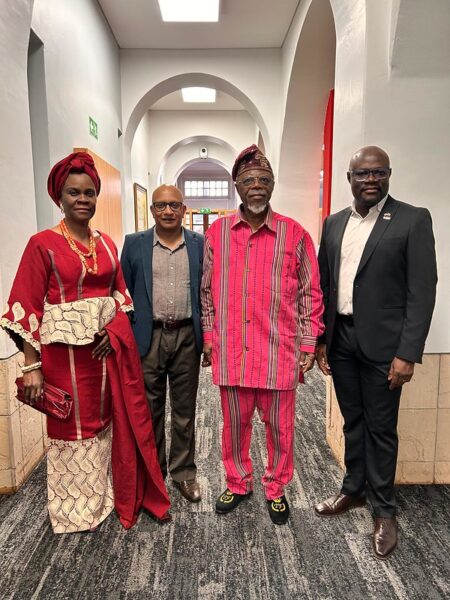
Professor Isike relocated to Pretoria, and the encounters expanded. Chris is genuinely affectionate. He is my driver, my companion, my drinking buddy. Thanks. Today, I couldn’t be in Pretoria without visiting his home with his lovely daughters and wife. Calling his wife, Dr. Isike, Dr. Mrs. Isike, I don’t know her first name. If you are looking for the best smile, see Mrs Isike. If you are looking for the best soup—gbanonon, obeta dudu, marugbo, egusi—visit Mrs Isike. I wondered one day whether Chris married Mrs. Isike because of the food. He relishes his wife’s cooking to the point where it sometimes appears to me that he has landed in heaven in God’s kingdom. Or maybe it is the wife’s beauty, as she is more beautiful than Chidimma Adetshina. Chris, I know your wife as a scholar, and the only time I have looked at her was when she was leaning on you in your living room!

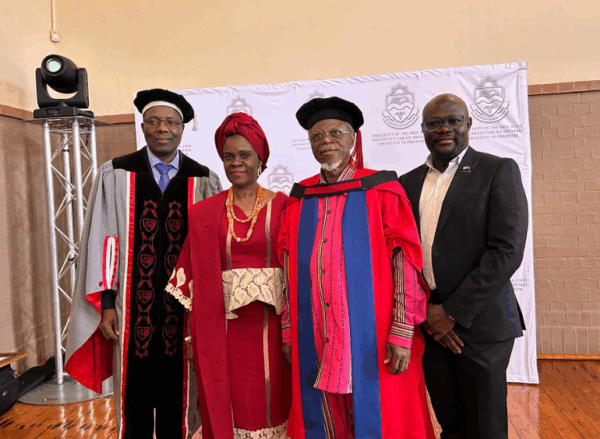
Chris, I cherish your friendship. You are a rare person. When you attended the events to mark my receipt of an honorary doctorate at the University of the Free State, I prayed that God would let me see the day when you are honored so that I can reciprocate.
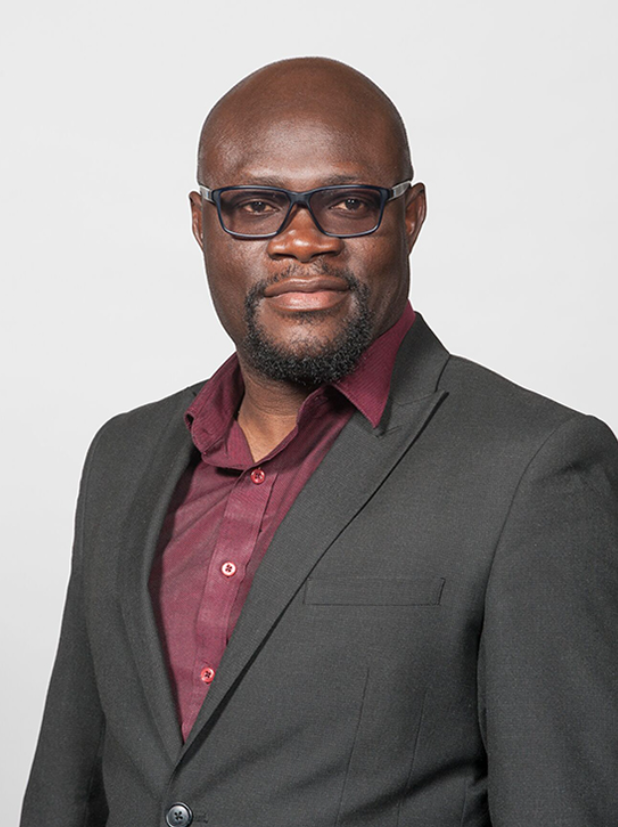
Let me comment on his real frame and pillar: His scholarship. The field of political science in Africa is home to some individuals with intellectual ability, social relevance, and continental ambitions. Christopher Isike is an example of such. He is a Professor of African Politics, African Development, and International Relations at the University of Pretoria. He stands among present-day Africanist scholars as one of its leaders with contributions that serve as connections between theories, policies, and public reality. His academic trajectory embeds scholarship in African reality, the interrogation of colonial legacies, and the postulation of novel governance and developmental ideas for the continent. This mode exhibits a deliberate attempt to restructure the African political future through intellectualism.
With an intellectual foundation developed from the Africanist perspective, he secured his PhD in Political Science in 2010 from the University of KwaZulu-Natal, where his engagement with African politics, International Relations Theory, Peace and Conflict Studies, and African Political Development, among several other perspectives, reached its peak. He is more focused on the African political landscape through diverse perspectives like women’s political representation, African immigration and xenophobia studies, peacebuilding, and the human factor in African development.
His contribution toward the restructuring of state formation in Africa, where he questioned the usefulness of the Westphalian state model – a legacy of the colonial era, for the structuring of African governance. This is just one of his many critical scholarly contributions, and there are several others, such as his research on the tension between African social systems and the formal state. Through this study, he urged scholars and administrators to implement African histories, identities, and political cultures in contemporary development models. Professor Isike can carve out new intellectual mediums for scholars interested in developing their knowledge of political legitimacy from an African perspective through these submissions.
Professor Isike’s works on women’s political representation in Africa, where he evaluated the quality and effectiveness of women’s participation in governance,, and his contributions to the topic of gender and peacebuilding, where he cites African women as peacebuilders of the African continent in contrast to Western-centric submissions are elevations for African women as they are placed as strategic actors of conflict transformation. Since his works are widely recognized for their originality, they are well-cited as rich sources for debates on peace, security, and gender justice across Africa and globally.
He has made scholarly contributions to the topic of African soft power. He explores this perspective through cultural, social, and moral resources mobilized by African states to develop their influence. His case studies included South Africa, Nigeria, and Ubuntu’s diplomacy, migratory and cultural identity, to make African experiences the center of global conversations about power and widen the theoretical base of International Relations. Some African scholars have extensively and innovatively explored this path.

Through these scholarly contributions, more than fifty peer-reviewed journal articles and several publications, including edited works, Professor Isike has been able to shape academic discussions across several subfields of political science. Some of his works like, Nigeria’s Soft Power Sources: Between Potential and Illusion, Towards an Indigenous Model of Conflict Resolution, A Socio-Cultural Analysis of African Immigration to South Africa among many others have become points of reference and part of academic curricula in tertiary institutions while others on migration, peacebuilding and regional power dynamics have become influential scholarly pieces not only in Africa but also in the Global North.
His leadership prowess complements Professor Isike’s intellectual acumen. He currently serves as the President of the African Association of Political Science (AAPS). He also served as a Vice President of the International Political Science Association (IPSA) and as Vice President of the South African Association of Political Studies (SAAPS). He implemented these roles as platforms to shape important disciplinary debates, strengthen institutional networks, and provide support for the next generation of African scholars. Aside from his exploits in the roles mentioned above, he also advanced African scholarship and enhanced the visibility of research centered on African realities through his positions as Editor-in-Chief of Politikon: South African Journal of Political Studies and as a long-standing Editor of Ubuntu: Journal of Conflict and Social Transformation.
This leadership acumen is not limited to the academic sphere, as it extends to the realm of public service, where Professor Isike has served as a consultant to UNFPA, UNICEF, UN Women, and the KwaZulu-Natal Provincial Government on matters related to gender equality and women’s empowerment. His proficiency in these matters led to his selection as a member of a South African government delegation to Ethiopia to study strategies for ending early and forced marriages. In 2020, the Minister of Sports, Arts and Culture – Mr Nathi Mthethwa appointed Isike as a Social Cohesion Advocate in recognition of the Professor’s outstanding contributions to peacebuilding, social harmony, and diversity management.
Within classroom walls, Professor Isike is regarded as a generous mentor – dedicated to shaping intellectual futures- and an incisive teacher. He imparts knowledge on International Relations Theory, Africa-United States Relations, African Soft Power Politics, and Security Studies, among other courses within African Politics at the University of Pretoria. His students have described him as a mentor who challenges them to think beyond established norms and question traditional perspectives, thereby creating novel scholarship that speaks to African contexts. It is not surprising then that several of Professor Isike’s mentees have developed rapidly and built lasting careers in academia, diplomacy, international development, and public policy. This indicates that his influence on the next generation of African scholars is as far-reaching as it is prominent.
Over the years, Professor Isike has built a career that prominently features a strong collaborative spirit. He has partnered with scholars across Africa and globally to connect political science with sociology, development studies, cultural studies, and security scholarship through his interdisciplinary collaborations, which have led to the production of essential policy interventions and training programs to enhance the visibility and impact of African intellectualism in a global setting. His works consistently demonstrate the values of intellectual honesty, a commitment to justice and gender equity, a belief in African agency, and a dedication to developing knowledge systems that reflect African realities. His scholarly ethos clearly states that Africa must study itself through its cultural, historical, and political frameworks.
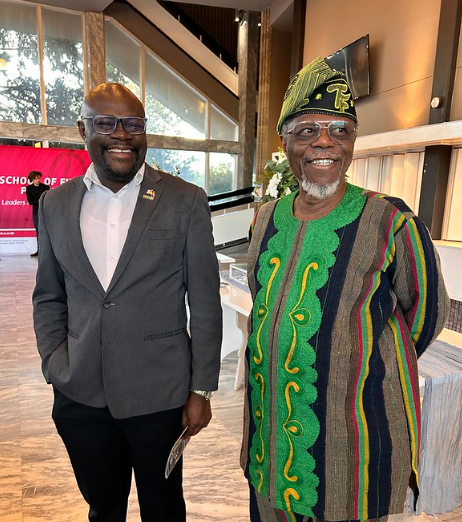
Today, Professor Christopher Isike is a leading voice in discussions on migration, gender equality, African soft power, another government implements his submissions by governments through policies, his commentaries are aired through the media and his works in general resonate with academic communities across the world in contemporary era where Africa’s place in global politics is being redefined, Professor Christopher Isike can be regarded as an example of a modern African scholar due to his stance on imagining a future shaped by African knowledge and Agency. His scholarly contributions to public policies, institutional development, and mentorship all exemplify the transformative power of intellectualism. His leadership and public engagement skills also continue to shape discussions that will play key roles in Africa’s political trajectory for years to come.
thanks for info.