
Toyin Falola

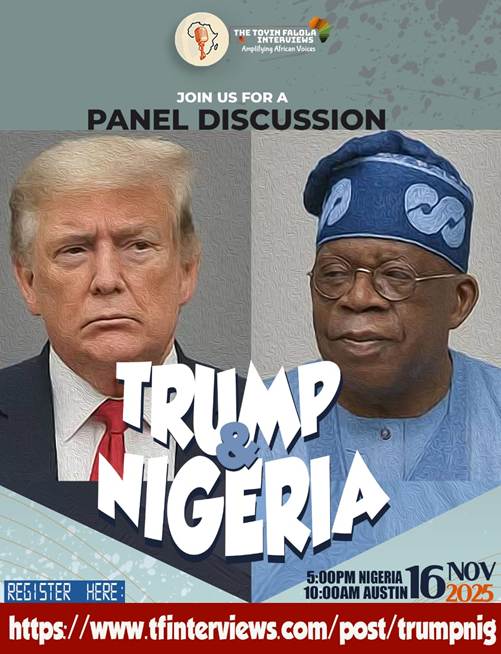
A PANEL DISCUSSION ON TRUMP AND NIGERIA, PART 1

(This is the first report on a panel discussion on Trump and Nigeria, November 16, 2025. For the transcript, see https://www.youtube.com/live/CrClIrWeJ6k?si=Sgd4rEafZbGc2x8A)
Despite the relative progress humanity has made in suppressing acrimonious tensions between and within countries, pockets of violence often reduce the achievements to a negligible portion. At the global level, effusive energies are accelerating between powerful countries with their aggressive threats, plunging the world into medieval atrocities. But these nations, perhaps for reasons not unconnected to their understanding of the magnitude of mutual destruction that such indulgence would do, have recently been louder in their threats than they are in their execution. Interestingly, if they don’t carry out the threats, this is a good development for humanity.
Notwithstanding, humankind is still confronted with a hydra of insecurity. Many countries of the world, particularly in the Global South, are stuck, as many of them incite tensions that claim the lives of innocent people. Nigeria is one of these countries, and the happenings in recent history indicate a pattern of acrimonious hatred targeted at group identities. With the instantiation of violence and the activation of destructive behavior, the Islamic State of West African Province (ISWAP) and its sister group, Boko Haram, have enjoyed a monopoly of violence against religious sects that do not share their ideologies. Now, their efforts to eradicate such sects have assumed global significance, to the extent that their actions have caught the attention of the most powerful nation in the world today: the United States of America.
Designated as Christian genocide in some circles, because the patterns of the killings have corroborated the public’s suspicion about an insidious intention to wipe out some people from the face of the earth, several public figures, analysts, and policy experts have taken directly opposite positions in their description of what is happening in Nigeria. Each of them is guided by layers of, or the conviction in, historical arguments, ideological positions, and sometimes, ecological explanations. One thing remains, however, evidence of the indiscriminate killings of a particular group cannot be pushed into oblivion or relegated just because the characterization of the violence along religious lines would hurt the sensibilities of some sect.

To have concluded that there is a Christian genocide does not indicate an intention to undermine those religious adherents who operate within the conventional decency of human behavior. Besides, we should not belittle the voices of several people who have reached a conclusion based on the patterns of the killings. Nevertheless, it is undeniable that the initiators of these indiscriminate atrocities are themselves Muslims in a small number and have unapologetically proclaimed to advance the tenets of Islam, even when other pious believers have raised concerns about the abrasive extremism of ideologues who hold such views. Regardless of whether they agree with their operations or not, what is essential before designating the violence as Christian genocide is the identity of the victims. In this case, many have claimed that non-Muslims have been constantly listed as predominant targets of the onslaught.
However, some voices hold a data-driven view on the country’s incessant hostilities. And these voices are no less important than others, especially in how they oversee the events of wars and conflicts and then prescribe the need for their eradication. According to some experts, the widespread violence in Nigeria, most especially in the North, speaks to the vociferous flame of the insurgent groups who are hiding their extreme beliefs about Islam under the toga of advancing a doctrinal imperative. The violence and hostilities are incomprehensible, given their overly conservative interpretations of the Quran to justify the menace and indiscriminate killings of innocent people.

Available data usually persuade individuals who hold this perspective, and the terrorists’ actions and engagements in the conflict-ridden environments are indicative of the heady ambition of a group that wants to take control of everything for their provincial objectives. Taking into consideration the victims of these persecutions and killings, it becomes obvious that numerous people, irrespective of their religious affiliations, have been at the receiving end of the malady. More perniciously, the onslaught of Muslims in identified areas has taken a skyrocket dimension, where it seems that the extremist groups indicted in the allegations have no sympathy for their victims and do not care whether they are also members of the Islamic faith. After all, there have been reports of the increasing number of Muslims who have been victims of the insouciant atrocity.
The ongoing conversation, therefore, opens an uncomfortable debate about the deliberate reconstruction of the Nigerian society so that it can be fertile for the instrumentation of sectarian violence that will accommodate religious tensions and sectional views, which would reproduce marginalization and expressive oppression of groups and communities that hold different beliefs. According to some analysts, the introduction of Sharia Law into a country that was proclaimed as secular and founded on the ethos of humanitarian compassion does nothing more than redirect the nation’s trajectory to a place where the possibility of religious freedom will become an illusion. By design, Sharia Law is a legal injunction that foregrounds the political philosophy of a people, and is not necessarily defined by divine authority, although the Quran is believed to be a direct revelation from the Supreme Being.

In essence, it is ideologically possible that such legal collection will highlight and even address the concerns of those with whom they share different religious philosophies. Invariably, the introduction of such a legal approach in at least 12 of the country’s 36 states emboldens the devotees of the Islamic faith in the region. At the same time, it indirectly threatens people of a different religion by default. This mindset would have been impossible if persecution, marginalization, and the systematic effacement of non-Muslims had not been initiated in these places. Strangely, we cannot say this without our conscience doubting our sincerity.
From whatever angle one looks at things, recent developments have shown that the victims are no more inclined to fold their hands and do nothing as they continue to be casualties of the extremists’ indulgences. They have raised their voices loud and clear to the extent that their cries have now pierced the ears of the international community. In fairness to them, as their voices are downplayed and their agitations overlooked by the Nigerian government, nobody would tag them morally delinquent for seeking help where they believe it can be obtained. Now, Donald Trump, the President of the United States, has shown interest in the challenges faced by the victims of incessant religious attacks within the Nigerian community.

Invariably, having President Trump speak about the events inadvertently provides the amplification needed for the whole world to understand what is going on in the multi-religious Nigeria. The fact that he accompanied his attention with interventionary threats makes the situation more debate-worthy because he is a Republican. One of the guiding principles of that political party is that freedom be served to people of the world, and that the Christian community across the world should not suffer annihilation based on the faith that they profess. This has brought a new dimension to the ongoing problems, and the issue of tackling security challenges remains the government’s top priority. It is no coincidence that the Nigerian military has responded swiftly to the issue lately.
Beyond all of these, however, we cannot underplay the constructive role of political optics that underlies the designation of Nigeria as a “Country of Particular Concern” by President Trump. Experts have examined his statement, using history as a guide to their understanding. Doing that, they noted that America’s interest in Nigeria goes way back decades, with the US consistently seeking to designate Nigeria as a place of interest by the international community. This has not been because they identify something noteworthy that Nigeria’s leadership is doing for itself, but because they have strategic interests in the country’s wealth, particularly the natural resources. An African proverb comes in handy in describing this situation: “A dog is given a bad name when the owner wants to kill it.”

While the US does not own Nigeria, it nonetheless has some ambition to serve the country on its dinner table. In any case, the issue must be handled with utmost care so that it does not escalate from a mere verbal debate to something more uncontrollable in terms of the damage it will cause.