
Toyin Falola
In this third piece on Babcock, I speculate on the future of this University based on the little I know of the place. The evolution of Nigeria’s private universities began in the late 1990s, following the nation’s public universities’ decline in resources, prolonged industrial actions, and inadequate lecture theatres. The prevailing question at the time was whether private universities had become a promise of hope for the nation’s higher education sector. Their emergence came with serial backlashes, mainly due to the high tuition fees, which were eventually justified.
While public universities experienced disruptions to their calendars, which affected their academics and curricula, this is taboo in private institutions. Between 1999 and 2022, the Academic Staff Union of Universities (ASUU) staged over 16 strike actions, not only disrupting educational plans and systems but also delaying and prolonging students’ potential.
According to a report by the United Nations’ Department of Economic and Social Affairs, Nigeria might be the third-largest youth population in the World by 2050, though achieving this will depend entirely on how well educational institutions prepare tomorrow’s graduates. Two decades later and with more than one hundred accredited private institutions, the question has metamorphosed from asking whether private universities could survive to authenticating the roles they play in reconstructing Nigeria’s higher education in the years to come. I foresee private universities becoming the backbone of Nigeria’s higher education system if they survive the challenges of access and global competition.
Babcock University traces its origin to the late 1950s as the Adventist College of West Africa (ACWA). The university, in existence as an educational institution over the decades has influenced different aspects of Nigeria’s higher education system. For example, it’s calendar has not been interrupted since inception, thus providing a stable and conducive environment the recommended classroom teacher and student ratio and all these and more have provided a platform for the all round growth and development of the school staff and students alike.
By 1966, Babcock had started the award of Bachelor of Arts (B.A.) degrees. In the mid-1970s, when it became affiliated to Andrews University, a school in Michigan, Babcock got its first shot at the international scene when it started the award of internationally recognized degrees in the fields of Business, History and Religion. In 1999, Babcock got its independence as an indigenous university in Nigeria when it was accredited by the Nigerian Universities Commission (NUC). Since receiving its inauguration certificate on May 10, 1999, the school has enrolled thousands of students in the faculties of Education and Humanities, Management and Social Sciences, and Science and Technology. Today, Babcock has expanded its academic portfolio and is now a more competitive, conducive, and learning-friendly university.
In 2010, the school’s postgraduate program was launched, and in 2012, the College of Health and Medical Sciences, which was named the Benjamin S. Carson College of Health and Medical Sciences, was formed and launched for full operation. Babcock adjusted to the new normal after the COVID-19 pandemic, and in 2022, it received NUC approval for new departments in the engineering and environmental studies programmes. At its 23rd convocation in 2025, the university became the first private university in Nigeria to award PhD degrees to Buoyed by its recent innovations, Babcock has expanded its reach beyond its erstwhile goals and is poised to make an impact on the global scene. Today, the university is not home to less than 20,000 students in its campuses. The Nigeria higher education sector is being redefined by the trends of digital learning and international accreditation demands. Babcock is robust, resilient and poised for greatness.
Notably, rather than adopting a one-size-fits-all approach, the Nigerian private university sector in the twenty-first century has diversified its interests into distinctive niches to serve humanistic purposes, making the system more prosperous, more competitive, and more fertile for growth and development. For instance, Covenant University, a worthy competitor, has built its reputation through STEM and leadership programs. The Lagos Pan-Atlantic Business School invests significantly in executive education and professional training. From 2010 to 2025, Redeemer University’s publication and research development profile has grown rapidly. However, Babcock’s strength lies in the scope and positioning of its missions, values, and goals. The institution started with a focus on teaching and improving its undergraduate programs. Over the years, it has moved into a different terrain, now concentrating more on postgraduate and professional training.
Babcock’s long-term vision of transforming into an “Ivy League” institution in teaching and research is already underway. It does not fall short in promoting innovative research and international cooperation that addresses societal needs. Apart from the postgraduate school and the growth in medical education, the school’s Distance Learning Centre has also taken off in grand style, graduating its pioneer cohort in 2025.
Babcock does not dwell in the pool of its achievements but has instead continued to find bigger challenges. Currently, its Research Innovation and International Cooperation (RIIC) department is strengthening grant writing workshops and encouraging faculty research to target international collaborations. Also, the university’s entrepreneurship centre is being elevated to a resource centre better suited to promoting innovation and students’ employability.
Undeniably, Babcock’s future is worthy to be painted in illuminating lights as it consolidates its gains and pursues new frontiers. The institution’s vision of becoming a hub of advanced learning is unfolding in our very eyes. By playing the pioneering role in establishing Nigeria’s first private medical school, Babcock has made it one of the centres of medical and public health education in the country.

Additionally, the current expansion into technology and engineering programs will enable it to ride on the new wave of digital evolution in higher education. Recently, Babcock reestablished itself as a first-class university by applying digital solutions to expand access beyond the campus to adult and continuing learners through its Open and Distance Learning Centre.
Remarkably, private universities in Nigeria have pushed government-funded institutions toward reforms. This has been recurring since the liberalization of Nigeria’s higher education sector in 1999.
Babcock has been not just a faith-based university but a shining example of a student-centred learning environment, and this consistent reliability is what has built Babcock a good name both nationally and internationally. The university is also building on its academic credibility, by promoting interdisciplinary scholarly efforts that will tackle the problems of climate change, food security and public health. This innovation is a necessary and important development to the country’s most critical needs, and as such Babcock has a strong shot at making an impact on the future of the country.
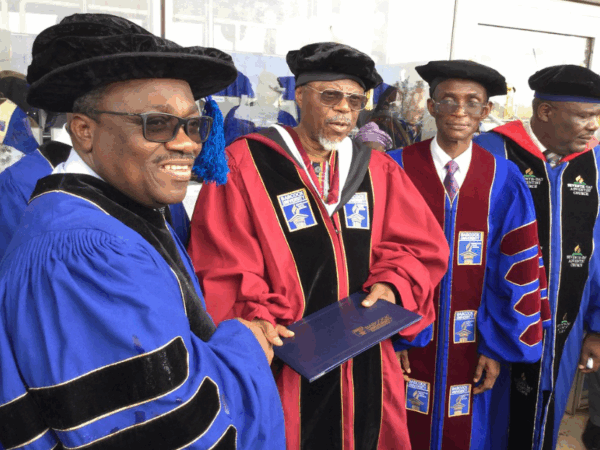
The story of Babcock University is one of institutional development and a complete re-imagination of the higher education space in Nigeria. Babcock University is an embodiment of the ideals of creativity, humanity and collaboration as an integrated model of learning. The university is on course to position its graduates for opportunities in Nigeria and in the global arena. But much still lies ahead of the university in terms of surmounting a few challenges; raising a significant endowment pool that will, in no small measure, address the recurrent cost and position the university as affordable yet uncompromising on quality, and maintaining a reputation of excellence as it scales its global footprint. To say the least, surmounting these challenges spells only one message: its relevance will never fade. In the same vein, the future of the institution lies beyond the need to create a legacy; it is about laying a foundation for the rising generation of thinkers, innovators and leaders that will re-write Nigeria’s contribution to the solution of global problems in the 21st century.
The Spirit of Survival
In my father’s garden,
Mango trees are heavy with fruits
Pineapples are begging to be noticed,
And the guavas are hanging at their lowest
For the consumption of the fastest fingers.
Yet we children thirst for juice;

We beg for food.
Such is a country rich in loss.
We are familiar with this battle
where innovation becomes a rebel,
a rebel that is caged before being crowned.
But let those who profit from darkness
Fear the ignition of the future.
What becomes of a dream
When we don’t sleep with our two eyes closed?
What becomes of a wing that gets broken
before learning the existence of the sky?
And if these questions remain unanswered,
Let it be said that:
We were here, burning like prophecy
In the lungs of a nation that refuses to die.
Photos: Babcock University
https://www.flickr.com/photos/toyinfalola/albums/72177720329992550/