
Toyin Falola
Victor Ekpuk and His Art: The Man and the Poetry of Signs, Part 1
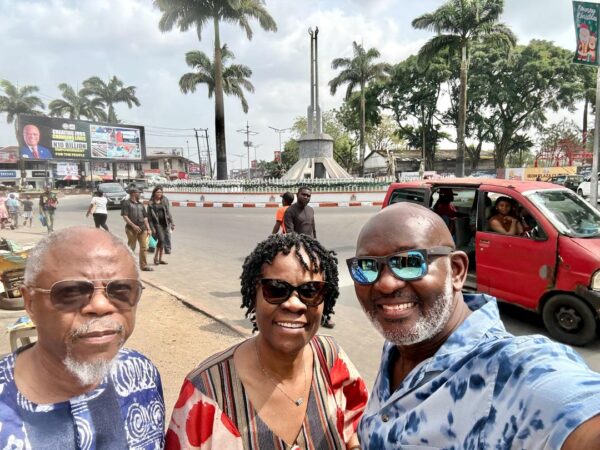
On November 21st, 2025, I ran into the great artist Victor Ekpuk in Atlanta, both of us heading to Lagos. While we were waiting for our luggage, I told Victor that I would like to visit him in Akwa Ibom for a few days. With Bisi, my wife, we took IBOM Air to Uyo on December 11th, 2025, to spend five valuable days in a month full of the season’s celebration. Years earlier, Professor Tunde Babawale of the University of Lagos had introduced me to IBOM Air, which I found to be professional and staffed by highly congenial people. In multiple short pieces, I will share my multidimensional experiences on this significant and pleasurable trip, focusing on the positive and endearing aspects.
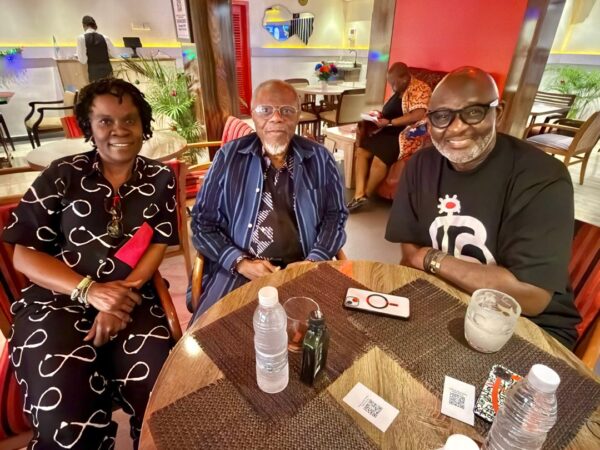
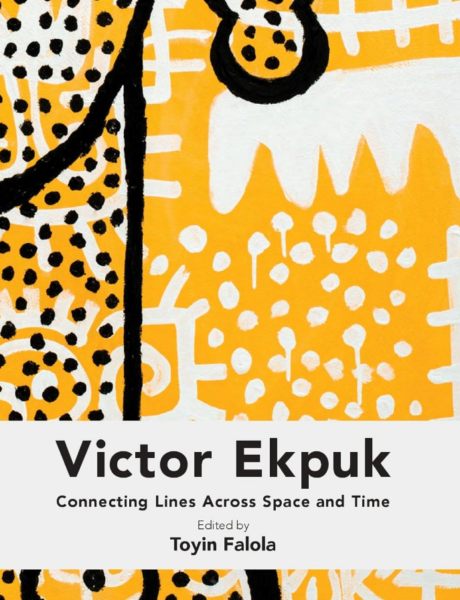
Victor Ekpuk is not new to me. A friend introduced him to me when he enrolled at Obafemi Awolowo University, and I knew firsthand about the art school’s orientation. I later put together a book on him, titled Victor Ekpuk: Connecting Lines Across Space and Time: https://www.amazon.co.uk/Victor-Ekpuk-Connecting-Lines-Across/dp/1943533202. I was at his studio in Washington, D.C. I spent a Thanksgiving day at his house, where I met his lovely wife and tall, elegant son, a talented fashion creator, taking after his grandfather, Mr. Monday Sampson Ekpuk, “The Tailor of Uyo.” James Adesina Falola, my father, who died in 1953, was also a tailor. Too many comparisons to talk about.
It is a pleasure to reintroduce Victor Ekpuk as part of my wonderful trip to the lovely Akwa Ibom State, with its countless “gardens of Eden.” Indeed, I became his Brand Manager, introducing him and his work to as many as came my way, including two state Commissioners and Vincent Enyeama, former goalkeeper of Super Eagles, the owner of Vinpy Hotels where we all stayed.
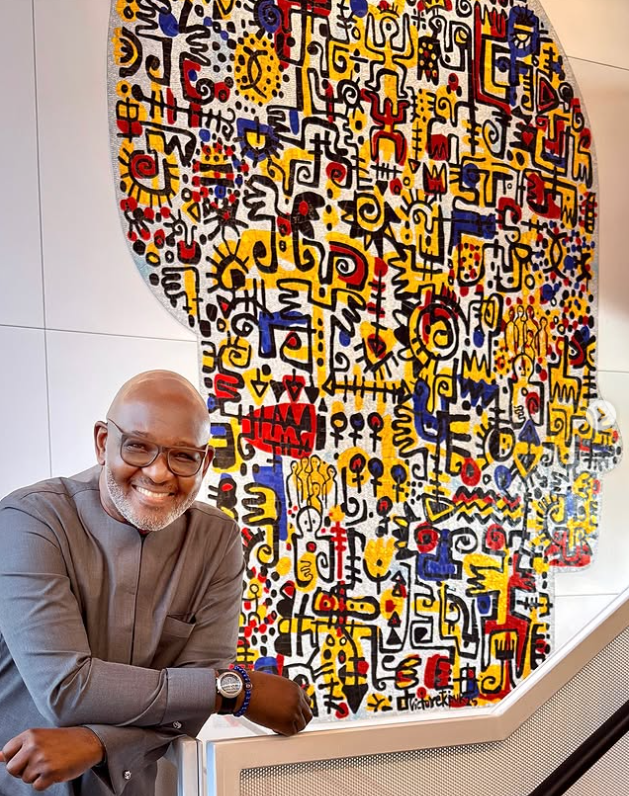
Ekpuk is best known for his poetic paintings, which convey depth to viewers. He pours out emotions in drawings, while the audience searches for words to read between these images. Ekpuk, who now lives in Washington, D.C., United States, is a prolific artist known for turning marks, symbols, and calligraphy into powerful imagery. His practice draws on “nsibidi,” an ancient African sign system used for communication, narrative, and recordkeeping. Ekpuk does not appropriate the signs; he reinterprets them in his art, making nsibidi both ancestral and fresh. It is precisely in this juxtaposition of familiarity and mystery that the artworks derive such power. In the encouragement to participate, Ekpuk calls for an encounter not through interpretation, but through the experience of rhythm, emotion, and memory. It is a world that steals clarity, and the need for quick understanding, and Ekpuk’s practice indirectly asks: What if meaning does not have to be literal to be real? It is with this that Ekpuk reminds us that language is just not written; it is remembered.
His background in Nigeria, including the course that his life took, further shapes his art career. He was raised in Eket and Uyo, Nigeria, where culture is replete with signs and marks as a form of communication displayed on walls, clothing, and public spaces. I walked with him on the same soil where he was raised. This childhood understanding of signification through signs in non-Western modes leaves a permanent stamp on how Ekpuk thinks about making his statements through expressions. This is followed by formal art training through which he remains linked to his local culture.
Ekpuk’s migration to the United States is essential to understanding his art career. As he settled into an entirely new culture, he became powerfully conscious of how little of what passes through the systems of knowledge from the African continent is either misconstrued, reduced for interpretation, or left entirely out of consideration. He fought the appearance of unreadability by delving deeper into his background, with his works traversing the more complex territory of what it means to belong, to be displaced, or to recover through memory. This cross-continental shift also broadened Ekpuk’s reach, situating him in cross-cultural art dialogues that still firmly lay roots in their cultural signification. Ekpuk’s personal journey from Nigeria to the global art community reveals, in essence, a track among numerous other artists of “diaspora” who retain their backgrounds, shifting their personal migration into one of their artistic strengths.
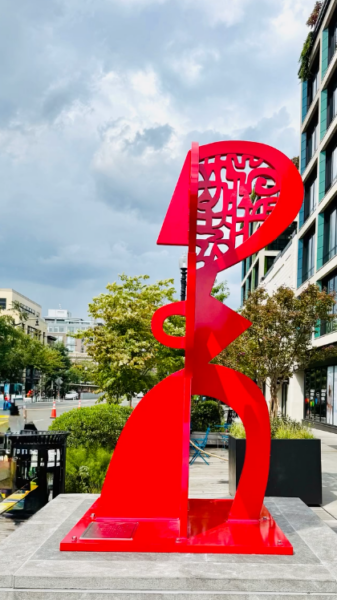
One of the hallmark features of Ekpuk’s practice is the evident marriage of order and randomness in his work. For instance, Ekpuk’s paintings are congested with layers of marks, gestural repetition, and symbol grouping that sweep through the pictorial space with rhythmic fervor. In Ekpuk’s paintings, there is a sense of movement, of talking, piling up, or almost hurrying. It is not simply the energy of a painting that leads the viewer’s eye to the significant point, but rather one that entices the gaze to roam along the way traced by the mesh of lines and gestures. The artist often chooses formats such as large drawings, paintings, or installations to multiply pictorial events that overflow the frame. His mark-making is dense enough to indicate a tactility that strongly suggests the sensuality of drawing itself. Each of his marks is deliberate yet open-ended. This ambivalence is what imbues Ekpuk’s practice with its singular dynamism.
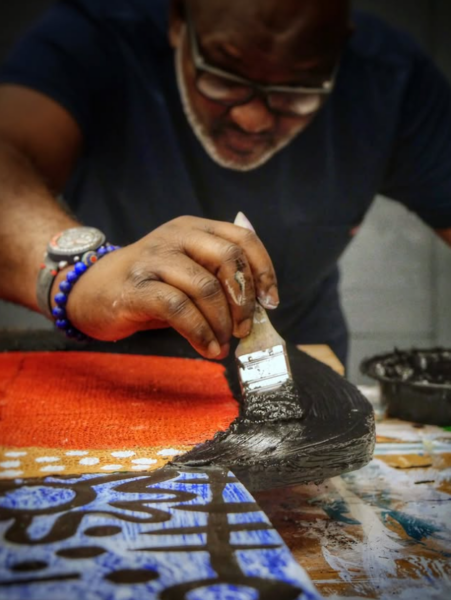
Ekpuk engages in a quiet dialogue with ancient sign systems, which predate alphabets by many centuries. “Nsibidi,” a symbolic language of Southeastern Nigeria, is one such system, representing concepts, relationships, and values. While Ekpuk could have treated “nsibidi” as a static sign system to be emulated, he instead preferred it to function as a fountain of living inspirations. He takes in the attitude of nsibidi: symbol language and sign language, but allows his own sign language to evolve by itself without any external meddling. This is important because “nsibidi” was never meant for universal understanding; it is rather a matter of context, shared understandings, and selective perception. Art would retain a notion of privacy, of protection from loss, thereby implying that some forms of cultural understanding derive their potency from self-imposed restrictions about their accessibility.
With this, Ekpuk demystifies the notion that there must necessarily be some attempt at description or translation for any African traditional experience to be valid or appreciated. By drawing on ancient signs without freezing history in its antiquarian state, Ekpuk keeps his culture and roots alive. His works create a continuum between past and present generations, so that history is not only to be understood and imagined as lived, but also told in their visual language. In this sense, we may see Ekpuk’s works as bridges from the past to the present.
But beyond their beauty, Ekpuk’s art also interrogates power, history, and who has the right to construct meaning. Ekpuk’s work is an indictment of colonial histories that celebrated some modes of knowledge while denigrating others as informal or primitive. In other words, his art centers on symbolic communication, which challenges historical presumptions about what constitutes valid communication. Instead of being a loud political gesture, Ekpuk’s act of defiance is one of form and of intention. The absence of a direct explanation itself is a statement that resists the insistence that non-Western cultures must necessarily explain or decode themselves for someone else’s enlightenment.
Ekpuk’s own practice is one of both creation and refusal. He refuses the immediacy of access, refuses to reduce to the simplistic level, and rejects the notion of value that is inherently explicable. His practice is also an indexing of a broader experience of migration and displacement, and of the negotiation of identity through movement and survival. This dialectical dynamic in his imagery indexes the experience of having histories that are often misconstrued. Ekpuk’s aim is one: to reinscribe histories through art. And what his practice makes clear is that cultural presence does not require permission to appear.
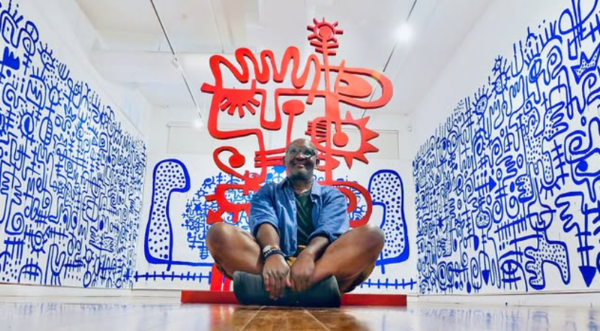
Being represented on international art platforms matters, as it shows greater representation of African or diasporic voices in the current context of visual culture. He has been described in major art exhibits and museums, including his unique style among artists from other corners of the globe. Those who view his artwork are often left with curiosity about its complexities, which convey multiple narratives. There is not always a direct narrative that allows for various interpretations through the multiple backgrounds that engage with it. Ekpuk’s international fame raises questions about institutions’ role in relation to culturally grounded art. It challenges the perception of art from Africa and the diaspora by questioning how museums define their knowledge. Another exclusive role Ekpuk plays is that of a creator and teacher, influencing discussions of art beyond the exhibition space. Ekpuk participates in discussions on issues of visual culture and interpretation through teaching, lectures, and public engagement. The international reception of his work encompasses not only individual achievement but also recognition of the new reality that demands serious consideration of complex forms of art outside Western culture.
Poetic semiotics at its best.