

Damilare Bello
Duke University
Toyin Falola’s Feminism, Africanism, and Globalism (Carolina Academic Press, 2026) enters continuing debates about the relevance of humanities thinking in the contemporary moment. Rather than pursue this strictly as an interrogation of disciplinary relevance, the book reorganizes the question by reminding readers that creative and critical (theoretical) methods offer irreducible complementary value in pursuits of knowledge. The book is Falola’s demonstration of both this reasoning and its importance in a time creativity and theory are hard-pressed to defend themselves: the one (creativity) is under attack, and the other (theory) is believed to be obsolete, if not “dead.” Falola’s 360-page monograph offers a critical study of Nigerian scholar and playwright Doyin Aguoru’s intellectual oeuvre as an exemplary case of this irreducibility.
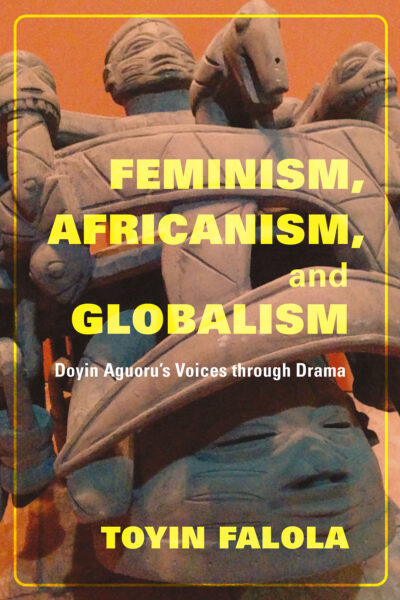
True to its title, the book organizes itself around three main conceptual clusters: feminism, Africanism, and globalization. These are shorthand for the relationship between culture and knowledge, power and power’s crisis, and women and agency that the book pursues. In a short, punchy sense, each lexical item in the title reflects the intellectual center of Aguoru’s output as much as Falola’s appreciation for the highly contested but also generative nature of gender, relationality, and cultural identity as conceptual categories. Together, these governing terms form the center of gravity around which critical and creative methods orbit, generating new modes of framing Africa’s place in the world. Falola is better known as a historian. But his resourceful handling of the subject through Aguoru’s literary dramas straddles dramaturgical, material, and historical analyses. Falola is in his interdisciplinary element here.
The governing terms that Falola introduces serve as an analogue orientational device, a point Falola infers early in the section, “How to Read this Book.” Here, he guides readers on how to track what initially appears to be his movements through Aguoru’s work but illustrates the complex patterns that surface on the page when creative imagination is shot through with the analytical reasoning and vice versa. His admonition to readers to engage the book thematically invites attending to the twelve chapters as multiple openings into Africa’s world. Political, economic, historical, gendered, and cultural realities are reanimated by centering woman as active agents in the making and remaking of Africa as a localized space entangled with the global. His focused and comparative treatment of Aguoru’s plays situates them as lenses for witnessing an unfolding conversation between Africa, women, power, and global influences. Each chapter decodes and enriches this conversation.

The first three chapters set the stage for the book. The first begins with a sustained exposition on narrative as an infrastructural condition for a particular kind of cultural perception and awareness. Literary texts emerge here as narrative arrangements that stretch out collective consciousness. This expository chapter offers the space on which the two other chapters find momentum. The second chapter extols intellectual work—any consistent reader of Falola’s corpus will find a familiar territory—while repositioning intellectual literary work as a tool for collective possibilities. The third chapter provides the narrative coda for this cluster by cautioning any engagement with Africa that ignores its relationship with world systems, disproportionate power arrangements, and global moments as problematically provincial. This thematic arrangement signals Falola’s practical understanding of the infrastructural value of narrative to intellectual engagement.
Chapters four to seven take off in a considerably elegant manner. The first chapter in this quartet picks Stolen Seeds by Aguoru to situate “blame culture” as dramatized in the book as gendered power. While this is threaded through familiar issues of infertility and who inherits blame, what emerges as consequential is the misrecognition and misattribution that comes with power as a universal phenomenon with local iterations. Chapter four hands off to chapter five in the sense that it reshuffles the culture of misrecognition from a domestic issue to a political one. The crisis here is not gender blaming but a misdiagnosis of what governance and responsibility to the social contract require. Chapter six locates the fallout of this warped culture in domains of social life where people become subjects of a failed governing power by living out political failure in the form of an identity crisis. Falola’s global awareness surfaces here as he identifies this crisis as unstable life under neoliberal capitalism. Chapter seven functions like a refrain: it rehashes some of these issues to stress identity politics, chauvinism, and bias as afterlives of a justice-deprived social contract.
Chapters eight to ten recenter Aguoru more forcefully. They prompt a collective return to devastating moments in African history, such as the Hutu-Tutsi conflict. Refugees of the Great Lakes by Aguoru anchors this flight across time. But much more than forcing a historical reckoning, chapter eight reads the character of Nyatu from the play beside the Yoruba heroine Moremi. Neither is presented as true foil or parallel but as strategic leaders whose femininity serves as sites of collective redemption. Chapter nine offers readers an economic perspective of these heroic acts, while chapter ten zeroes in on the immense toil and sacrificial burden women’s bodies are made to bear as suturing and reparative units of culture. The horrors of genocide and conflict pass through women precisely as they become both the sites through which the violence of power is understood and meaningful intervention pursued.

The last two chapters return to themes raised in the introduction by offering possibilities of a resolution to the problems exposed in the early chapters. Chapter eleven identifies a possible turning point in the convergence of positivist science and local traditions. This becomes a generative example of local-global entanglements. Chapter 12 strikes an interesting though belated comparison between Aguoru and Athol Fugard. This comparison rests on their shared investment in amplifying resistance and other irruptions of degraded power. Falola moves here to shift the scale of the problem, a motivated gesture that wants more sustained attention and prior signposting.
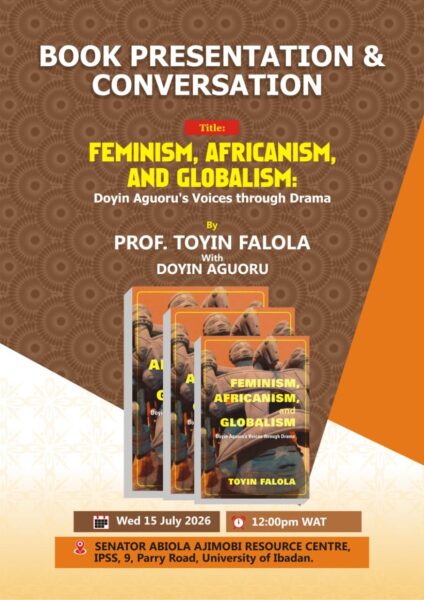
Feminism, Africanism, and Globalism’s quality is its ability to set up and return to the same literary sites without appearing as literary sociology or historiography. This shows synthesis, a quality that readers might perceive as dialogue between and across chapters. Falola exposes the problem, who bears the cost, and on whose back renewal can happen. In all these, he points to the future of Africa as one in need of both creative imagination and critically reflective conceptual approaches. On this note, the book is not just a study of Aguoru’s output: it reimagines her corpus as a cue to the necessity of multi-dimensional reflections on Africa’s relationship with the world.