
Toyin Falola

A Conversation With HRM, Alayeluwa, Oba Professor Saka Adelola Matemilola, PhD, FNSE, Oluyalo Otileta VII, The 14th Olowu of Owu Kingdom, Abeokuta
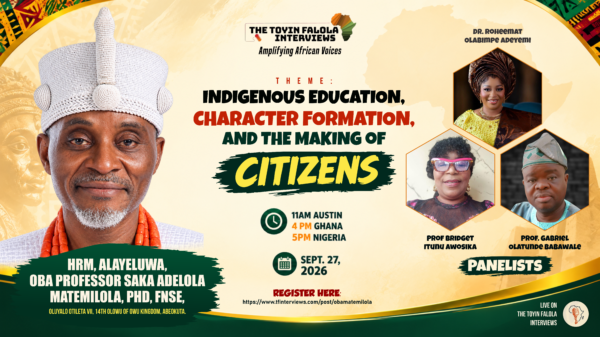
(This is the first report on the conversion on September 27, 2026. For the transcript, see: https://www.youtube.com/live/5Nj7O4k7-R4?si=ShSCdRGkCQfubI9N )
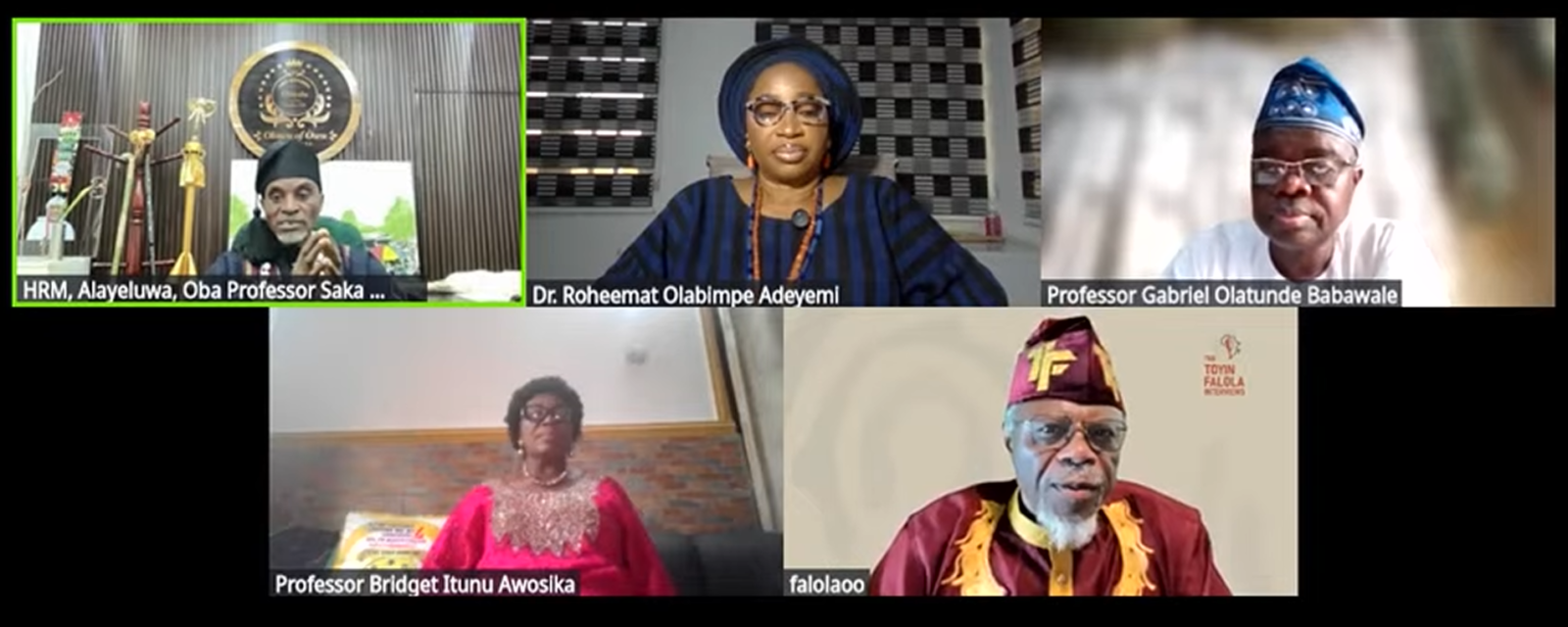
A question sits beneath almost every conversation about education in Africa: what exactly are we trying to produce when we educate a child? Is the purpose of education to produce someone who can read, write, pass examinations, acquire professional qualifications and compete successfully in an increasingly globalized economy? Or is education supposed to produce something larger—a person who understands responsibility, community, history, language, ethical conduct and the obligations that come with belonging to a society? The TFI with His Royal Majesty, Oba Professor Saka Adelola Matemilola, the 14th Olowu of Owu Kingdom, turned this seemingly simple question into a broader interrogation of the relationship between education and citizenship. The conversation revealed an uncomfortable possibility: Nigeria may be producing increasingly educated people without necessarily producing “quality” citizenship.
The discussion’s significance lies partly in the unusual position from which Oba Matemilola speaks. He is not only a traditional ruler defending an inherited institution, nor is he simply an academic reflecting on education from the university. He occupies both worlds. His first-class and master’s degrees in Mechanical Engineering from the University of Ibadan, his doctorate in Applied Mechanics from Cambridge, his professional experience across several countries, and his career in engineering and industry give him the language of modern professional education. His position as Olowu, meanwhile, places him inside a traditional institution where questions of culture, memory, language, communal responsibility, and moral authority cannot easily be separated. The decision to place such a figure in conversation with scholars of language, political economy, and education therefore created an important intellectual encounter: the university and the palace are not competing worlds, but institutions that might teach each other.
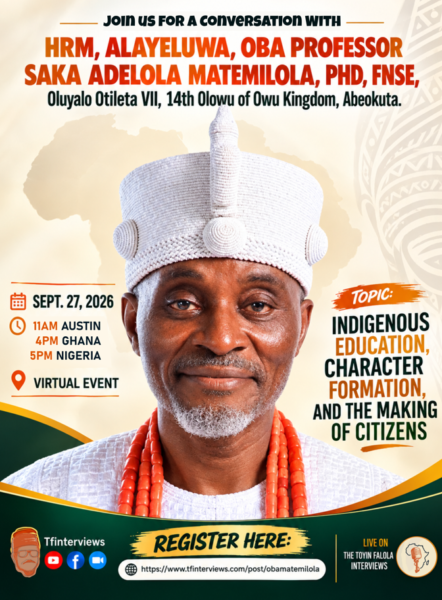
Dr Roheemat Olabimpe Adeyemi established that framework from the beginning. A scholar of linguistics and Nigerian languages, as well as a poet and chanter, she approached the conversation through the relationship between education, language and culture. Her opening intervention challenged the narrow definition of indigenous education as belonging to a vanished past. In the traditional Yoruba setting, she observed, education extended beyond the classroom. Children learned through observation, listening, participation, work, correction, proverbs, stories, and interaction with elders and the wider community. Knowledge was therefore inseparable from the kind of person that education was expected to produce. Her question to the Olowu was consequently more demanding than asking what indigenous education once looked like. She wanted to know the difference between an educated person and a responsible citizen.
Oba Matemilola’s response moved the conversation from certificates to participation. Drawing on an ancient Greek distinction between citizens and other categories of people, he described citizenship in terms of contribution to the commonwealth. For him, the citizen is not merely someone who lives in society and meets certain qualifications. The citizen contributes to the construction of society and realizes that they are both a recipient and a giver. This distinction becomes crucial in the Nigerian context because it exposes a flaw in an education system that measures success on an individual basis. An individual can achieve great grades at school, get employed, travel to another country, and become successful without any ties to the social obligations of citizenship.
That concern becomes more compelling when Oba Matemilola reflects on what happens after young people leave home. He describes a changing social environment in which children may become increasingly detached from their parents, families, and communities once they leave for university or migrate abroad. The problem, in his view, is not mobility itself. The question is the breakdown of the bonds that once linked individual success to a broader communal narrative. Education, conceived merely as a means of escape, may unwittingly produce the very issue it is meant to fight. The individual becomes adept at leaving, but not necessarily at coming back; at competing, but not necessarily at contributing; at acquiring knowledge, but not necessarily at using that knowledge for the public good. The bigger question is not whether we romanticize the past, but whether lessons from those past systems of communal education can inform our present-day society. That distinction matters, as the conversation does not suggest that Nigeria should reproduce past educational structures. Instead, it asks whether modern education has discarded certain mechanisms of social formation without replacing them with equally effective ones. This is where the question of character becomes central.
Oba Matemilola put it into a striking formulation: the palace forms character while the university forms the intellect. The question was whether becoming a traditional ruler had changed his understanding of character formation in ways that his university education had not. His answer was revealing. Ascending the throne, he explained, had made him rethink character as something that cannot be confined to the university or even to formal schooling. It must begin much earlier, from childhood, and culture must be incorporated into the formation of the person. His personal experience with his children provided perhaps the most memorable illustration of this argument. Although he had ensured that his children could speak Yoruba, he discovered that linguistic fluency did not automatically mean cultural understanding. He recalled giving his son a familiar expression from the kind of Yoruba poetry and recitation that had shaped his own childhood. The child could read the words but could not fully understand them. That made him realize a difference one does not always notice: being able to speak a language does not automatically mean being aware of the whole worldview that language embodies. This difference matters because a language is much more than vocabulary. Proverbs, idioms, praise poetry, songs, stories, and common phrases are built on assumptions about work, responsibility, relations, dignity, age, community, morality, etc. If a child stops getting access to these meanings, they might lose much more than vocabulary. The child will continue to speak the language, yet the cultural memory connected to the language will recede into the past. That is how Oba Matemilola understands the link between language and character building. For him, teaching children Yoruba is not simply about preserving a means of communication; it is about giving them access to a cultural vocabulary through which they can understand responsibility and identity.
His response also moved the discussion beyond the family. As Olowu, he said he had encountered highly educated and successful people who struggled to speak Yoruba in the palace. He therefore sought to make the palace itself a space where indigenous language and culture could remain active. He spoke of working with teachers of indigenous languages, supporting conferences and cultural programs, and encouraging younger people to understand food, dress, drumming, talking drums, Ifá, and other dimensions of Yoruba cultural knowledge. His discovery of the historical significance embedded in Ifá further reinforced his argument that cultural practices can record collective memory and origins. But if language and culture matter, who transmits them? Oba Matemilola deliberately distributes the answer across three institutions: the family, the school, and the palace. The family, he argues, is the first site of moral education. Parents cannot simply pay school fees, send their children to prestigious schools, and assume that the institution will perform every responsibility of upbringing. The example parents set, the time they spend with their kids, the discussions they have at home, and the culture they pass on shape their children’s character. This idea places a heavy burden on parents; however, it also raises questions about the tendency to blame schools for the social and ethical issues that arise among young people. Schools can only act on what parents give them.
For Oba Matemilola, the curriculum therefore matters enormously. He questions educational policies that marginalize indigenous languages and argues that successful societies have historically taken their own languages seriously in educating their children. His argument is not simply about linguistic pride. He sees language as connected to moral formation, cultural understanding, and the capacity to locate oneself within a community. Professor Bridget Itunu Awosika deepened this argument by asking what happens when indigenous knowledge disappears with the elders who carry it. Her question brought a new dimension into the conversation. She referred to proverbs, crafts, decorative arts, weaving, dispute resolution, ecological knowledge, and other forms of indigenous knowledge. She asked how to document these for a generation growing up in a digital environment. Her concern was not nostalgia; it was preservation, transmission, and adaptation. If knowledge remains only in the memories of aging custodians, what happens when those custodians are gone?
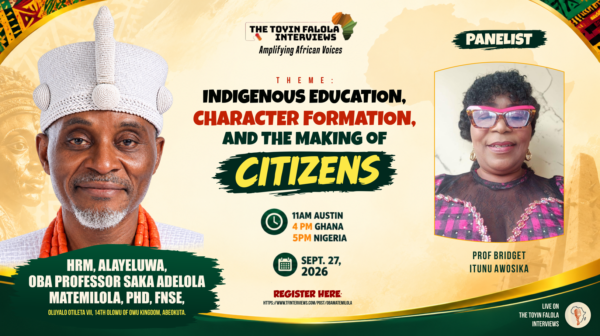
Prof. Awosika also returned to the central distinction between certificates and character. She asked how the palace, university and family could work together to produce graduates who do not merely possess qualifications but can demonstrate what they have learned through ethical behavior, patriotism and responsible conduct. In doing so, she expanded the conversation from what children should know to what they should become. Education becomes meaningful only when knowledge enters conduct. Oba Matemilola described efforts in Owu to document genealogies, compound histories, traditional titles, migration histories, and the responsibilities attached to different positions. He explained that such documentation can be incorporated into archives and cultural publications, allowing younger community members to encounter their own histories in accessible forms. The response is significant because it suggests that tradition need not survive solely through oral transmission. Indigenous knowledge can be documented, archived, and brought into conversation with contemporary forms of education and digital communication.
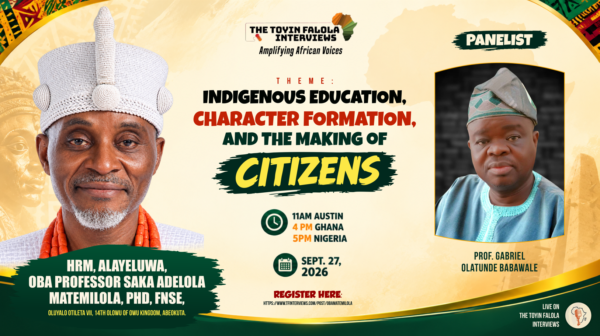
Professor Gabriel Babawale’s contribution to the wider conversation adds another layer to this question of character: institutions themselves must embody the values they claim to transmit. His later intervention on traditional institutions emphasized due process and the integrity of the processes through which traditional rulers are selected. That observation matters to the educational question because children do not learn only from textbooks or formal lessons. They also learn from institutions. If institutions demand ethical behavior from citizens while operating according to contradictory standards, education becomes a performance rather than a lived social practice. Character is taught not only through what adults tell children but also through what institutions demonstrate. This brings the discussion back to the palace. Oba Matemilola insists that traditional institutions must serve as moral examples because people watch the behavior of those in positions of authority. A palace that speaks about dignity but displays misconduct undermines its own moral authority. A chief who preaches responsibility but behaves irresponsibly teaches a lesson more powerful than any proverb. The same principle applies to universities, schools, families and political institutions. Institutions educate through their conduct.
The one important insight emerging from the conversation, therefore, may be that curriculum reform alone cannot solve the crisis of citizenship. It is a problem of social formation. A child acquires from parents, teachers, elders, peers, institutions, language, stories, rituals, and the behavior of those in positions of authority. A university will refine the mind, but it cannot bear the whole burden of creating ethical citizens. The family might build the foundation of ethics, but it cannot impart all the information a modern citizen needs. The palace may preserve cultural memory, but it cannot replace school. Each institution has its own role, and when one fails, the other must shoulder more of the burden. One point from the Olowu dialogue is the contradiction in contemporary education. Nigerians now have more access to formal education, professional training, and global information, but acquiring credentials alone does not make an individual more responsible to the community. The problem is not that young Nigerians are becoming educated. It is that education has too often been separated from the question of what that education is for.
Perhaps this is why one of the important questions raised by the conversation is not whether indigenous education should replace modern education. It should not be framed so narrowly. The deeper question is what modern education can recover from the older understanding of learning as a process of becoming. The Yoruba child who learned through stories, proverbs, observation, work, and interaction with elders was not simply accumulating information. In other words, the child was brought up in a moral community. Today’s task is to revive this tradition without renouncing the opportunities modern science and technology open in education. The question we are left with is far broader; what sort of people do our schools want to educate? If the answer is graduates and competitive professionals, then we have missed something vital. A society needs educated people, but it also needs people who belong; successful people but also serving people; people who know a language, but also people who know its history and worldview; people who have knowledge, but also people who can apply it ethically. The crisis of citizenship arises when a society becomes good at educating its young citizens on how to succeed personally but is unsure how to teach them what they owe each other.