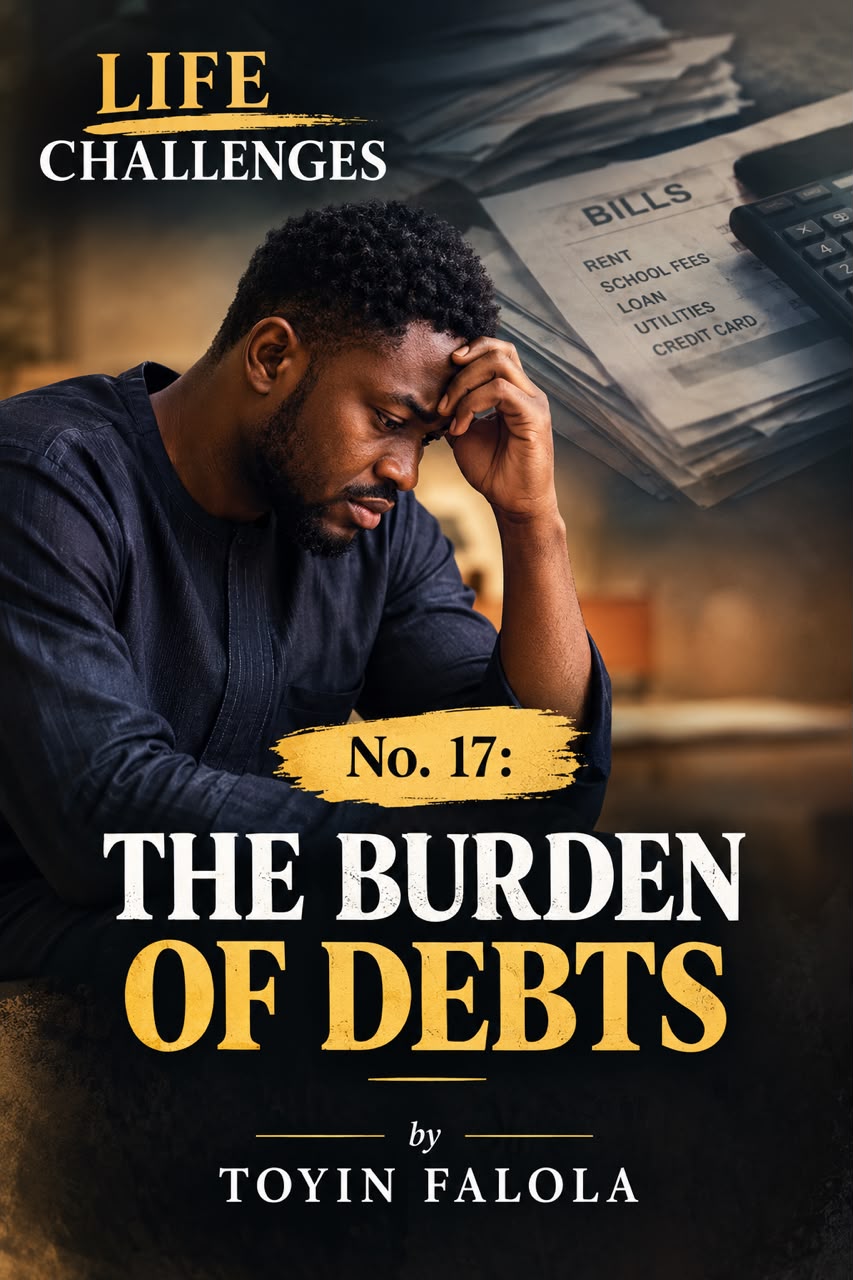

Toyin Falola
The Money I Cannot Return
I borrowed because hunger
had learned my children’s names,
because the landlord stood at the gate
and would not sit down,
because hope required a deposit
my hands could not provide.
You gave me money.
I gave you a date.
That date has passed.
Another has followed it.
Now the calendar hangs on the wall
like evidence against me.
Your name lights up my phone.
I watch it ring
until the room becomes quiet again.
Then I sit with the silence
I have made between us.
I know you need your money.
Perhaps someone waits at your door too.
This is what keeps me awake:
my relief has become
a weight in another person’s house.
I rehearse explanations
over a plate of yesterday’s rice.
Each sounds smaller aloud.
The work did not come.
The payment did not arrive.
The little I gathered
went into medicine and food.
At night I count what remains.
By morning, interest
has eaten beyond the edge
of my arithmetic.
Once, my word could cross a market
and return with what I needed.
Now I carry it from door to door,
and people check its pockets
before they let it in.
My mother taught me:
return the bowl in which you were fed.
I have washed yours.
I have wrapped it carefully.
I cannot fill it.
Please believe
I remember what I owe.
I remember the kindness first,
the amount after,
and the exact sound of my voice
when I said,
“You will have it by Friday.”
Friday
I turn the phone face down.
Outside, someone laughs.
My children ask
why I am not eating.
I tell them I am full,
and move my portion
onto their plates.
In the previous series, I discussed the cost of living as a life challenge, and it gave me an inkling of indebtedness. To be specific, loan debts. I will be wrong to state that taking loans is necessarily a bad financial decision for individuals. Big corporations and respectable individuals do it and plan decisive financial and business steps around it. It could be investments, business expansion decisions, or major decisions. I mean, many of us take loans, mortgages, and other forms of credit to take some of those steps. So, it is perfectly fine. However, there is a thin line between taking loans as a good decision and a bad decision, and sometimes it is not noticeable. It can be so bad, as in many places now, that it becomes a life-threatening challenge. It becomes a taker of peace and a deteriorator of people’s physical and mental health.
The situation has become critical in Nigeria as the currency depreciates, inflation rises, and other pressures increase the cost of living. At present, consumer loans in Nigeria are in the trillions, and it keep growing day by day, with personal loans further expanding the base. With the current situation in Nigeria, loans to finance food and personal needs have unavoidably increased.
It is even more pathetic that, these days, taking personal loans has become so convenient that almost anyone can get one within just a minute. The advent of digital loans, or loan apps as they are commonly called in Nigeria, worsens the situation and amplifies its effects. There is no collateral or security, and your qualification for the loan is evaluated on your credit history and income. Even commercial banks now provide convenient personal loans accessible in just few minutes. This is good but it must be regulated.
While the convenience may seem commendable, it is a trap set by many of the loan apps. It often comes with high rates of about 20% to 40% and rolling default fees of about 1-5 per cent on the sum per day; it keeps accumulating until you settle the debt. The more you take loans and pay them back, the more your credit score increases, and the more eligible you become for additional borrowing and opportunities, despite having many debts to pay.
Unfortunately, personal loans are barely regulated by the government in many ways, which has greatly increased the complications that make this subject a life challenge, a life-threatening one at that. Information and attention to high interest rates often don’t get the spotlight they deserve when a borrower is about to borrow. The rate is about 20% and more on almost all platforms. However, the tenor could also make it compound. Interest is often a flat rate or reducing balance; in the former, you pay the same interest charge of about 20% of the principal every 10 days, month, defined tenor, or milestone of payment in the tenor; in the latter, you pay 20% on the principal at first and 20% on the outstanding principal every month or milestone of the tenor. As a result, the interest you pay could climb to about 45% to 60%.
Thisday Live in August 2025 reported accounts of devilish loan rates. One lamented that when you borrow N100,000, only about N59,000 is deposited into your account with the remaining in charges, and the rate can go as high as 69.5% weekly interest. As a result, you repay N169,500 by the end of the week. If you default, the debt continues to grow to about ₦486,900, and by the eighth week, about ₦4.02 million; by the twelfth week, around ₦33.16 million. Within three months, an initial ₦59,000 cash in hand has exploded into tens of millions in debt.
If you default, your penalty could be simple or compound interest, and your problem can compound. For simple interest, your default penalty applies only to the principal and interest, with a daily default penalty of 1%. For compounding loans, it is on Principal + Interest + Accumulated Penalties. If you are not careful, you could end up paying more than you borrowed. The compounded sum keeps increasing as penalties accumulate, pushing it beyond the borrower’s reach. It creates a loop for borrowers who do not initially have enough to pay back what they owe.
Another fundamental problem is that other loan apps ignore credit scores. To pay off accumulated loans from one app, many Nigerians move to another loan app to borrow, pay what they owe the other apps, and cover immediate expenses. Without accounting for the compounded debt from the initial app, the new loan shark lends more at higher interest. The cycle continues, trapping the individual in a never-ending loop and making it seem like he or she is only working for the loan apps while still owing more.
Borrowing is not the only problem in this life challenge; the audacious means this loan sharks use to recover overdue loans are, too. A man disclosed what he faced from several of them. They place nonstop calls about 17 times a day, along with several texts. Their agents use insults and threats with no civility. From there, they go on to send disturbing messages and threats to the person’s contacts. They also circulate pictures of the borrowers as chronic debtors, criminals, or whatever descriptions they think will cripple the borrowers’ minds.
These threats, pressures, and harassment build up psychological and mental stress that put the borrower in distress, depression and anything you can imagine. They run from the public, fearing embarrassment and disappointment from people who may have been contacted about their inability to service their loans. They fear the incriminating defamation the apps and their representatives have spread.
Unfortunately, people do not wear this on their faces; they go to work as if nothing happened. They do not tell anyone about it, and the debt becomes a heartache and an eternal worry that knocks on heaven’s door. Many drop dead with no understanding of the cause of death. The number of people suffering from high blood pressure is immeasurable, and when this compounds, it becomes something beyond control. In 2023, a sad incident happened. Sanni Hameedah, a young 300-level girl at the University of Ilorin in Kwara State, killed herself after she could not pay back a loan of N500,000 from a loan app. It was also uncovered that Hameedah had an outstanding N270,000 unpaid loan about 5 months before her death. There were reported attempts to resolve it, but she later took out another N500,000 loan. She could not pay her loan, and the pressure and harassment became unbearable and led her to her grave.
In 2022, FIJ reported that a man, Alaba Nelson, a vulcanizer, told them he was about to commit suicide because of the constant harassment from a 3-month overdue debt which started with N9,000. The loan app sent defamatory messages to his contacts, telling them he had failed in life, failed his family, and couldn’t pay the loan.
Now, we have an idea of how deadly loans have become in Nigeria, but let me talk to you as the borrower. I understand that you are currently overwhelmed and, in fact, cannot see an end to this ordeal. It could seem like the walls are closing in on you; your blood pressure is through the roof. You see, that is really not the end of life. And it is important to tell you that if you are not deliberate, the circle will not end.
Hence, the first thing to do is stop borrowing. When you borrow more to pay current loans, you expand the money you owe and push it further beyond your reach. It is just a temporary fix. Scrap that; it is not a fix at all. It is a trap they wanted you to enter. No matter how much interest increases, don’t borrow more. Only pay from your earnings. If you can reach out to the loan app for concessions, do. If you can afford a lawyer or can get one who can help you pro bono, have the lawyer write a letter or take it up with the loan sharks about harassing you. Then they can help you get a payment arrangement. But whichever way, do not take another loan.
Moreover, get phone apps that can block numbers known for such harassment. It is often the case that these numbers have called several people. Report each of the numbers. When anyone threatens you, write a letter informing them that you will pay and that any other threat will be taken up legally. More importantly, have a payment plan for loans you already have. If you have steady income, dedicate a percentage to paying the loan. You can also reach out to friends and family who can lend you money interest-free. Pay the apps and work out a payment plan with the non-interest borrower. Just stop the borrowing cycle.
No matter the pressure, remember that you can overcome this phase, and you will surely overcome it. Your case is not the worst, and you will not be the last, but it will not be the last for you either. It is one of those challenges; it will pass; it will surely pass. Please, also remember to speak up. Any loan you cannot pay is beyond you, and you must share how you feel with others. In the next 2 years, if you do not borrow more, you will have a different story about how you overcame it. More importantly, maintain a decent lifestyle. It’s time to spend far less than you used to. Say no where you do not have; no one will kill you. That is the situation you are in. As many of your life problems have been resolved, this life challenge will also pass. Stay strong.