
Toyin Falola

A PANEL DISCUSSION ON POLYGAMY, PART 1
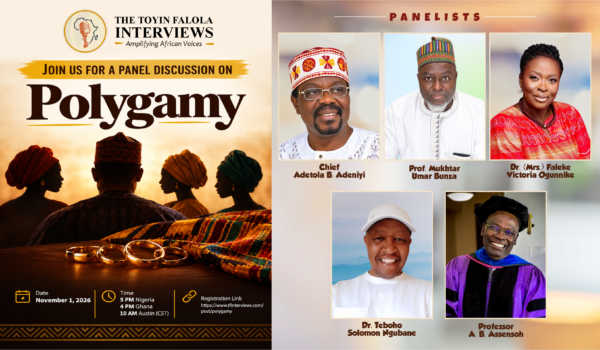
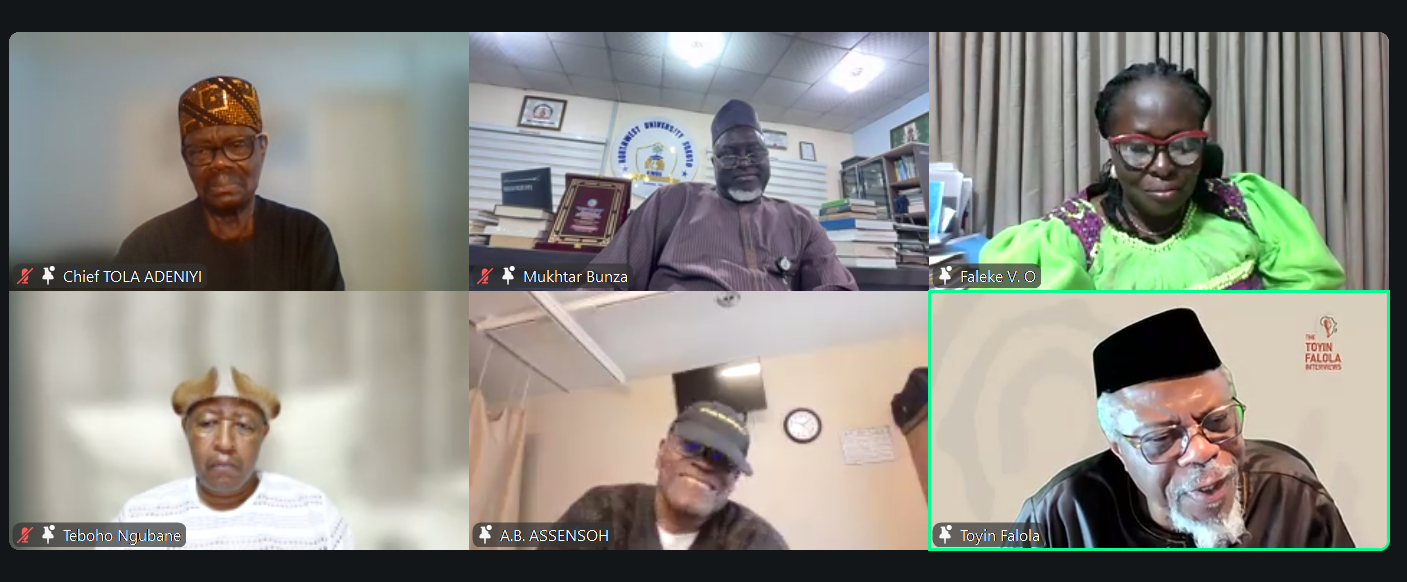
(This is the first report on a panel on Polygamy, November 1, 2026. For the transcript, see: https://www.youtube.com/live/vpQlUAMc9Vw?si=JmT3zPjmGbdMjKj_)
Marriage in Africa is not only about uniting two people. From its very inception, it has always been associated with the family, lineage, inheritance, religion, community organization, and succession. Yet marriage can also serve as a way for communities to reflect on, sustain, and modify their traditions in response to changing circumstances. Perhaps, there is no other sphere of the domestic relations in Africa where controversy has been as heated as that concerning polygyny, known in the academic literature as polygyny. While for some polygyny has remained a living expression of the African tradition, for others it poses difficult issues of gender equality.
It is important to move the debate beyond the easy confrontation of tradition versus modernity and focus on a tougher question: what African societies should make of an institution that has endured for generations but whose interpretation and implementation have been constantly evolving. Professor Mukhtar Umar Bunza questioned the conventional wisdom that the institution of polygamy either had its roots in Africa or was brought to African communities by means of Islam. Drawing on his expertise as a historian, he placed the institution in the broader history of humankind, noting that several types of marriage were practiced across different geographical and cultural contexts. He cited examples from ancient Assyrians, Mesopotamians, Egyptians, Chinese, Greeks, and Romans to support his point.
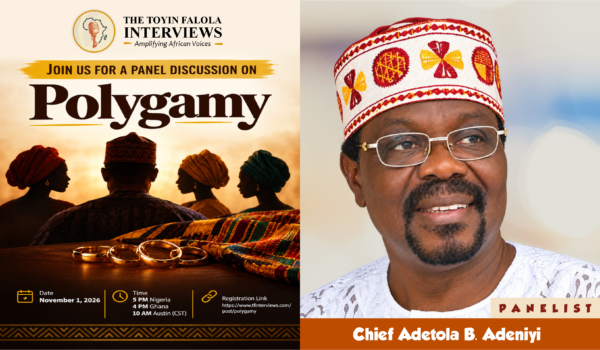
According to Prof. Bunza, the existence of polygamy in different eras of human history implies that it should be considered an institution that adapts to new situations. It was shaped, he argued, by various factors such as geographical imperatives, economic systems, demography, and sociological expectations. What matters about the distinction between societies that practice polygamy and those that reject it is the diversity of ways they adapt to societal needs.
His historical perspective also included religion in the argument. Concerning the connection between polygamy and Islam, Professor Bunza explained that Islam did not initiate this custom but regulated an already existing institution of human society. He focused on multiple marriages in history and scripture connected with the figures of Abraham, Moses, David, and Solomon, saying the custom was also present in religious history before Islam. But while defending the Islamic point of view, Professor Bunza did not try to justify unlimited marriage. On the contrary, he said that Islamic teachings have restrictions in this question, especially the need to maintain justice between wives. While mentioning the possibility of having up to four wives, he pointed out that this custom includes an essential restriction.
The distinction between the two was central to Professor Bunza’s presentation. First, he noted that polygamy in the context of Islam is not a must but a permissible practice. Second, there are conditions in which polygamy could take place. For example, polygamy may occur when a couple is unable to produce children; when a husband falls ill; and when the same person would like to maintain his first marriage while getting a second wife. According to him, polygamy is a social phenomenon that exists to solve some human and social problems and to allow men to accumulate wives without restrictions. Professor Bunza’s contribution was valuable because his presentation drew on a combination of historical and personal experience. Specifically, Professor Bunza noted that he is married to three wives and has 21 children. This means his personal experience continued a family tradition he knew well.
He also shared his family’s educational background, explaining that some of his children were university graduates and his wives had higher-education credentials. This presentation contradicted the notion that a large family consisting of polygamists is inevitably at odds with education and personal success. Most importantly, he brought to the table the real-life experience of a man who practices polygamy to contribute to an otherwise theoretical debate. However, Professor Bunza’s historical and religious case for polygamy was not left unanswered. Dr Victoria Ogunnike Faleke’s linguistic background helped make an important distinction.
According to Dr. Faleke, there is an inaccurate use of the term polygamy in situations where it is viewed to mean a marriage of a man to several women. According to her, polygamy refers to a marriage practice where the person has more than one spouse at once. There are two types of marriage practices under polygamy, namely: polygyny, where the man has more than one wife, and polyandry, where the woman has more than one husband. This was more than a clarification of terms. The implication of this was that although polygamy can contain various marriage practices, polygyny is the most common practice of polygamy among many African communities. This stems from patriarchal structures in many societies. Dr. Faleke attributed this prominence partly to patriarchal cultural structures and men’s historical dominance in determining marriage arrangements.
Her involvement thus became an obstacle to the treatment of polygamy as a monolithic institution. The way in which marriage was talked about needed to take into account the distinctiveness of the institution that it was describing and its power dynamics, as well as the historical and religious interpretation of polygamy from the Bible. Based on her interpretation of the Book of Genesis, she pointed out Lamech as one of the first figures in the Bible who took two wives, according to Genesis 4:19. She made a comparison between the story told in this part of the Bible and the original biblical concept of monogamous marriage of one man and one wife. The interpretation of the biblical story that Dr. Faleke offered was different from the view of Professor Bunza on Islamic law in that while he considered polygamy as an institution which was subjected to certain conditions by Islam, Dr. Faleke interpreted polygamy as an institution that developed after the creation of marriage. She also examined the circumstances surrounding Abraham’s marriage to Hagar, connecting the decision to the problem of childlessness.
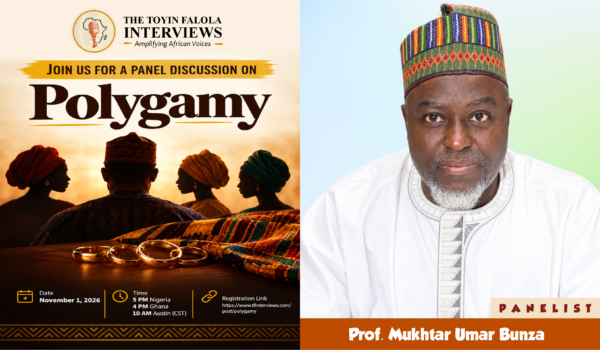
This disparity between the two views proved that religious traditions do not allow themselves to be interpreted into a single understanding of marriage. Even when history and biblical texts coincide, conclusions can differ depending on the presuppositions and theories used for interpretation. Chief Adetola B. Adeniyi built his argument on the views of Dr. Faleke on polygamy and polygyny, taking advantage of his differentiation to challenge the boundaries with which societies traditionally distinguish marriage. In his rather controversial opinion, he said that those who get married, divorce, and get married again could also be called polygamous, considering the broader meaning of the word. His intervention was partly humorous, but it raised a serious conceptual question: why is the simultaneous marriage of multiple partners often treated differently from successive marriages involving different partners?
The discussion showed how terminology shapes people’s perceptions of marriage. In the African context, what is referred to as polygamy is actually polygyny, and other types of marriages fall into different categories. This is important as the language used in describing marriage is never neutral but comes with assumptions about gender, morality, and cultural legitimacy.
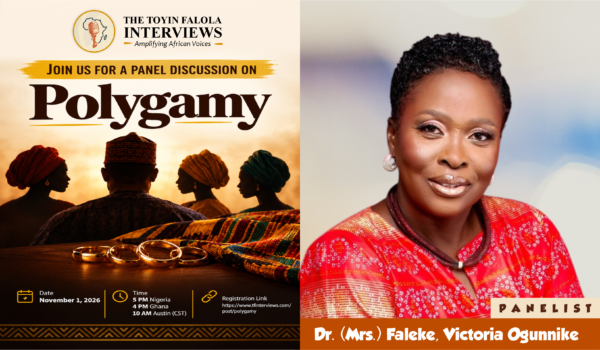
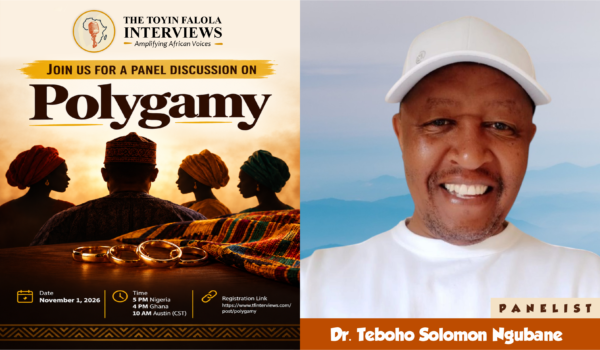
Dr Teboho Solomon Ngubane made his points in relation to the broader philosophical outlook on African family relations. Using his personal experience of practicing polygamy and being from South Africa, where polygamy is common, he suggested that the traditional form of African marriage did not involve only two people. In this case, marriage linked the family, tribe, ancestors, and descendants. According to Dr. Ngubane, marriage implied certain obligations beyond the immediate marital relationship between the man and the woman. These included preserving the family name, maintaining traditions, preserving ancestral knowledge, and building strong ties in society. In this context, the practice of polygamy became just one form of organization of such responsibilities.
He delved deeper into how many wives a person could have. According to him, it was not the number of people in a family but the values that kept the family together. According to him, an African perception of family must be based on discipline, responsibility, wisdom, and Ubuntu leadership. Ubuntu, which basically means that your humanity is linked to other people’s humanity, formed the basis of his argument. The polygamous family could operate efficiently when family members showed respect, cooperation, compassion, and responsibility. Every woman deserved dignity, and every child needed to be loved and taken care of.
Dr. Ngubane’s stand raised an important point about the cultural defense of polygamy. Unlike many other scholars who defended the practice by referring to its traditional nature, Dr. Ngubane noted that there is nothing inherently successful about polygamous relations. According to him, their success or failure depends on how participants behave toward one another. A larger family may mean stronger networks of support, responsibility, and heritage preservation, but only if it is organized properly and the leadership is responsible. This example showed that African cultures are dynamic and do not always follow past rules. In particular, Dr. Ngubane showed how polygamy existed in previous generations of his family, then faded for a while and returned.
In this regard, African culture should not be viewed as an unchanging set of traditions each generation must uphold. African culture is dynamic, and its meanings depend on how people within the tradition experience it. The most interesting discussion came from Chief Adetola B. Adeniyi, who raised the issue of what he called the hypocrisy of monogamy. Even though he has been practicing monogamy for decades, Chief Adeniyi felt that the celebration of monogamy masks another reality where men are having extramarital affairs and raising other children besides their wives.
In his own experience, he recalled a situation where important people such as professors, judges, and businesspeople took part in religious ceremonies with their wives. He explained that he knew some important men associated themselves with monogamy, but they also had relationships with other women. This did not mean to him that monogamy was an unattractive form of marriage. He admitted that it can be an attractive form of marriage to those people who believe in it and practice it. His problem was with those people who pretended to justify their own marriages.
He noted that societies would need to be much more frank regarding the various kinds of relationships that can be found within their confines rather than decry polygamous unions yet ignore clandestine affairs, mistresses, and serial marriage. Further, he was critical of the notion that Western societies had managed to develop a universal consistency in their adoption of monogamy due to divorce and remarriage cases. He further developed his arguments by criticizing the effects of colonialism and the imposition of European values on African societies. He insisted that the contact that took place during colonial times involved degradation of the native African culture and portraying European culture as being superior. He added that sometimes Africans had accepted these views without evaluating them.
It was not only a justification of polygamy, but rather a discussion of cultural authority as well: who determines whether a certain pattern of marriage is acceptable, and on what grounds should African communities consider their own customs? Adeniyi’s arguments questioned the conventional belief that adopting modernity inevitably involves rejecting traditional forms of family. But at the same time, his arguments also required critical consideration – the existence of hypocrisy in monogamy does not automatically prove the superiority and even the attractiveness of polygamy; the mere existence of something in history does not mean its relevance in each particular case. Still, his contribution highlighted an essential contradiction in public debates about marriage. Communities cannot critically discuss various models of marriage without considering the discrepancy between people’s publicly stated values and their private relations.
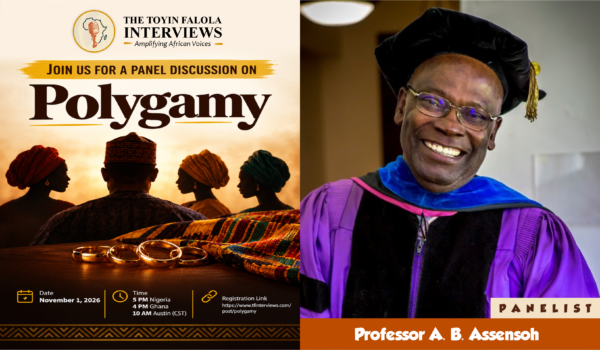
Prof. A. B. Assensoh also presented a very insightful perspective on this issue in that he had a well-formed opinion regarding polygamy because he grew up in a polygamous household while choosing a different marriage practice. Prof. A. B. Assensoh is an ordained Baptist minister, and it is clear from his work that he does not support practicing polygamy in any way. However, he respects those who practice it responsibly. His personal history provided a compelling illustration. His father had six wives and 48 children, of whom Assensoh was the 36th. Coming from a traditional area of Ghana’s Ashanti region and belonging to a royal family, his father operated within a cultural environment where polygyny was encouraged. He was also a wealthy businessman with extensive farming interests and a kente-weaving enterprise. Assensoh recalled that his father explained the economic dimension of his marriages by suggesting that marriage provided women with opportunities for income and economic security. His father’s farming activities also benefited from the contributions of wives and children who participated in the household’s productive activities.
But Assensoh’s description of the practice was not entirely positive. He noted that his mother, his father’s fifth wife, ultimately left the union because it was difficult for her to stay in a union where she had access to her husband only under time-sharing with other wives. This point is quite significant since it indicates that the experience of the polygamous marriage could vary from person to person even within the same household. Although Assensoh describes an apparently amicable family environment, his mother’s experience showed its complexity. Additionally, Assensoh noted that his father used to organize meetings with his wives to discuss family matters and the future, during which he assured them of his love.
In this way, Assensoh’s argument did not fall into the trap of making it an issue of whether polygamy should be defended or condemned. His own experiences made him realize that an institution can have economic and cultural value but also present considerable problems for the people who practice it. His comparative observations from his travels in Asia helped expand the debate. He recounted his experiences in polyandry, in which he encountered women having two husbands, a marriage system he had never heard of before because of his experiences in West Africa. All marriages have their strengths and weaknesses.
Since marriage is an institution that adapts to changes in its environment, does its legitimacy depend on its past existence alone? Or must it continue only because it fulfills modern requirements of dignity, responsibility, respect, and family welfare? These questions are worth considering in the context of African communities facing changing economic environments, education, and growing knowledge about gender roles. The socio-economic conditions that helped larger families function well in the past may no longer apply. In the same way, cultural values around lineage, inheritance, and family size may also be evolving among younger generations as expectations change.
But that does not mean African societies should let go of their cultures and embrace modernity. Instead, it means maintaining culture requires thought. Traditions that cannot accommodate criticism, responsibility, and change could become obligations without becoming culture. What is not required is creating one form of marriage for all African societies, but creating forums for debate and healthy interpersonal relations. The politics of marriage in Africa cannot be discussed without discussing the politics of culture. The polygamy debate is an issue of defining African identity, interpreting religious traditions, understanding societies’ obligations to their citizens, and assessing how inherited institutions respond to contemporary developments. Polygamy, along with monogamy and any other type of marriage, needs to be analyzed not only based on cultural or religious justifications but also based on the responsibilities, relationships, and personal experiences of individuals. Therefore, the point is not whether polygamy is a part of the African culture. The point is African societies’ attitude toward their institutions.