
Toyin Falola
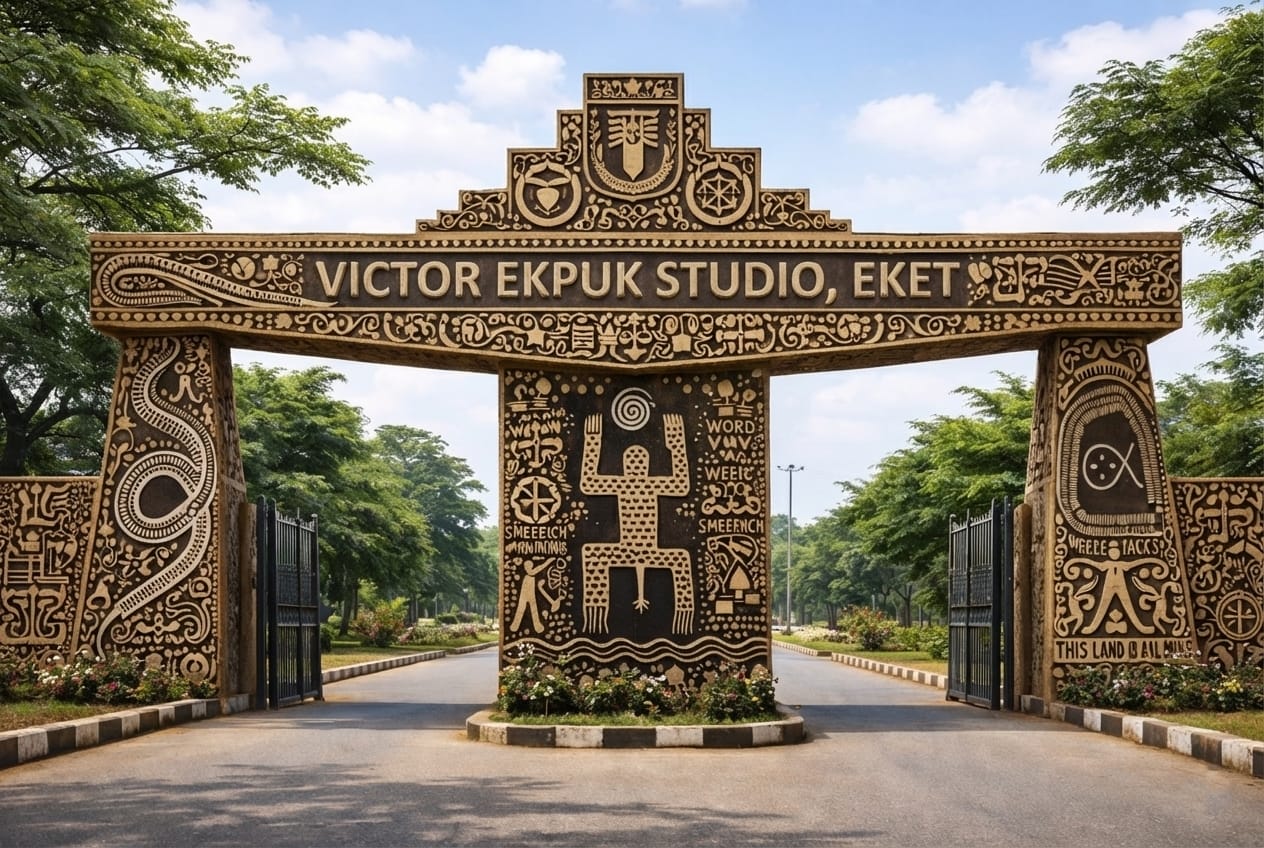
The Victor Ekpuk Studio at Eket: Imaginative Possibilities
Nothing else dominated my discussion with Victor Ekpuk far more than his lifelong ambition to create a studio in his hometown of Eket. I visited two possible sites. In this closing piece, I offer my elderly advice, drawing on my rich experience and visits to studios and galleries across Africa. If you are not familiar with this territory, you can start by viewing some of the popular studios in West Africa.
https://www.artreport.africa/post/7-alternative-art-schools-to-visit-in-west-africa?
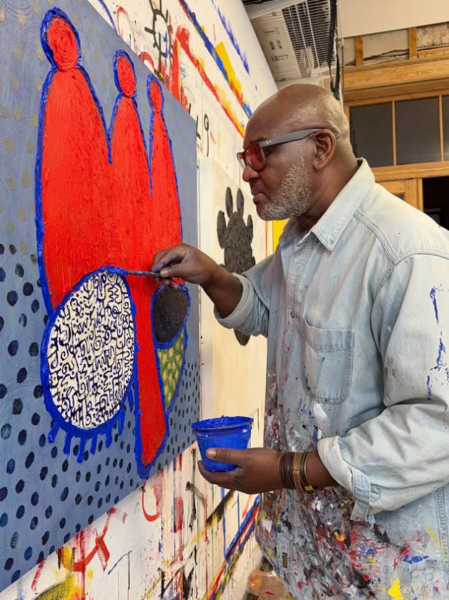
The studio practice of Victor Ekpuk should be mapped at the dense conjunction of memory, symbol, and diasporic refiguration. Drawing on the ancient graphic system of nsibidi and the aesthetic registers of Uli, Ekpuk elaborates a visual lexicon that negotiates the tautology between history and modernity, communal signs and personal expression. I want to imagine Ekpuk’s studio as an epistemic site, a crucible through which material, myth, and the metropolitan realities of the contemporary artist meet. By comparing and contextualizing his practice within the larger African legacy-studios and retreats of G.A.S. by Yinka Shonibare, Bruce Onobrakpeya’s Onobrak Art Centre and Harmattan workshops, El Anatsui’s collaborative studio-atelier, and Kehinde Wiley’s Black Rock residency in Dakar, we can recalibrate the discussion and reconsider the question: What is a studio for today’s African artist?
A studio should not be only a place of work; gestures, choices, and narratives mark it. In the modern African context, it acts as an archive and pedagogical space oriented towards the public. Victor Ekpuk draws, paints, and should sculpt his studio as a site of recuperation: ancient sign systems, intergenerational memories, and formal rethinking of African modernity. In Ekpuk’s practice, there must be an insistence that a studio is indeed a site of disciplined play. It is here that ancestral scripts such as nsibidi are not relics but active grammatical material for a contemporary idiom.
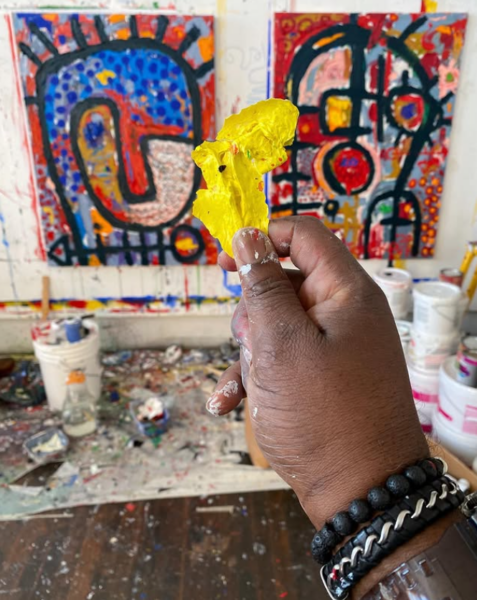
Victor Ekpuk, born in 1964 in Uyo, Akwa Ibom State, has a formation that cuts across local and global geographies, from Nigerian art schools to diasporic engagements in the United States, where he is currently based. This is an ongoing affair with nsibidi, the cryptic, ideographic writing system of southeastern Nigeria, in which a long line of artists has recovered the indigenous knowledge systems to contest universalizing art histories. The symbols on Ekpuk’s canvas are not decoration; they are syntactic units, replete with mnemonic, epistemic, and ethical force.
Ekpuk’s line is the index of voice, of ritual, of memory. The nsibidi signs he mobilizes are transformed, recomposed, inverted, and sometimes deprived of literal legibility so that they might enact sign and signifier simultaneously. Enacting this double movement between legibility and opacity, the politics of refusal plays out: the refusal of the demand for transparency produced within the logic of the colonial archive. Ekpuk’s drawings and paintings thereby insist that African visual languages have their own hermeneutics; they demand that viewers slow down and learn to read otherwise.
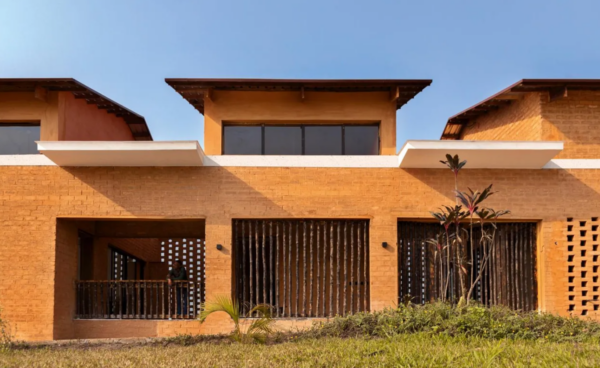
Across the continent, studios have emerged as sites of transmission and training. Yinka Shonibare’s G.A.S. Farmhouse speaks to one model in which retreat, ecological practice, and cultural exchange come together—it is a studio-as-residency that privileges long-form experimentation. Bruce Onobrakpeya’s Onobrak Art Centre and its Harmattan workshops are another variant: studio as a site of intergenerational mentorship and printmaking pedagogy. The atelier of El Anatsui, characterized by collaborative production, the employment of assistants, and radical material recycling, shows how the studio can function as a social enterprise and community of craft. Kehinde Wiley’s Black Rock residency in Dakar reframes the studio as an infrastructural investment in African cultural futures. Of these models, each one believes what a studio can be. I think Ekpuk’s practice speaks to all of them, yet remains singular in its semiotic emphasis. Ekpuk’s studio, whether in Washington, D.C., or during residencies, works with the same double attentiveness to craft and cosmology. It holds the humble instruments of drawing—the graphite, ink, and paper—but also the prolific ledger of cultural forms: books on nsibidi and Uli, field notes, photographs, and transcriptions of oral histories.
.jpg)
The works in the studio are not incidental; they bear witness to a practice that is at the same time scholarly and practical. Ekpuk’s preparatory drawings function as field notebooks, his larger canvases as archives of recomposed symbol-forms. Ekpuk’s art is as much ethical as it is aesthetic. In excavating and reworking nsibidi, he generates an ethics of seeing—a demand that viewers attend forms that encode communal norms, rites, and moralities. The recuperation of a visual language is intrinsically an act of political return of epistemic dignity to systems marginalized by colonial modernity. Imagination is not fantasy alone in Ekpuk’s studio; it is a disciplined reconstruction of inherited cognitive tools. Yinka Shonibare’s retreat and foundation speak to a pedagogy of sustainability and exchange. G.A.S. Farm House offers the artist time and ecological space to test ideas, reminding us that the studio can indeed be rural, regenerative, and community-oriented. Bruce Onobrakpeya’s workshops point to the centrality of the studio to the transmission of technique, particularly in printmaking and etching, rendering contemporary practice through local craft lineages. El Anatsui’s studio is similarly instructive in its model of collective labor: assistants and technicians stand at the core of realizing these monumental, modular works that explode conventional studio mythologies of the solitary genius. Kehinde Wiley’s Black Rock residency speaks to how even private, indeed luxurious, studio infrastructure might be oriented toward wider cultural diplomacy and the building of creative ecosystems in Africa. While sharing with those studios the institutional impulses, Ekpuk maintains a semiotic focus singularly his own. His studio should be less a factory of production than a laboratory for the making of signs. Ekpuk’s engagement with scale, from intimate inkworks to ample canvases, reflects the flexibility of register: his nsibidi-derived forms can intimate close, private intimacies and assert public civic commentaries. Within the diaspora, the studio now serves as a site for reconciling multiple temporalities; Ekpuk’s work maps the distances between origin and displacement, ritual and cosmopolitanism.
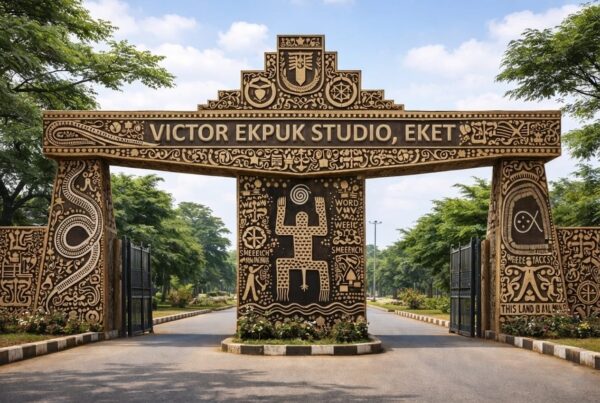
Ekpuk’s media footprint, across galleries, museums, and social platforms, attests to this practice, straddling scholarly seriousness and public intelligibility. His official website and Instagram present an artist who is aware of both the archival record and community reach. The public dimension of the studio invites dialogue: exhibitions and residencies create moments when the visual grammar he reconstructs meets diverse publics, challenging familiar narratives about African art’s supposed marginality.

What does Ekpuk’s imagined studio suggest about future artistic imaginaries? First, it indicates that recuperation of indigenous visual languages will continue to offer fertile grounds for political critique and aesthetic innovation. Second, Ekpuk’s practice gestures toward hybrid pedagogies, where the studio becomes a site for both research and making, an academic laboratory and a craft workshop. Third, by operating transnationally, Ekpuk can model how studios can mediate diasporic conversations-allowing African visual grammars to travel, adapt, and transform. Victor Ekpuk’s studio should exemplify emergent African modernity, which privileges memory and semiotic complexity. His studio must be a moral engine, in that it insists on the dignity of indigenous expressive systems; it is epistemic, in that it reconstructs ways of knowing that the colonial archive attempted to erase. When read alongside studio models of Shonibare, Onobrakpeya, Anatsui, and Wiley, Ekpuk’s practice reveals the plural possibilities of what a studio may be: a sanctuary, a school, a factory, and a temple.
Àṣẹ
orchids, toyin, for this 5-piece, comprehensive essay that is compelling as a reportorial, a scholarly exegesis, an experiential narrative, and a critical, motivational notations aimed at assisting victor in determining what,, ultimately, the carapace of his dream studio should look like. you have already intuited what the soul
and intellectual spirit of such a studio might be. victor could not have had a better advocate than toyin. who, among us scholars, artists, and public intellectuals, would spend so much time with an artist all on our time, and then proceed to share such comprehensive thoughts, except one who is possessed by the falola spirit of pleasurable inquisitiveness?