

By Toyin Falola
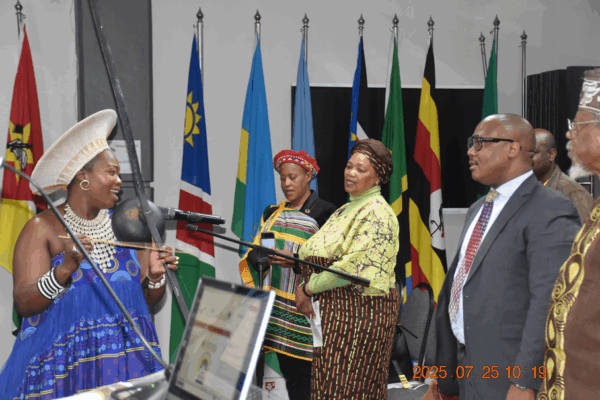
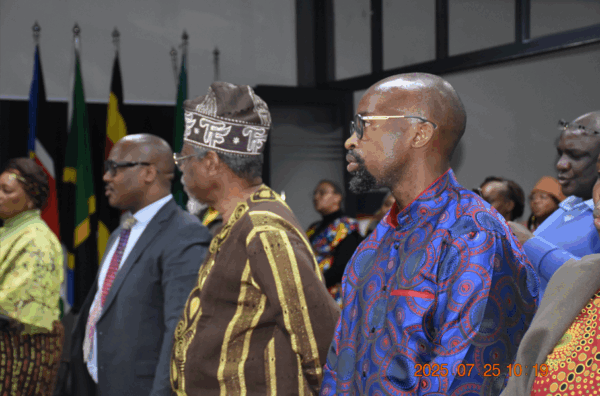
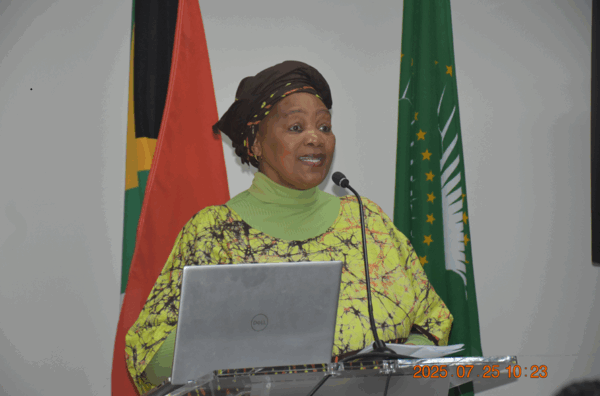
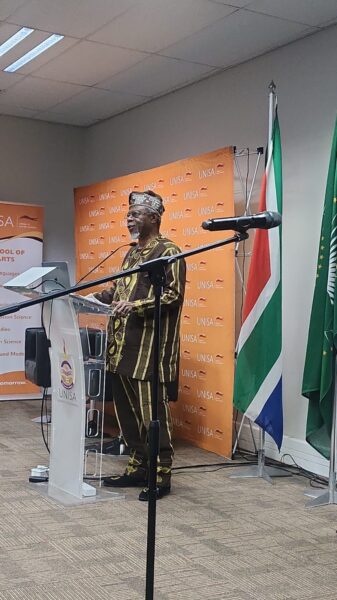
I am delighted to be a Keynote Speaker at the 2025 World Kiswahili Language Day, held at the University of South Africa on July 25, 2025. Language is not just a tool; it is the breath and soul of the people, the drums of memory, and the seed of their mind. In Africa, the suppression of indigenous languages under the colonial government was a function of a silent mechanism. Scholars and cultural activists like Ngũgĩ wa Thiong’o and Kwesi Prah have made significant efforts to help restore what the colonization of Africa erased, drawing from the wealth of oral tradition, cultural sovereignty, and African selfhood.
In “Selected Works of Chief Isaac O. Delano on Yoruba Language, Yoruba Creativity, and Encyclopedia of the Yoruba,” I explained that language serves as a medium to assert identity and recover indigenous intellectual traditions. As in practice by Ngũgĩ wa Thiong’o, who transformed language into political praxis. His use of Gikuyu, his native language, was a radical move of literary and intellectual defiance. For Ngũgĩ, language was a means of speaking to his ancestors, where memories reside, and where decolonization begins.
Ngũgĩ’s works were not just literary milestones; they were acts of defiance, rooted in lived experience and deep love for his people. Growing up in colonial Kenya, he witnessed firsthand how language separated children from their roots. In school, Gikuyu, the language of his mother’s lullabies, his elders’ proverbs, and his community’s wisdom, was labeled backward and forbidden. English was the language of reward and aspiration, while Gikuyu became associated with shame. This painful split between language and identity haunted him, and it eventually became the foundation of his life’s mission.
As someone who has witnessed the cost of silence, Ngũgĩ speaks with urgency in Decolonising the Mind (1986), when he critiques systems and speaks for generations that have been forced into silence. Writing Caitaani Mũtharaba-Inĩ, Matigari, and Mũrogi wa Kagogo in Gikuyu was not mere literary choices, but a return to the homeland. It was an act carried out of trust in the language that raised him, and a gift to readers who had long been told that their stories were only valid when told in a foreign tongue.
Ngũgĩ was not resisting English by using an indigenous language, but rather restoring dignity. He understood that language shapes how we see the world, how the world sees us, and therefore is not neutral. By reclaiming Gikuyu as a language of literature, philosophy, and power, he was reclaiming the right of African people to define their realities.
His use of Indigenous language went beyond aesthetics; it was also about the recovery of memory and community, serving as a political tool. His belief is rooted in the assertion that language is not just to be studied; it should be celebrated, expanded, and honored. In Yoruba Gurus: Indigenous Production of Knowledge in Africa, I highlighted that Yoruba scholars were not only knowledge bearers but also linguistic innovators. Their mastery of proverbial speech, chants, and oriki (praise poetry) shows that African languages are vehicles of profound philosophy.
Scholars like Isaac O. Delano in his pioneering texts, such as Modern Yoruba Grammar and Àtúmọ̀ Èdè Yorùbá, were among the first to treat Yoruba as a modern intellectual language. Through works such as these, the Yoruba language was repositioned not as folklore, but as scholarship —structured, systematic, and worthy of academic reverence. In Yoruba Creativity: Fiction, Language, and Songs, the interweaving of language, music, and performance in Yoruba cultural expression is well discussed. This highlights the significance of idioms, rhythms, and storytelling traditions in Yoruba cosmology and ethics. It also emphasizes that Yoruba is not a language of the past, but of the present and the future, like Ngũgĩ’s affection for the “language of memory.” This shows that language is a living storehouse of cultural and intellectual knowledge. We need to fight against the loss of African languages from the academic canon and support their use in modern research.
Professor Kwesi Kwaa Prah studies all of Africa’s languages, while Ngũgĩ examines some languages and communities. Prah’s work through the Centre for Advanced Studies of African Society (CASAS) advanced the harmonization and intellectualization of over 2,000 African languages into roughly 100 mutually intelligible clusters. Prah argues that linguistic diversity should not be viewed as a developmental liability, but rather as a rich resource for nation-building. He famously said, “No language, no culture; and no culture, no development.” Like Ngũgĩ, Prah views language as a condition for liberation, not merely for cultural survival but for intellectual autonomy.
The future of African languages depends on how politics, culture, and scholarship work together. There are many challenges facing African indigenous languages, such as the legacy of colonialism, globalization, and a lack of support from institutions. Colonialism made it such that local languages could only be used in casual circumstances. English, French, and Portuguese are among the European languages that have become the primary languages for government, education, and intellectual discourse. In the modern era, language hierarchies are still in existence, as most African countries continue to use colonial languages as their primary languages in schools, governance, and for business. The Indigenous languages continue to seem inadequate and outdated as the global languages dominate the media, education, and government sectors, widening the relevance gap between them and indigenous languages. When a child cannot express their thoughts, dreams, or pain in the language of their grandmother, something irreplaceable is lost, not just vocabulary, but worldviews.
It could change the languages that younger people already speak when they learn to speak more common ones. This is what people refer to as a “language shift.” This could be due to urbanization and social and economic constraints. These languages are also more likely to become extinct due to a lack of instructional materials or government funding. Schools, markets, courtrooms, and the media should employ African languages more. Ngũgĩ calls this “linguistic justice,” and we must implement it by recording, organizing, and teaching.
Reform groups in education must urge schools to offer instruction in more than one language, with the primary language being the most important. Students learn more and gain a better sense of their cultural identity when they are taught in this way. New technologies, such as mobile apps, social networking sites, and AI, can make it easier to create and share content in native languages. Prah’s CASAS language harmonization project is a fantastic example of how to employ African languages in schools, government, and communication across countries. However, across the continent, a quiet revolution is underway. In Nairobi, Lagos, Dakar, and Cape Town, young Africans are writing poetry, making music, and building apps in their indigenous languages. To turn this revival into a transformation, we need action at every level.
Language plays a vital role in the psychological well-being and self-esteem of African people. The devaluation of one’s native tongue equates to the devaluation of their sense of identity. There should be a reinstatement of African languages in the education, government, and media sectors, allowing people to reclaim their psychological integrity and recover linguistic spaces. Generational mental colonization can be dispelled, and the ability to dream, reason, and feel in one’s Indigenous tongue can all be recovered to recapture the sense of belonging to a particular group. The experiences of Ngũgĩ wa Thiong’o expose the internal conflicts created when language is alienated from self-expression. For Africans to be genuinely liberated, it must start from their psychology. Language plays a key role in this by acting as a mirror, helping Africans see themselves as intelligent in their cultural contexts.
Language policy should be inclusive of everyone, and governments should allocate resources to establish local language classes and train teachers. Schools and colleges should oversee the writing down, standardization, and publication of materials in African languages. We must forge ahead with further efforts and more drastic measures. The aim is not to revert to any ideal past, but to model a future for Africa that is diverse, multilingual, and unrestricted in terms of learning opportunities.
Although colonial languages may be used for international commerce, the local economy can thrive better, especially when people learn to transact and invent in their indigenous languages. For instance, agricultural services, healthcare plans, and financial programs can be more effective when delivered in indigenous languages that the people better understand. There should be investments in technology to translate digital tools and the entrepreneurial curriculum into indigenous languages. This would help nations unlock the creativity of the majority of their populations, who have been linguistically marginalized from the formal economic systems, as language extends beyond culture and education. It also forms the foundation for sustainable development.
Individuals must possess the ability to learn in their indigenous languages; an Igbo should be able to learn arithmetic in Igbo, a Wolof should compose poetry in Wolof, engage in philosophical discourse in Kiswahili, and develop software compatible with Yoruba. We must concentrate on heeding the wisdom of our ancestors as conveyed through songs, rites, lullabies, and proverbs.
Knowledge from proverbs about planting seasons, folktales of balance between humans and nature, taboos for the protection of sacred groves and rivers, is evidence that African languages serve as a repository for centuries of ecological wisdom; therefore, they promote environmental sustainability. This knowledge is often passed down orally from one generation to the next; thus, when languages go extinct, the knowledge dies, and there is an encroachment on environmental ethics. With the problem of climate change currently plaguing the globe, tapping into native environmental knowledge becomes essential and urgent in providing alternative solutions. To this end, the reclamation of indigenous languages is also connected to ecological responsibility. To ensure that Africa is linguistically free in the future, we must revitalize these languages, and our knowledge must be comprehensive.
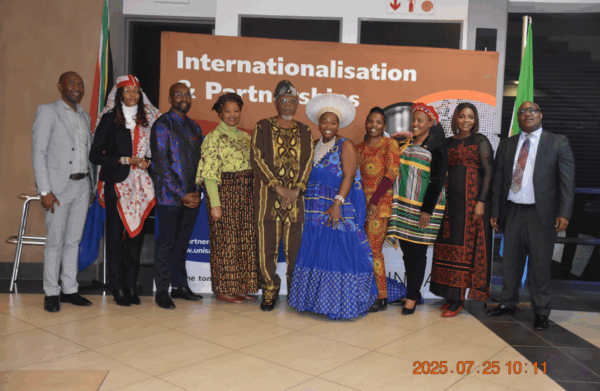
Swahili Afrika and UNISA Celebrate World Kiswahili Language Day – July 25, 2025
https://www.flickr.com/photos/toyinfalola/albums/72177720327884660
Thank you for the wisdom indeed it is necessary and important for us to not shift for our identity and encourage also generations to come to know and understand the importance of knowing our roots and identity. The is a difference between democracy and domination. I must say this is very interesting and important topic ever .Thank you