
Toyin Falola
When Professor Akin Alao requested to see me in Ibadan on November 27th, 2025, I expected a social interaction. No. He came in his capacity as the Dean of the Faculty of Arts of Emmanuel Alayande University, Oyo. The new initiatives were well articulated, and we joined the Vice-Chancellor on the phone, who relayed his own enthusiasm. The broad framework is good, and I am attracted to two of them.

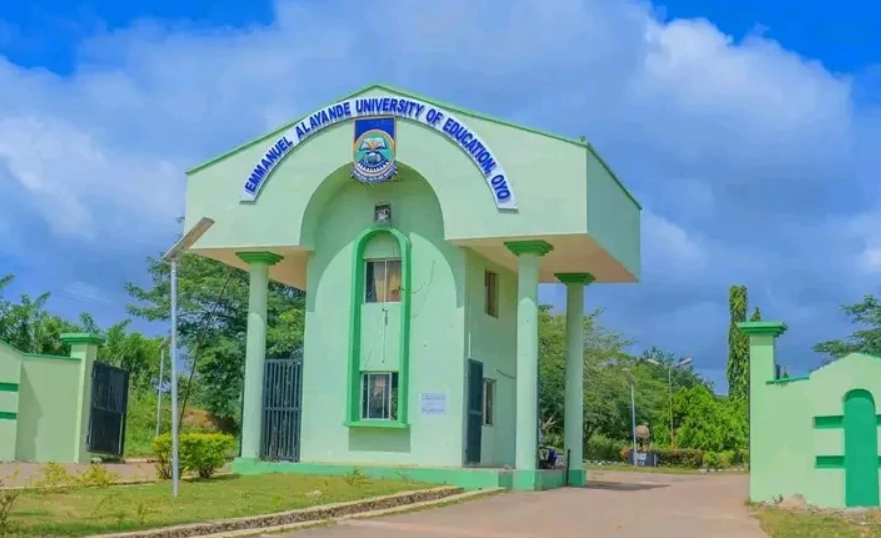
In Oyo State, a tertiary institution, Emmanuel Alayande University of Education, approaches an epoch-making moment in its history as it aims to reintroduce itself to the academic scene as a source of producing African knowledge, whilst also reintroducing the Yoruba culture as a nucleus of global academic discourse. In this era, when many tertiary institutions still struggle to define their identity, purpose, and relevance, Emmanuel Alayande University of Education charts a steeper path, fashioning its future from the material of its cultural inheritance and developing an academic system that will compete with the best available globally. The new ideas brought to the fore to push this ambition are the establishment of the Alaafin Institute of Yoruba Studies and the establishment of Imodoye: A Journal of Discourses in the Humanities. I object to both titles, while endorsing their significance. There is no point adding “Alaafin” to the name of the Institute in a politically volatile environment, and the gerundium of “discourses” in the journal is unnecessary.
On the 16th of June 2025, the Senate of the institution convened, through a seven-member committee, to deliberate on the establishment of the Alaafin Institute of Yoruba Studies. On the 27th of the same month, the committee held its inaugural meeting, gathering some of the best minds in the institution across linguistics, history, education, cultural studies, and specialized fields. The collaboration of these scholars, backed by an operational research template and deliberations that were gathered through a shared collaborative platform, the committee was able to develop a comprehensive blueprint for a cultural manifesto that understands how the Yoruba culture can be a globally influential intellectual tradition with an epistemology structure that encompasses the fields of literature, philosophy, medicine, aesthetics, governance, spirituality, science, technology and artistic performance.

Its recognition of Yoruba culture as an evolving and sophisticated epistemology is evidence of the institution’s aim to bridge an academic disconnect that has long been neglected. The Yoruba culture is globally popular, especially in places like Cuba, Haiti, North America, Brazil, the Caribbean, and Europe. However, there are a few academic institutions devoted to a comprehensive, interdisciplinary study of Yoruba culture. This disconnect is what Emmanuel Alayande University of Education seeks to redress. By establishing its Alaafin Institute of Yoruba Studies, which has been described as a “Centre of Academic Excellence for Yoruba Studies,” the institution aims to build a world-class intellectual space for research, teaching, archival documentation, cultural preservation, digitization, and community engagement. With this plan, the institution envisions itself as a clearinghouse of Yoruba knowledge, where future generations of scholars are bred through contact with scholarship, history, creativity, and innovation.

The mission of the proposed institute is to conduct novel interdisciplinary research toward the development of programs that train undergraduates, graduates, and postgraduates for the documentation and digitization of endangered Yoruba heritage, the publication of accessible and rigorous scholarly submissions, the direct engagement of indigenous and diasporan Yoruba communities, and the implementation of Yoruba knowledge to solve contemporary problems. The proposed institute is also innovative, as it aims to make Yoruba epistemology a solution to future issues in environmental sustainability, technology design, conflict resolution, ethical philosophy, medicine, and administration. In a broader sense, this mission aligns with the African goal of decolonizing knowledge and restoring the long-neglected African epistemology.
Several positions back the establishment of the Alaafin Institute of Yoruba Studies. The Yoruba culture is globally popular, and its legacy, oral tradition, rituals, dialects, crafts, philosophies, and performative arts continue to be submerged under modern pressures. This problem cannot be adequately or effectively corrected by implementing academic disciplines scattered across regular departments. Therefore, dedicating an institute to solving this problem is a practical solution, as it offers focus, structure, visibility, and intentionality. This institute can serve as a research space, a repository of Yoruba knowledge, and a meeting place for scholars, practitioners, and diasporan Yoruba seeking to reconnect with their roots. By establishing this Institute, Emmanuel Alayande University of Education, on the one hand, strengthens its academic veracity and, on the other hand, takes a position as a guardian of culture.

The Alaafin Institute of Yoruba Studies is also blessed with an excellently detailed plan. Academic programs, research facilities, archival and digital facilities, administration, community partnerships, and pathways to sustainability, among others, are all meticulously defined in the plan. Educational programs range from undergraduate to doctoral, and the Institute also offers certificates in Yoruba traditional medicine, indigenous legal systems, Yoruba performing arts, and diasporan studies. Research will be integrated through a program of inquiry defined by an interdisciplinary template that draws on history, linguistics, medicine, metaphysics, ethics, Yoruba values, and material culture, among other fields. The Institute will house a Yoruba language corpus, an archive of Yoruba heritage, a digital humanities laboratory, and a journal of Yoruba studies for online and print publication. Smart classrooms, performance halls, exhibition galleries, libraries, cultural studios, and outdoor spaces for traditional and contemporary expressions will all be integrated into the infrastructure.
The planning committee aims to partner with local and international bodies that support Yoruba scholarship, like Goethe-Institut, the Centre for Black Culture and International Understanding, NICO, Yoruba Academy, Art X Lagos, CORA, the National Troupe, Global Yoruba Cultural Institutes, Diaspora Heritage Foundations, Guggenheim, ELDP among others to attract grants, fellowships, residencies, exhibitions and collaborative projects. The Institute’s administrative structure includes leadership from tertiary institutions, traditional rulers, global scholars, representatives, and cultural stakeholders. The Institution’s inclusion of conventional royal institutions, especially the Alaafin of Oyo and the Ooni of Ife, reinforces the deep relationship between academic scholarship and Yoruba political-cultural authority.
The remaining half of Emmanuel Alayande University of Education’s intellectual arm’s complement has its bearing on its launching of Imodoye: A Journal of Discourses in the Humanities. Imodoye is a space for ideas to thrive, for the humanities to reassert its hermeneutical vigor, and for African voices to be loud and proud in global discourses. The Journal aspires to become a space for recentering the humanities from the African vantage point, cultivating the next generation of African scholars, elevating critical voices, and propelling African indigenous philosophies and the attendant discourses in conversation with universal engagements. It may be said to have been established as the Institution’s response to an ever-evolving world, where the humanities must be more proactive in thinking, writing, and other forms of intervention.
Through these initiatives, the university becomes an embodiment of a living, dynamic, community-oriented knowledge. The university embodies decolonization of expertise as it moves away from inherited academic models toward intellectual structures that are attuned to the values of culture, heritage, and indigenous epistemology. These initiatives also position the university as a pioneer of the reimagination of Africa’s educational future, where African languages are seen as frameworks for innovation and the indigenous knowledge is thoroughly studied, documented, and implemented. The synchronization of the Alaafin Institute and the Imodoye journal can aid the creation, dissemination, storage, and interpretation of knowledge.
By positioning itself as a global beacon for Yoruba studies, the Emmanuel Alayande University of Education could earn itself a truckload of globally recognized laurels through its activities, thereby directly increasing research capacity and productivity, strengthening global recognition, and producing a new scholar stock grounded in Yoruba and African epistemological traditions. Its activities to preserve endangered cultural practices, revitalize language use, and amplify community pride will also have a positive impact on the Institution’s local and global image. Finally, its curricula, teaching resources, IT, digital aid, and advanced instruction in the Yoruba language help shape Nigeria’s cultural policy landscape and make significant contributions to cultural tourism – hence, driving revenue. Globally, the intellectual background of Yoruba knowledge will contribute to the ongoing discourse between the world and Africa, with Yoruba culture being a contributor to human knowledge.

Emmanuel Alayande University of Education, through its new plans, embarks on an intellectual renaissance and the decolonization of knowledge. Its latest plans can be regarded as an investment in the future of a knowledge system that honors the past and shapes the future in the same breath. It also stands as a reiteration that the development of Africa is embedded in its languages, philosophies, and cosmologies.
Congratulations to the University, and Kudos to Prof. Akinkunmi Alao and his team.
Very soon, we shall be receiving international students, which will make the academic environment more robust.
More wins!
This is a very comprehensive plan of action, a, detailed curricular by the Alaafin Institute of Yoruba Studies, well done our dear TF. Having gone through and digested the masterpiece, Emmanuel Alayande University of Education’s New and exploratory chapter in Yoruba Studies, stands out, and distinguished from what obtains in most similar Institutes so named. However, I like to make some suggestions that could make the Institute stand out better. There’s need to raise not only new intellectuals, but the Institute should consider sustainability of our crafts: wood carving that resonates with the great Lamidi Fakeye’s figurines, door panels, stools, chairs; I like to see trainers and apprenticeship in crafts like calabash carvings, talking drum-making; and in the area of textiles and fabrics, the Adire art and crafts, I remember that Twin-Seven-Seven was popular for training some young folks, and for taking the craft to the USA, and Europe. Let there be a wung where middle level craftsmen and women are regularly trained, and established across Yoruba making and selling of such crafts. The Chinese popularized their doors, the Institute can train interested certified Indigenous Door panel producers, too., among several other things.. A standard Museum to house indigenous crafts, contemporary is possible. At UI, there’s museum with not less than 300 figures, most of which are not contemporary arts. We got a MacArthur Foundation grants and did our best to create awareness and managed a tiny space we found. The Museum which is located at the Trenchard Hall Gallery has since gone to sleep. No one is interested. Alaafin Institute may approach UI management and ask that they be donated to its Institute where they could be better taken good care of. I am sure Chief Adedayo, the CEO Alaroye, and Prof Kola Owolabi are twosome great Yoruba culture enthusiasts. They could be approached too for support in any way they know best, to advance the objectives of the Institute. I could go on. Hearty Congratulations to the Dean of Arts, Prof. Akin Alao. Cheers. Ademola Dasylva
While I admire the context of the innovation, I have these reservation on the name of the institute bearing Alaafin. It should simply be Institute of Yoruba Studies. This will be accepted by the stakeholders of Yoruba from within and outside knowing fully well that there is Yoruba politics.. moreso if you want the certifications from the institute to be accepted and honoured and contributed to by other Yoruba because they also have their own presentations.
If this is not considered, others can start similar Institute that is devoid of politics and will be better accepted.. This is not to desparage Alaafin stool but for better acceptance.
Many thanks.