
Toyin Falola

A Panel Discussion on Nigeria in 2026
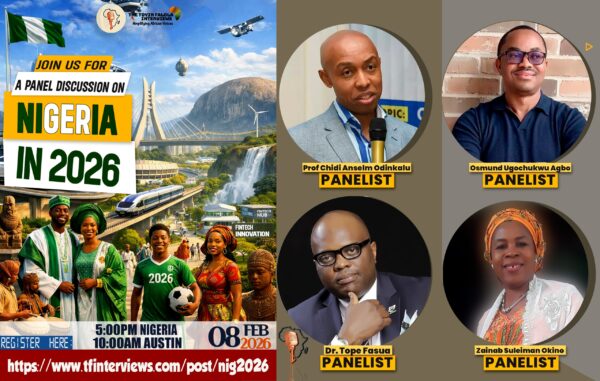
(This is the First report on a Panel Discussion on Nigeria in 2026, February 8, 2026. For the transcript, see: https://www.youtube.com/live/0OHcKiU8UrU?si=CN3Up7Es8_YFkMXD)
At the beginning of this new year, well, not so new anymore, a question flashed through my mind: What are our expectations for 2026 as Nigerians and not as mere individuals? My mind travelled to the story of Samuel, an indigene of Yalwata, Benue State, whose entire family was killed in the Yalwata June attack that claimed the lives of over 100 people. He was a security man in Lagos and was found drunk and in agony for the whole week. I then pondered what Samuel’s expectations and resolution will be for the year 2026 as a Nigerian.
As individuals and families, the new year is often a significant development, evidence of hope for a restart, and an opportunity to hold situations, things, and everything differently. We have resolutions and strategies for how the year will play out, probably based on how the year before ended, the trauma we faced, the unmet desires, and the new goals set. But, like humans, society often seeks resolutions: to move beyond restraints and shared challenges and arrive at a collective desire.
Nigeria is one of the most unique sets of people with dividing lines along different parameters, ethnic, religious, political perceptions, and other convictions that have developed over the years of our national history. In Nigeria, 2025 was not an uneventful era. The nation aspired as a corporate body, with the people gearing up for some possibilities.
Without underestimating the successes the nation had achieved, there was indeed trauma that had pushed up expectations for 2026. There are millions of direct and indirect victims of terrorist attacks across the nation, with 2025 being a very trying year for the people. Benue, for instance, was a boiling pot of attacks in Yalwata, Gwer, Kadtina-Ala, Ukum, Apa, Agatu, and many other areas. This is not to talk about the array of attacks across the whole North, particularly in the southern part of the nation.
In 2025, kidnapping became one of the most worrying battles the nation faced. There is almost no part of the country that has not felt the impact of this danger that has been brewing for too long. With over 1,000 people, mostly children, kidnapped, and many people killed along the way, kidnapping peaked in 2025. Schools, religious centres, farms, highways, and even homes became the unsuspecting traps of kidnappers, where people expected to be less disturbed. And this was not an incident confined to the North; it was suffered equally by southern Nigeria.
2025 also challenged Nigeria’s democracy. Or should I say, laid bare how slack the country could be in practicing democratic ideals? The President unilaterally removed a democratically elected governor of Rivers State, citing a State of Emergency. He expanded the limits of the Constitution as much as he could. This became one of the tragic paths of democracy and federalism in Nigeria. It set a disgraceful precedent by subjecting the constitution to the whims of the president. In the same year, the governors continued to resist the call for local government autonomy. They outrightly ignored the president’s calls and particularly disregarded the Supreme Court’s decisions on the said issues. They are reluctant to allow the monies meant for the local government administration to fall into their hands—a mockery of democracy.
But those were not only threats to the sanctity of democracy in Nigeria. There were rumours of an attempted coup in September 2025. Following this, the President removed all service chiefs and retired some to sanctify the military. Following this, about 30 people were arrested in connection with the plots. Although the government has refused to address the situation fully, it has created apprehension about the Nigerian democracy.
Well, this piece is not a synopsis of what had happened in 2025; it is to highlight the fact that Nigeria has perennial problems. They eat into our system and leave the nation to bear the consequences. The problems of 2025 were not those created in the year; they were long-standing national challenges that the people and their government had failed to take a strong stand against. Well, 2026 is another important year in the nation’s trajectory in almost all respects. It is the year preceding the elections, it is full of anticipated projects, and the hope of a good standard of living.

Although citizens have grown accustomed to negative news and events, they still have a strong expectation of a better Nigeria. It could be that year the people have been dreaming of. It could be that, in that year, doctors, teachers, civil servants, and others expect uninterrupted payment of substantial salaries. It is that year when students hope there will be no academic interruptions. It is the year that farmers and villagers won’t be attacked. It is the year of some collective expectations, whether openly said or not. Nigerians, in short, hope for a change.
However, without dashing these expectations or describing them as the wishes of beggars, I have messages for two groups: Nigerians and the Nigerian Government. I believe this should be a year of renewed serenity. However, there have been incidents of tolerance toward many Nigerians who believe they owe the nation no loyalty, thoughtfulness, or resourcefulness. I mean, it is counterproductive to be that committed to a cause that has only dashed one’s expectations and ambition.
I am convinced that the people are the conscience of the nation, not even the leadership. The great revolutions that have happened in history have always been led, or inspired by, the people and nothing else. If we are not careful enough, truly, the nation would soon be a desert where nothing grows. It may look quite odd, but I plead that Nigerians forgive Nigeria this year. For all they’ve lost, and all disappointments that cut through the people’s hearts, the nation is even more we could win back. I implore all to give the nation a second chance.
The new sense of citizenship is that the people think first, independent of the government. We now need to focus on driving the nation’s trajectories through economic, social, and political commitments. Visits to places like Alaba International Market and other commercial centres have shown how industrious the nation can be. Where everyone has an industrious mind, there is much more we can do for ourselves. It will affect the workforce, the standard of living, and, eventually, the cost of living. I believe that while not everyone in Nigeria can be a Dangote, it is possible to start a business with at least N200,000, no matter how small. We can set up that small-scale farm and run a side hustle while working those 9–5 jobs. The result is not just adding to Nigeria’s economic statistics, but also economic independence for Nigerians without waiting for government intervention.
It is often the case that how industrious people are determines the scope and structure of foreign investment that will have a positive impact. I really wish everyone who can afford a start-up could stick it out so that we can move beyond dependency.
More so, many of the challenges and disruptions are fuelled by covetous influences and leaders. When citizens are kept engaged, crime rates drop. The longing for work and sources affects the trajectories of crime avoidance. However, citizens and communities must take action to protect their homes from crime. Security has to be the citizens’ core objective.
It is time for citizens’ actions; it is time for the people to take control of the political state of the nation. 2026 is enough time to prepare for the eventualities of 2027. It is time to put all personal advantages aside and hold every politician to account. I am not even talking about the presidency alone, but the local government officials, state Honourables, and other politically elected officials. 2026 should be a foundation for the citizens’ day of reckoning and accountability, if this can inform preparation for the general election and the eventual elections.
And to those in government, a sense of citizenship is an expectation of the people. The leaders must also rediscover that they are citizens first before the billions they steal. Where leaders are true patriots, leadership returns to the people through them. I believe the root cause of Nigeria’s problems is not only bad leadership, but also unpatriotic leaders who put themselves above the national agenda and the nation’s needs
While in a popular city in Nigeria, I discussed the governor with a group of drivers who had heard bad things about a politician. They pointed to the roads and other projects the governor had carried out. I realised that what he had done had not been extraordinary; he only provided the minimum, and the citizens became pleased with him. If an average Nigerian office holder could do just the minimum, it would answer the yearning of the people. The minimum is the least the people want, but the predominance of unpatriotic leadership in the country will not allow such realisations. The politicians must see themselves as citizens and wear the shoes that pinch the people, too. The Nigerian leaders must be citizens too, and also become citizens in action.

Finally, where citizenship is the hallmark of leadership and the direction of policy, it goes to the root of the nation’s present and future. Where citizenship is demonstrated through leaders’ policies and actions, it will automatically rekindle collective patriotism. That is the starting point of development, that may even be all we need. Hence, it will lift us above the failures of 2025 and chart a new course for the nation.