
Toyin Falola
Drug Use in Nigeria
Drug use in Nigeria has metamorphosed over the years from a disregarded social issue with little concern into a national crisis that requires urgent attention. This crisis takes centre stage, as it touches virtually every layer of Nigerian society, spreading like a pandemic. Sometimes in the past, the use of drugs has been erroneously tagged and associated with limited insights, with criminal subcultures, or the marginalized urban spaces. However, in truth, drug misuse cuts across various age groups, social classes, professions, and even educational levels.
It is not unknown amongst secondary school students. Even professionals and learned individuals of high reputation have been reported as dependent on prescription stimulants at a frightening rate. This proliferation reflects a modern reality within Nigerian society. This is because drug use in Nigeria is not just because of an individual’s moral failure, but a culmination of other mitigating factors such as economic hardship, weakened institutions, cultural misconceptions, and continuous system neglect. As Nigerians grapple with the consequences, the use of drugs immensely threatens societal stability, national development, public health safety, and the country’s image globally.
Within society, the effects of indiscriminate drug use are both outspoken and insidious. Many communities have experienced a spike in insecurity, particularly in communities where substance dependence has become instrumental in violent acts like cultism, armed robbery, ethnic cleansing, kidnapping, domestic abuse, and reckless behavior. In the heights of this violence, families lose their loved ones, cherished properties, and sources of income, in addition to suffering psychological losses.
As a result, many families break under the emotional and financial weight of addiction and violence due to drug use. This is often accompanied by a cycle of denial, shame, silence, and suffering with no help in sight. By extension, schools within these communities struggle to perform with a visible decline in school discipline and overall academic performance, as learners arrive impaired, distracted because of drugs, directly or indirectly.
When that happens, societal-level issues and deeper issues of trust come to the surface. When drug use becomes widespread, societal values such as responsibility, self-restraint, communal care, empathy, and long-term planning are compromised. They become weakened, leaving communities less cohesive and more vulnerable to social dysfunction.
By default, these events cumulatively affect national development. As it is, a nation’s progress depends significantly on how destructive and creative it is, how often it uses them, and what can be left unchecked. For example, persons suffering from drug dependency are more likely to experience a reduction in their cognitive functioning, poor health, which can translate to taking sick leaves, absenteeism, and demotivation at work. Collectively, this pattern strains their deliverables at work, resulting in lost economic output.

In response, when these conditions persist, the government is then forced to take actions, diverting scarce public resources from beneficial endeavours such as investment in education, infrastructure development, or innovation to law enforcement, healthcare interventions, and rehabilitation, yielding little success due to systemic inefficiencies. Over time, a pattern emerges, creating a vicious cycle of drug dependency that leads to economic loss for employers, underdevelopment for the dependents who feel despair, and then relapse into drug use again.
Globally, the effect of drug use on the nation fuels concerns. The country’s image amongst partners on the international stage bears the weight of this crisis. Global narratives in recent times continue to link the country as being strategic to drug trafficking routes, with increased reports on pharmaceutical misuse and unregulated drug markets.
Even though the possibility that such narrations may be exaggerated or selectively targeted at the nation may seem plausible, the increasing focus on this aspect of national crises has gained credibility, particularly as Nigeria’s domestic systems have failed to curb abuse or regulate distribution effectively. As is typical of bad representation, the portrayals paint a distorted image of the country to foreign partners, straining investment opportunities, diplomatic confidence, and the mobility of Nigerian citizens abroad.
Very specific to the Nigerian context are several interconnected factors that explain the growing prevalence of drug use in its society. Of all factors, poverty plays a central role. Statistics show that a significant percentage of youth populations in many countries are underemployed. With no certainty, individuals are seeking drugs to escape frustration, boredom, despair, or taking drugs as a coping mechanism, preferably drowning in them instead of being helpless. A proper social safety net would have been more effective in this case.
Additionally, systemic governance failures have reinforced these crises. Presently, drug regulations in Nigeria exist but are weak. These weak regulations allow pharmaceutical drugs to circulate freely without oversight. The weak regulations, in most cases, stem from the corrupt practices within enforcement agencies, undermining drug control policies and enabling open markets where controlled substances are sold with impunity.
Rural and urban migration is another reason why drug use is widespread. In recent years, Nigerians have moved from rural settlements to urban areas to seek better opportunities. As a result, there are strains on available resources within these urban communities. By implication, these areas become overcrowded. In no time, people begin to scramble for the limited resources in these communities. In the absence of corrective social planning to tackle these crises, such as the provision of recreational facilities, mentorship structures, and positive outlets for youthful energy, youths in these areas may use drugs to fill the vacuum left by absent institutions.
A critical misconception that needs to be addressed on this subject matter, particularly as it worsens the crisis, is the fallacy that drug abuse is limited to the use of “hard drugs” such as cocaine, heroin, or methamphetamine—this perpetuates the falsely manufactured substances. For instance, codeine-based cough syrups, tramadol, benzodiazepines, painkillers, energy drinks, and even antibiotics are popular.
A significant number of the Nigerian population in this category do not see themselves as drug users because they see these drugs as being socially acceptable and medically prescribed. Yet, over-dependence on them has caused long-term harm regardless of how legal they are. This myth stalls the fight against drug abuse as it delays intervention, normalizes misuse, and allows addiction to progress unnoticed.
Ironically, Nigerian healthcare institutions often contribute to the fact that, unknowingly, users are unaware of the use of herbal medicines. In demand, vendors often operate outside regulatory limits, recommending potent drugs without medical assessment. Also, many low-income earners resort to self-medication when drugs are too expensive, reinforcing dangerous health behavior.
Addressing drug use in Nigeria demands solutions beyond just enforcement. Even though law enforcement plays a central role, overreliance on criminalizing the acts overlooks the problem’s apparent social and psychological roots. Prevention must first start with comprehensive, evidence-based, and truly grounded sensitization.

Drug literacy should be introduced in the health curriculum beyond fear-based messaging. This should include mental health awareness, decision-making skills, and resilience-building. These efforts should be supported by communities, religious institutions, and civil society organizations working together to reshape perceived norms around substance use jointly.
At the same time, stronger regulation within the healthcare system should be investigated. Healthcare providers should be routinely retrained as necessary to prevent the use of the source. Mental health services should be prioritized, as psychological distress is best treated under clinical supervision rather than chemically.
Government and policymakers must collectively extend efforts in confronting the known motivations for drug abuse. Job creation, youth empowerment, urban planning, and social welfare programs, even though direct solutions, play a major role in reducing the crisis. When individuals experience dignity, opportunity, and social support, drug abuse and addiction are greatly reduced.
In conclusion, drug use in Nigeria is not just a public health issue but a reflection of the weakened social systems that hold nations together. Issues of hopelessness, unmet needs, and loss of ambitions are major factors leading to substance use. To confront this is to approach the matter from an intellectual standpoint, crossing and dotting the necessary points to ensure holistic success. As it is, drug use is not only a menace to the individual but also to the community and nation at large.

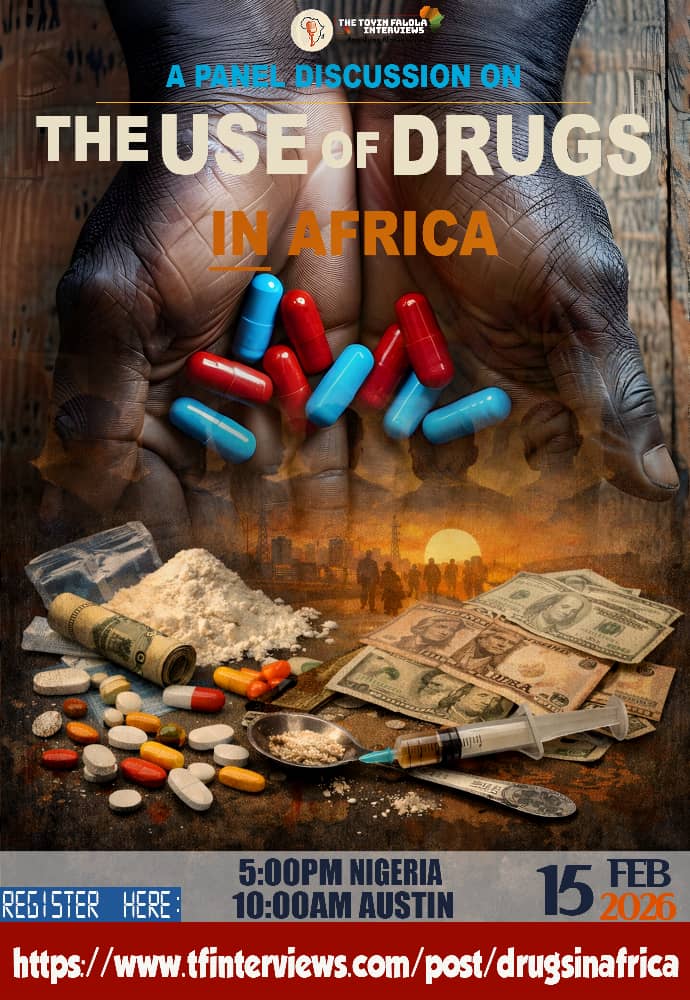
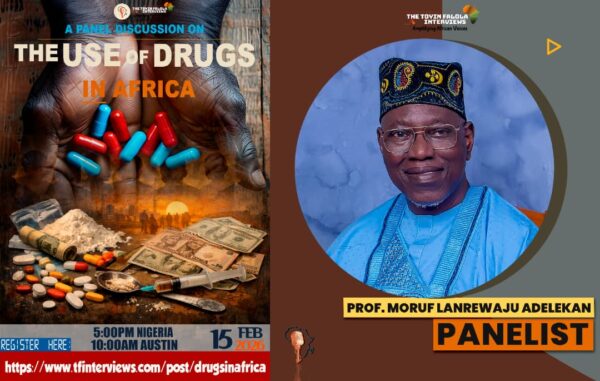
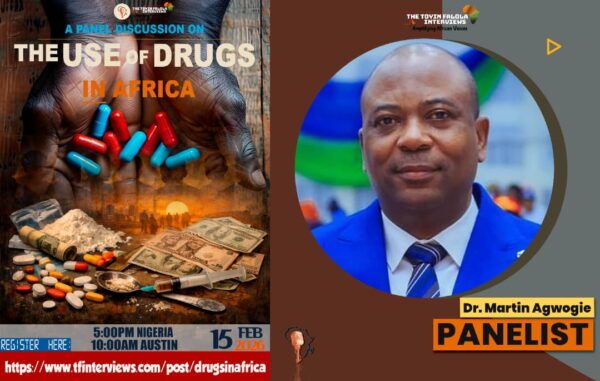
Please join us for a panel discussion with our distinguished panelists, Professor Moruf Lanrewaju Adelekan, ACGN Ibiba Odili (rtd), Dr. Martin Agwogie, and Abdulmalik Yahya who will be sharing their expertise on “The Use of Drugs in Africa.”
Sunday, February 15, 2026
5 PM Nigeria
4 PM Ghana
10 AM Austin
6 PM South Africa
Register Here:
https://www.tfinterviews.com/post/drugsinafrica
Join Zoom Meeting:
https://us02web.zoom.us/j/88647082385
Watch on YouTube:
https://youtube.com/@tfinterviews/live