

Toyin Falola

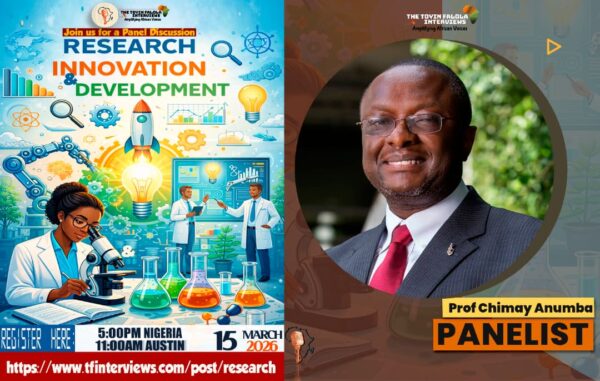
It is a pleasure to have hosted the program on this topic by some of the most eminent researchers and scholars in the world, comprising Professors Ilesanmi Adesida, Akintunde Akinwande, Chimay Anumba, and Lola Eniola-Adefeso. The recording can be found at https://www.youtube.com/live/B04Ql4R4J88?si=iKvSwIIZtL0k-5fY.
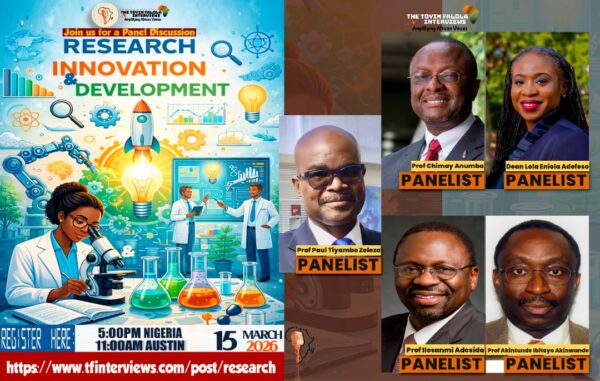
For Africa, research, innovation, and development are a central trilogy for futuristic transformation. They are the determinants of knowledge generation in society, the conversion of ideas into solution and the application of those solutions for the betterment of humanity. Research is a great determinant of economic, political, technological, and even healthcare development across the world. Thus, Africa’s capacity and ability to strengthen its research culture will play key roles in its ability to make scientific contributions to the world and in its achievement of intellectual freedom. To this end, the discourse of RID from the African perspective does not end within the walls of academic institutions, as it encompasses debates on decolonization of knowledge and resuscitation of the indigenous episteme.
Research deals with the realization of knowledge through thorough investigation, experimentation, and inquiry. Innovation is the transformation of this realized knowledge into systems or structures that can be deployed to solve societal problems, and development emerges as an aftermath of the implementation of innovation. These processes work hand-in-hand for societal progress, and for Africa, they operate within complex historical and intellectual frameworks that have been externally influenced through colonialism and inequalities in the global knowledge system.
Historically, Africa developed an indigenous episteme for centuries before it was deposed and replaced with the Western episteme through colonialism, missionary schools, and Western-style universities. Africans evolved knowledge in sectors like agriculture, which enabled the growth of their societies and ecology. They evolved knowledge in the art of metallurgy, which served as a medium for the production of weapons and farm tools, to enable socio-economic and political advancement. Their knowledge of botany and metaphysics enabled their development of a sophisticated medical system, and their knowledge of philosophy also enabled the development of complex and sophisticated bureaucracies. It is for these reasons that African scholars have strongly argued that the future of African intellectualism is heavily dependent on its development on indigenous systems and realities whilst maintaining a strong connection to the global episteme.
African knowledge is stored and passed from generation to generation through oral traditions, apprenticeships, cult groups, and artistic performances across different societies, like that of the Yoruba, Ethiopia, Swahili, and many others. However, through colonialization, these complex systems were deposed for the restructure of African intellectualism along the line of serving the Western political and economic agenda. To this end, indigenous development of African societies was halted, and these societies became more of extensions of European societies as they exhibited traits of Eurocentric education systems. The aftermath of this was the emergence of a structural imbalance, which made Westernized African universities function only as teaching institutions and not a space for original research.
Even though this constraint existed for centuries, research culture in contemporary Africa has become rejuvenated in recent decades. As evidence that the continent demands growing interest in higher education, it has developed more than two thousand tertiary institutions, with many of them leading research activities that have made potent contributions to global knowledge production. Institutions like the University of Ibadan, the University of Cape Town, and Makerere University have made several contributions to global knowledge across diverse disciplines, while the African Institute of Mathematical Sciences has also made contributions to advanced scientific training in the world. These are some key examples of the transition happening in the African academic space.
However, the research contributions can still be regarded as meagre in comparison to the African population and its developmental needs. Currently, Africa contributes less than 3% of scientific publications to the global episteme, but there are factors or hindrances that could have played key roles in this situation. First, African societies often underfund academic activities, especially research. Due to underfunding, research becomes unnecessarily tedious as scholars are unable to access adequate laboratory facilities, libraries and are unable to access some important academic journals.

Africa is also plagued by a serious case of ‘Brain-Drain’. This situation sees African human power, especially intellectuals, migrate from Africa to other continents for better opportunities in life and academic ambitions. Although diasporan Africans can still make economic and intellectual contributions to their countries, brain-drain is a problem that reduces local manpower and reduces the ability for indigenous research activities to be carried out. Alongside the issue of brain-drain, Africa is also limited when it comes to the commercialization of its research results, and this has negative effects on the process of transmitting these results into practical solutions.
Although these problems continue to exist in contemporary African societies, they do not stop innovations, especially in the urban areas where the technology industry is rapidly developing. Lagos, Accra, Cape Town, and many other cities have all become hubs for digital innovation and start-ups where technology entrepreneurs continue to provide digital solutions to African societies, markets, and problems. Their solutions have been used to address problems in the financial, healthcare, agriculture, and governance sectors, amongst many others. Several examples of African technology innovations have emerged in Africa, with a popular one being the M-Pesa – an app that revolutionized financial systems in East Africa through a system that allowed millions of users (who once lacked access to traditional banking systems) to make secure, mobile payments.
Aside from the financial sector, Africa has also experienced research and development activities in fields like agriculture, where innovations from agricultural research institutions have directly affected food security, livelihood, and environmental stability. Through innovations, Africa has been able to develop modified crop varieties that can withstand drought, pest and harsh climate conditions. There has also been the invention of technologies to inform farmers of weather patterns, soil health, and market prices. In the health sector, research and innovation activities have been intensified around the development of vaccines, public health systems, and a cure for infectious diseases. African health systems, through institutions like the African Centers for Disease Control and Prevention, responded adequately to epidemic cases like Ebola and COVID-19. The strengthened regional collaboration of data analysis, surveillance, and emergency response of these organizations has been key to their contributions to Africa and the world at large.
It has been stated earlier that Africa faces some problems when it comes to research and innovation activities, and a lack of proper funding, brain-drain, a lack of proper channels and conduits to promote research and innovative ideas have all been mentioned as hindrances. These can, however, be solved by first, the expected population sprout of African youth by the 21st century. The proper grooming of this population with adequate education and proper research funding could enable it to become a catalyst for unprecedented advancements in scientific and cultural production. Africa can also solve these problems by integrating its indigenous episteme into contemporary scientific inquiry. This would enrich scientific knowledge and also contribute to the broader project of decolonizing episteme in Africa, whilst reclaiming the dignity of indigenous episteme.
Furthermore, there needs to be a collaboration between African governments, academic institutions, intellectuals, and international partners. It is their duty to recognize the long-term benefits of research and innovation and, therefore, provide the necessary financial and intellectual commitments for the development of research and innovation. When this is achieved, proper conduits for the publication and implementation of research results and ideas must also be provided. And finally, there must also be a connection with the diaspora population. This would create a valuable opening for Africa to collaborate internationally. This opportunity would open a leeway for the exchange of knowledge for the coming generations of African scholars.
Africa’s future growth in research, innovation, and development culture rests on whether the continent nurtures and develops a knowledge-generating character. Africa’s development can no longer ride on the back of economic analysis; there has to be research and intellectualism behind it. If bureaucracy supports these developments through funding and an enabling environment (sprouting of intellectual academic institutions), Africa can harness a research ecosystem capable of making world-class scientific, technological, governing, and cultural contributions.