
Toyin Falola

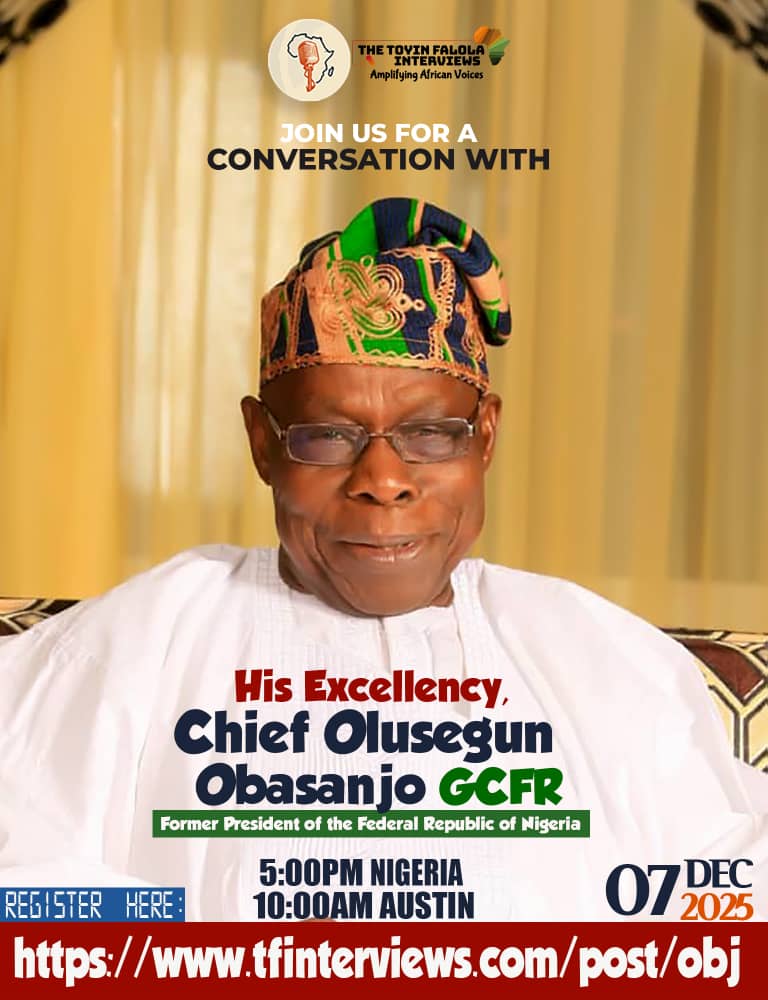
A CONVERSATION WITH HIS EXCELLENCY, CHIEF OLUSEGUN OBASANJO, GCFR, FORMER PRESIDENT OF THE FEDERAL REPUBLIC OF NIGERIA, PART 1

(This is the first report on a Conversation with His Excellency, Chief Olusegun Obasanjo, GCFR, December 7, 2025. For the transcript, see https://www.youtube.com/live/OmfDuV7dMZk?si=O77ZYc9RLj82ppka )
The widespread occurrence of terrorist attacks in Nigeria has recently caught the attention of the international community, revealing the sharp undersides of politicizing security affairs for cheap political gains. Several uncoordinated but connected attacks carried out by various terrorist groups in Nigeria are overstretching the country’s fragile unity, particularly because these attacks have taken on dimensions that are alarmingly different from what the government has previously experienced. Since the proliferation of violence under the current administration, experts have examined the tragedy of insecurities from various perspectives, many of them providing convincing conclusions as to the causes and, perhaps, the likely solutions to the resilient scourge.
The northern part of the country has been a hotbed of internal strife, driven by unscrupulous individuals motivated to pursue their parochial interests without ceasing. For instance, the Boko Haram sect has continued to wage terror on the vulnerable people in Northern Nigeria. The initial foundation of their horrendous undertakings is that Western education should be repelled and even repealed in their own environment, or anywhere their sphere of influence expands. Straightforward, but also questionable, as experience has shown that people always manufacture reasons for their insidious actions, and, whether those reasons are morally justified or not, they pursue their intentions with a ferocity that is not so common.
In recent times, at least for about a year now, the insecurity that has taken hold in Northern Nigeria is spreading to other parts of the country, beyond its initial sphere of influence. This means that the people who profess different religious faiths and hold irreconcilable ideological identities have become victims of these destructive escapades. With attacks after attacks and kidnappings reaching their boiling point, people began to make accusations, not based on emotions, as some people have argued, but on logical reasoning drawn from observing the patterns of violence in the country. The people of the North Central, whose larger population holds the Christian faith, have become targets of this terrorism. How the attacks against them grow pathetically has compelled an evaluation of this problem that puts Nigeria in a remarkably different yet challenging spotlight before the international community.
Among the popular interpretations of the violence against the people is that the killings and kidnappings are targeted at a particular faith. Whether one agrees with such a convenient position is not usually the most crucial topic of argument when things reach the breaking point. After all, death does not require how rational an individual is before it strikes. And then the narratives spread to the extent that the world’s most powerful country, the United States of America, made several comments indicating its intention to protect the Christian body from annihilation by people whose brainwaves have been programmed negatively. But then, how does the country contain this insecurity in the interest of peace and the vulnerable?
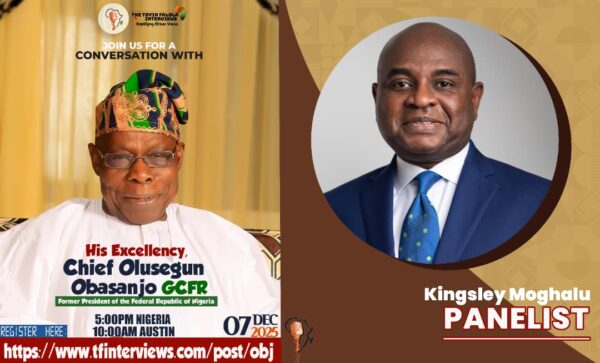
An erstwhile President of Nigeria, General Olusegun Obasanjo, offered instructive insights that can help the public better understand the problems confronting the country’s security sector. According to him, four factors must be considered when combating the recalcitrant elements that perpetuate these problems. First is training. Contrary to the public’s sentiment that the Nigerian military has not been able to contain the Boko Haram, killer herders, and kidnappers’ issues, the former President argued that training is pivotal in tackling groups such as this. He submitted that the military is usually trained to fight conventional wars and is therefore more skilled at neutralizing those who are either stationary or whose movements are predictable.

Furthermore, he noted that Nigerian military officers are not sufficiently trained to effectively combat the various categories of perpetrators of the insecurity highlighted above. It is a huge challenge to identify the members of the Boko Haram and its sister terrorist organizations. Most of them live with others in the community. They have siblings with whom they exchange social and cultural ties in their day-to-day engagements. As a result, they have no weak points that can be identified and immediately attacked. Although it can be argued that they have their bases, it remains true that these are places where innocent citizens also dwell. Whether the dwellers are innocent or not is a matter to be determined, but, in any case, training the military for this kind of problem may be one way to combat the issue of terrorism in Nigeria.
General Obasanjo also stated that equipment is essential to fight terrorism effectively. The military’s available materiel is not designed to address security challenges posed by terrorist attacks and operations. What this means is that, except where guns and direct ammunition can be used, fighting terrorists to a standstill will be fierce. On another examination, confronting the terrorists with extreme violence poses a significant problem for the country. This is because the perpetrators are difficult to identify, and they have perfected the practice of using everyday people as shields. Consequently, it is difficult for the government to neutralize them while attempting to control such engagements.
It should also be noted that the individuals afflicted with this malady bring religious and ethnic dimensions to the problems. In all of these, intelligence is a fundamental tool for fighting terrorism worldwide. Meanwhile, since intelligence is crucial and even critical in the war against terrorism, it remains an essential part of the efforts to de-escalate tensions and neutralize the perpetrators of the inimical actions in the country. General Obasanjo maintained that the correct information to help in that fight is not in the government’s possession. He added that people with such strategic details do not even trust the government enough to divulge what they know, as it could risk their own lives.
The last factor that the former President considered is technology. He noted that the modern world has undergone an unprecedented transformation driven by massive technological advancements. With technology, people can access activities happening in faraway locations. However, these terrorists also use cutting-edge technologies to carry out their attacks; therefore, to fight them, the country must have the latest tools for such operations. With the right technology, terrorists can be easily identified and dislodged from their bases, and the government will have more confidence to confront them. Without that, those in different political circles will continue to record failure against the enemies of the country, whom they are sworn to combat decisively, to enhance peace.
When all these elements are prepared in moderate amounts, it becomes essential to consider non-kinetic means to fight the enemy. This is where we begin to identify those who are sponsoring terrorism in Nigeria. We remain firm only to the extent that nobody is sabotaging our collective safety. If this is not the case, combating terrorism successfully will not only be challenging but also complex.
General Olusegun Obasanjo is convinced that those who have deliberately taken it upon themselves to sabotage the country’s security do so for financial rewards and political compensation; therefore, they are susceptible to compromising the country’s security architecture for their own gain. In essence, identifying such individuals is crucial, and dealing with them decisively is the key to bringing terrorism to a standstill. People have always tried to take advantage of their closeness to the government by commercializing information for pecuniary benefits. Identify them, and insecurity in Nigeria will be a thing of the past.