
Toyin Falola

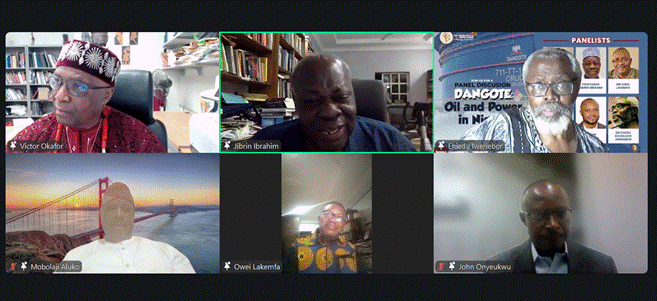
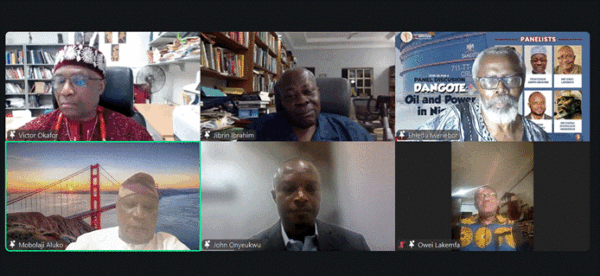
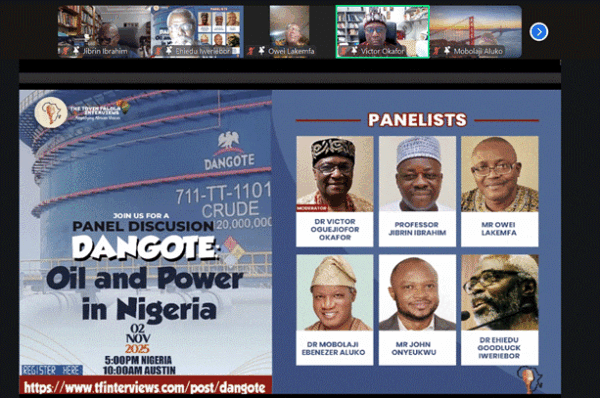
A PANEL DISCUSSION ON DANGOTE, OIL AND POWER IN NIGERIA, PART 3
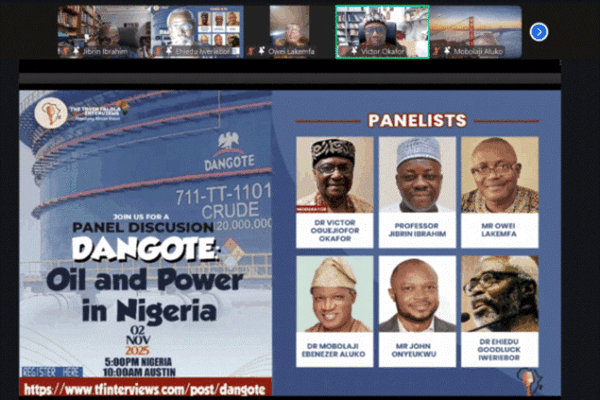
(This is the final report on a panel on the Dangote refinery. For the transcript, see https://www.youtube.com/live/x2jiK24xRYo?si=m5CVmrlAthLi2ubG )
The story of the Dangote Refinery represents something much more significant than just an industrial watermark; instead, it underlines the profound systemic contradictions at the heart of Nigeria’s political economy for decades. Until recently, Nigeria’s oil sector operated under a paradox so profound that it bordered on the absurd: it is one of the world’s largest oil producers, yet it still relies on foreign refineries to convert its crude into usable fuel. This results in the further exportation of raw wealth and the reimportation of value at a premium price: a saga aptly likened to selling cheap mangoes only to buy back expensive juice. Dangote’s refinery would have been the light that lit the industry’s blackout and a prototype for other investors willing to propel the country’s oil sector to the next level. Still, his efforts have instead attracted defiance from institutions that profit from the nation’s inefficiencies. The struggles he faced included access to crude supply, union interference, and regulatory inconsistency, all of which point to the invisible infrastructure of vested interests that thrives in the shadows of the Nigerian oil economy.
This reflection engages not only with Dangote’s project but also with a broader lesson that it reveals. In Nigeria, development is not just about building infrastructure, but also about dismantling the hidden power systems that sabotage progress. Nigeria’s experience serves as a cautionary tale for any African nation seeking to undergo industrial transformation. One of the striking revelations from this panel discussion is how often institutional actors, who are meant to protect the public interest, become actors of economic stagnation. When the Dangote Refinery commenced operations in January 2024, it faced an ironic challenge: despite Nigeria’s abundant crude oil reserves, the country could not purchase its own crude within its borders. Crude had to be bought instead through foreign intermediaries, paid in U.S. dollars, and at elevated prices. The strangeness of this arrangement reveals just how deeply entrenched the extractive elite has become in Nigeria’s oil distribution networks. Then there are the unions, named PENGASSAN and NUPENG, which quickly positioned themselves as powerful forces of resistance to industrial reform. Unions have typically championed the cause of workers’ welfare and labor justice, but in this case, the motive appears to be different: financial protectionism.
Suddenly, a zeal to unionize the workers at Dangote, after years of silence over underpaid gas station attendants and truck drivers elsewhere, raises critical questions over consistency. The reason was that modern compressed natural gas trucks introduced by the refinery would finally break decades-old supply chains controlled by profit-making intermediaries and eliminate thousands of lucrative fees per truck movement. The struggle for workers was to preserve rent-seeking privileges. At another level, regulatory authorities, whose equipment for functional tests was not available, also attempted to undermine Dangote’s product quality claims—a move that seemed less to do with environmental standards and more about enabling the imports of substandard fuel that benefited competitors. Along these lines of conflict, it is clear from the Dangote case that institutions are not necessarily aligned with development imperatives in Nigeria; many are captured by interests that benefit only from national failure.
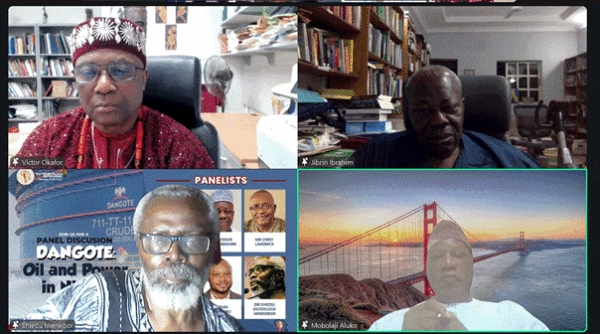
This, in turn, raises the level of suspense regarding the threat of shutting down the refinery and highlights the fragility of Nigeria’s economic infrastructure in terms of the stakes of institutional power struggles. When PENGASSAN ordered workers to stop supplying crude and gas to the refinery, without any legal notice or even in adherence to the industrial court regulations, the impacts were immediate and alarming: faltering electricity generation, gas stations starting to dry up in Lagos, and the haunting memories of long fuel queues resurfacing within the national psyche. This event highlighted how a single strike action, spurred by interests disconnected from the public’s welfare, could plunge approximately 230 million citizens into crisis. It is representative of how vulnerable Nigeria is to disruptions, not owing to a lack of resources but to over-centralized power among actors who hold the nation hostage for economic leverage.
The discussion of a comparison wherein it is said that these struggles face every African country attempting industrialization reinforces a greater continental dilemma: innovation threatens those who profit from broken systems. Any time someone builds to eliminate bottlenecks, the custodians of inefficiency retaliate. Thus, the Dangote episode becomes more than an internal dispute; it reflects the greater challenge facing Africa’s movement from resource extraction into value creation. This scenario raises a critical question for policymakers: How can a nation industrialize a small but powerful force that can weaponize basic services and strategic infrastructure? Until that governance vulnerability is fixed and addressed, the continent continues to experience the impact of transformational initiatives, due to foreign dominance, but hindered by internal resistance to progress.
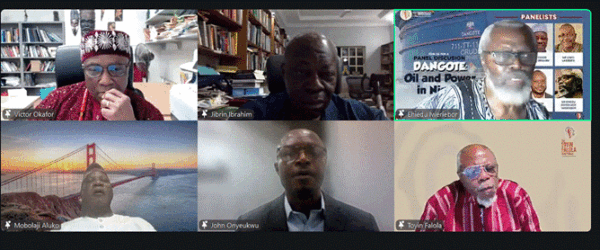
The eventual intervention by the Nigerian government brought a temporary sense of relief but also confirmed the limits of state authority in a system where vested interests have entrenched themselves too deeply. While the refinery was allowed to proceed with its whole operation, and the unions agreed to suspend their strike, none of the most critical barriers to Dangote’s success were addressed. He still cannot buy Nigerian crude directly; this means the intermediaries keep their profitable chokehold. The depot owners that he would bypass with his direct distribution strategy remain dominant in the market structure. And the unions that had shut down a strategic national asset without legal compliance got away scot-free. This compromise is what, in political economy parlance, is described as “a negotiated status quo,” a situation where systems are adjusted just enough to avoid collapse, yet no foundational transformation is made. This raises the question of Nigeria’s capacity to protect national interests when these interests conflict with the private revenue streams of the powerful.
Claims of Dangote posing a monopolistic risk also represent a distortion in the national discourse. At a time when Nigeria has issued 31 refinery licenses, only Dangote has taken the bold financial and operational leap to build one. Now, this leads us back to this question: where should the fear of monopoly be addressed? Is it to the only one who dared to create value, or to those who defend market inefficiencies for private benefit? It is this tension between aspiration and sabotage that exposes the more profound dilemma: Nigeria celebrates development rhetorically but structurally resists it when it threatens the interests of entrenched beneficiaries. Let this be a call to arms; this is a challenge that faces us with underdeveloped architecture still crippling Africa’s potential. The story of the Dangote refinery illustrates one phenomenon aptly described as institutional capture, where organizations meant to ensure fairness, underlined by unions and regulators, act to preserve the interests of the minority. In such an ecosystem, development is treated not as some shared national pursuit but as a threat to long-standing patronage networks.
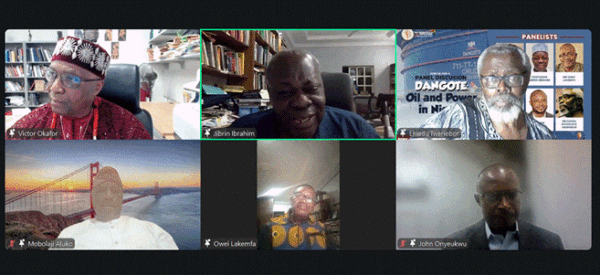
The most ominous implication of these structural and institutional challenges is what it portends for future innovation. Suppose Dangote, who is a billionaire with enormous political access and financial leverage, continues to absorb this systemic pushback. What then happens to the unknown entrepreneur who dreams of taking other sectors of Nigeria’s economy to the next level? With the never-ending nature of these crises, many may not even dare to dream of achieving their goals, having foreseen the violence of opposition before taking the first step. And so, the actual cost of this conflict cannot be measured solely by delays and financial strain; it must also encompass the invisible opportunities lost, factories that were never built, jobs that were never created, and transformations that were forever postponed.