
Toyin Falola

A PANEL DISCUSSION ON GLOBAL AFRICA, WOMEN, AND SLAVERY, PART 1
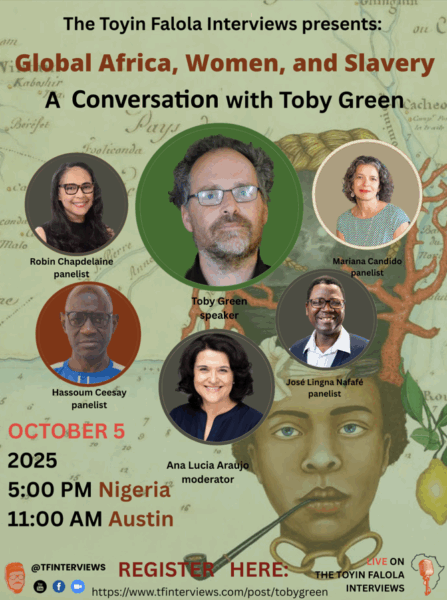
(This is the first report on A Panel Discussion on “Global Africa, Women, and Slavery,” October 5, 2025. For the recording of this successful event, see https://www.youtube.com/watch?v=P9NProqLVAc.)
Historical narratives often pay much attention to the proliferation of slavery as perpetuated by Europeans, involving their very active enslavement of Africans and their transportation to the Atlantic world. In the institution of slavery, perpetrators of the traffic included men and women who contributed to the capture and trade in diverse ways. However, the global focus has always been away from the systematic participation of women in slave trading. I mean, some very influential women engaged in the commodification of enslaved individuals, including zealous female slave traders who facilitated the transportation of these individuals to different places.
Across different African groups, some people carried out enormous tasks to ensure that Africans were highlighted as victims of the slave trade, with many of them participating because it promised substantial financial gains. In The Gambia, for instance, several women took advantage of the engagement, doing business in slavery in numerous ways. However, the roles of women in this evil trade have a mixed dimension.
Recent conversations and scholarship about trans-Atlantic slavery highlight the immense significance of the contributions of different women, allowing us to discover previously suppressed aspects. Certain enslaved African women who defied all the torturous experiences and became global citizens had their history of enslavement traced to the involvement of notable individuals. Their roles and involvements are worthy of extensive examination.
During the time, the vulnerability of the women was exploited tremendously because in every hostile engagement that saw to the capturing of people, which eventually led to their commodification for interested buyers, women and children were the primary victims. So, technically, women became a substantial fraction of the African population transported to the Americas. Meanwhile, slave business entrepreneurs had different expectations for their slaves. Since their trading was motivated by capitalist intentions, it was understandable from an economic angle that they retained the women and children in the engagement. This was not because of any expectation of high productivity from this demographic, but because they needed them partly to manipulate the enslaved men and their enslavers.
While it is true that slave merchants did not always allow freedom for their victims, they, nevertheless, did not treat them the same way. Men were exploited for maximum productivity, allowing their economic growth to skyrocket through the work they did on the plantations. Women and children were equally exploited, but many were retained at home for various domestic activities. In any case, their confinement in that space came with pain around sexuality.
For one, the domestication of enslaved African women helped preserve African identity and ideas in the New World, to the extent that they became actively invested in the revival of African cultures, as evidenced by data from Brazil and Cuba. Often, their male counterparts were busy on plantations, and it was the responsibility of the women to assume various other roles, allowing them to spend their time promoting culture. Meanwhile, in some African societies, the role of indoctrinating new members of society, that is, children, was exclusively that of women because of the emotional closeness they naturally had with them, or the social structure that was predominantly adopted.
A traditional environment provided women with the opportunity to introduce their children to societal values, thereby laying the foundation for their existence in social, cultural, and ideological contexts. This structure, or perhaps system, was partly retained when they found themselves in the Atlantic World, apparently because the white enslavers had economic and other uses for the women. Consequently, the women began to utilize their internalized knowledge and understanding to develop their children’s consciousness, enabling them to imbibe African values and adopt indigenous epistemologies for their cognitive and philosophical development. It worked, as the thriving of many African identities, including their especially vibrant cultural engagement, in the Americas today attests to that continuity.
Scholars believe that by virtue of the enslaved African women’s proximity to the white enslavers, they had close access to the values and ideological identities of their owners, which puts them on another pedestal to influence their intellect for the remaking of that space for reinvigoration and revival. For one, the domestic space where these women were condemned became a site of negotiations for those who would eventually use it to their own advantage. By serving as cooks and preparing meals, and planning schedules, women gained the confidence to the extent that they were entrusted with caring for their enslavers’ children.
Of course, it was natural that they would not raise children in ways unfamiliar to them. An African image shaped their minds, their ideas were drawn from an African environment, and their indigenous experiences also influenced their understanding of life, even before they were transported to foreign lands. Gradually but steadily, these women began to instill in their own children a deep connection to the fabric of African ideals and ideas, introducing them to African customs and immersing them in their philosophy. They needed to raise children to embrace their African spiritual identity, ultimately because that was the only means through which they could communicate with the unseen forces. Interestingly, as they raised their children in African ways, they also influenced their new associates.
Another thing that is not very much talked about is the instrumentality of these women in the enhancement of freedom for the enslaved Africans. As already indicated, they had the relative opportunity to participate in mini-economic and commercial activities, which gave them the privilege of overseeing certain affairs that would have been considered impossible, owing to their status and circumstances. By participating in such involvement, however, they opened for themselves fresh and distinct possibilities that could be used to materialize their ambitions. It should be noted that forcing enslaved people to attend religious events was aimed at re-engineering their minds and ensuring that they did not have the breeding space to contemplate emancipation.
At the time, the enslaved people were constantly reminded of the superiority of their masters and the need to submit themselves to the absolute authority of their enslavers. But the Black community would use that opportunity for something more telling. They wanted to liberate themselves from the shackles of the overwhelming slavery and control by their owners. As a result, women gained moderate economic power through their exposure to domestic activities and microeconomic events, and they began to utilize that power as part of a larger plan. In this actual moment, these women invested in the struggles for emancipation.
In view of these and coupled with the fact that enslaved African women were forced to experience double jeopardy of being slaves and being used as reproductive elements, we realize that the underrepresentation of their tribulations in the discourse of slavery and its sardonic consequences is an acute injustice. It cannot be overemphasized that, given the magnitude of their emotional and psychological triangulations, tribulation, and torture, these women deserve to be appropriately recognized for their contributions toward the freedom and emancipation of the enslaved. True, some women actively participated in the commodification of enslaved people, but many of them were vanguards of liberty, and their histories, biographies, or contributions have not been appropriately amplified. The focus on women is one of the reasons why Toby Green’s book, The Heretic of Cacheu: Struggles over Life in a 17th-Century West African Port, is relevant.