

Toyin Falola

A PANEL DISCUSSION ON WOMEN IN AFRICA, PART 1
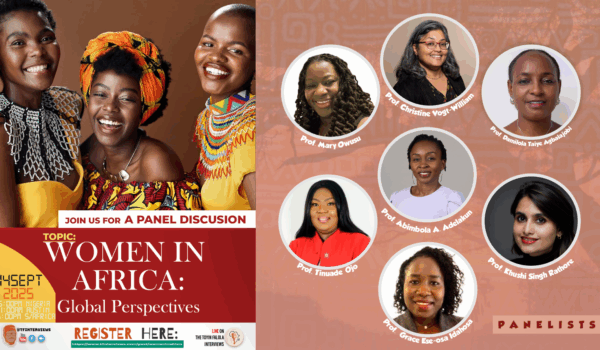
(This is the first report on a panel of Women in Africa, September 14, 2025. For the transcript, see https://www.youtube.com/live/ivFIgBuEoxY?si=NQ6h_PEKnVR18OtW
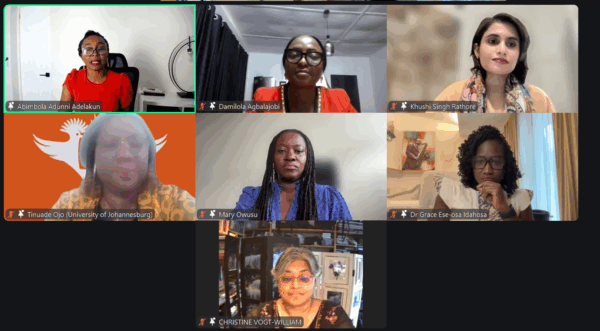
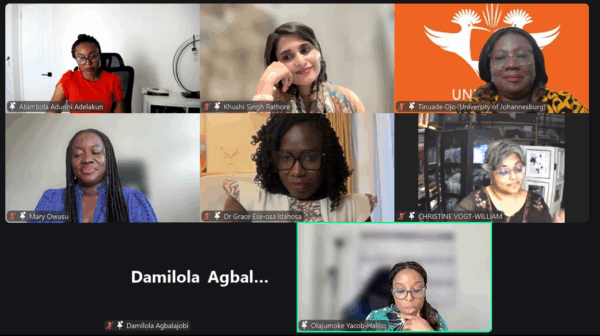
The feedback on the panel about Women in Africa reached me in huge volumes, from audiences in more than twenty countries who watched or listened on live radio stations and multiple platforms. The powerful speakers, Professors Abimbola Adelakun, Damilola Agbalajobi, Grace Ese-Osa Idahosa, Khusi Singh Rathore, Christine Vogt-William, Mary Owusu, and Tinuade Ojo, raised many important points that give me angles to deepen the conversation on the postcolony and decoloniality. I will organize my thoughts into three pieces based on the insightful statements of this impressive group of speakers.
The limited participation of women in African postcolonial affairs stems from deep-rooted patriarchy-infested attitudes brought by colonialism. This led to complex colonial tactics, all aimed at reshaping the minds of the colonized. Until recently, decolonization efforts have sparked intellectual debates focused on reevaluating African realities after colonialism ended, often leaving unresolved issues related to colonialism. One such issue is the coloniality of imagination.
In the recent Toyin Falola Interviews, conducted to stimulate scholarly discussions on a recent book, Women In Africa, their history, and identity over time, participants asked very relevant questions that helped us explore the contents of the publication. These questions are timely and important because they help us understand several key areas that have been either deliberately left out in our collective search for truth or unintentionally treated as marginal in our overall intellectual inquiry. While efforts are made to understand the complexities of human nature, which shape social habits, relationships, and attitudes, human agency cannot be overlooked as unimportant in the discussion on how gender relations are built.
The coloniality of imagination ensured that African minds, deeply rooted in the murky waters of colonialism, are reconditioned to accept that a concept and phenomenon must adopt a universal outlook, discarding the socio-environmental dynamics that often influence or shape how a people respond or behave when confronted with a similar experience. Decoloniality suggests that the understanding of women and men, especially within the context of sociopolitical relationships and power dynamics, is influenced by the imported imagination that coloniality enforced.
Discussants in the Toyin Falola Interviews argued that such an imagination can be decolonized. However, that process begins with the conscious awareness and acknowledgment that African minds have been dangerously manipulated, often without the victims’ knowledge. To understand this issue, one must examine the mindsets of everyone—including men and women—regarding how they convince themselves of the actions expected of them based on their gender, thereby shaping their roles. In the African world during the postcolonial period, men are often seen as the primary decision-makers for society.
Sadly, it is this imagination and orientation that inevitably lead to the engagements that register more men than women on occasions and platforms that discuss and regulate power and politics. It is, for example, apparent that the involvement of people in politics, which tends to skew towards men, reflects the centralization of men as individuals who can think and make decisions. Women’s resistance to this provocation must grow stronger.
The centralization of men leads to the vulnerability of women in seeing political participation as necessary or otherwise based on gender. In the post-independence world of ex-colonized peoples, especially in Africa, you are going to find more men in politics. Feminists are convinced that such a condition is influenced by how the consciousness of women is constructed in the first instance. It is absolutely the reason why many men do not care when women are pushed into the background, where representation is a necessary precondition for the construction of ideas that would have a substantial impact on them. Generally, the possibility of males producing good ideas and strategies that would have a massive impact and influence rapid development for women is low when women themselves are not involved in the decision-making process. There is, therefore, an extraordinary relationship between the male-manufactured apathy of women in political engagements in postcolonial Africa and the re-engineering of their imagination as postcolonial subjects. We cannot underplay that the gap between them would hurt.
Once equal participation in political engagement is restricted, it naturally eliminates the possibility of economic equality. This is straightforward logic. The typical postcolonial African woman is excluded from the top of the economic landscape because she is led to believe that economic power is beyond her influence. It originates from the postcolonial mindset that women should be cared for rather than struggle to claim a significant share of the pie. Such a patriarchal model of organizational culture undermines the efforts of African women to reach their fullest potential.
There is a need for the decoloniality of imagination that dismantles colonial models of political and economic thought, both of which largely shape the world in which Africans live their daily lives. The realization that women and men actively participate in perpetuating colonial ideology makes it more urgent to begin the decolonization process, thereby promoting the right models of thought and development.
Africans need to be freed from the mental chains that colonial ideas have placed on them. They must start by understanding that their imagination has been remotely controlled, and they need to intentionally work to reclaim their engagement and minds. Let us move forward with new imaginaries, as the speakers suggest.