
Toyin Falola
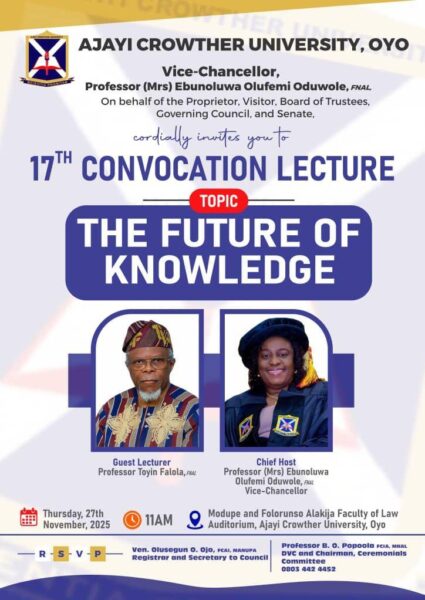
Ajayi Crowther University, one of the fastest-growing faith-based private tertiary institutions over the last decade, is set to hold its 17th Convocation ceremony on Thursday, November 27, 2025. As part of its celebration of intellectual achievement, a Convocation Lecture on the theme “The Future of Knowledge” has been scheduled. The lecture is taking place in the Modupe and Folorunsho Alakija Faculty of Law Auditorium. The conference features scholars, students, policymakers, and the public and is an occasion to discuss the evolving dynamics of knowledge and power and their implications for humanity’s future.

The topic is an intentional intervention aligned with the present reality, where meaning, ownership, and the production of knowledge are being redefined. This theme, therefore, raises Ajayi Crowther University’s 17th convocation profile beyond mere celebration. It also presents signals that Ajayi Crowther University is committed to participating in Africa’s struggle for epistemic agency, where inherited modes of knowledge are challenged, learning is reimagined, and there is a strong demand that knowledge should serve humanity.
This lecture will examine the academic scene in Africa during the colonial era, when African universities were developed, modeled, and operated as caricatures and extensions of colonial bureaucracies. This position will provide a better understanding of how Western-centric knowledge penetrated African societies and became entrenched, while African epistemology was restricted and relegated to mere myths. It will also provide explanations on how products of these institutions functioned more as machinery for the continued survival of colonial administrations. In contrast, the institutions themselves became sites of both enlightenment and exclusion.

The lecture will continue in its stride by examining the African academic scene in the postcolonial era – a period where the number of tertiary institutions and their students rose. It will examine how these institutions remained heavily reliant on Western-centric epistemology, funding, and accreditation, and how the postcolonial African academic scene received a boost, but its operating system remained unchanged. Therefore, this lecture will address whether the educational scene of this period was booming or failed to achieve the progress Africa desired.
After examining the colonial and postcolonial eras, the lecture will be brought full circle with its examination of the contemporary era, where the terrain of knowledge has now shifted to incorporate Internet of Things (IoT), Artificial Intelligence (AI), and intensified migration, all of which have now democratized the production, certification, and dispersal of knowledge at an alarming pace. It will examine the benefits of this novel idea, which allows African students access to expertise beyond African borders, and the perils associated with it, as African nations could become dependent on these technologies, thereby reenacting the dependency features of the colonial and postcolonial African academic scenes.

At the core of this lecture, Artificial Intelligence will be examined as a tool that enhances efficiency and democratizes access to knowledge, yet introduces the questions of ethics and morality. Components of Artificial Intelligence, like algorithms that have the potential to replace human judgment, can inherit human bias and evolve into tools of domination, and will also be examined. Based on these evaluations, the discussion will focus on the path Africa should take with IoT and AI – accept, reject, or adapt.
The lecture will assess Africa’s survival odds with the emergence of new modes of intellectualism. Diversification and decolonization of knowledge, which could potentially breed pluriversalism as postulated by several African philosophers like Kwesi Prah and Paul Tiyambe Zeleza, will be discussed as a viable means of survival for African epistemology for its coexistence with other modes of knowledge and as a means for African epistemology to be redefined as legitimate, modern, and globally relevant.
This development can also lead to the hybridization of knowledge, which will be further explained in the lecture as a blend of global and African expertise. The lecture will reimagine a future in which African epistemology serves as a medium for innovation through modes such as Afrofuturism. It will discuss the downsides of hybridity, especially as Artificial Intelligence can complicate it, breaking down barriers between human reasoning and machine algorithms and raising ethical issues. Going further, the lecture will assess automation – a new development upon which knowledge hovers, especially with the implementation of Artificial Intelligence. It will explore the dangers that could emerge if technology takes over the intellectual landscape and human duties, such as ethical reasoning, cultural sensitivity, and critical thinking, are left to machines.
Finally, the culmination of these diverse positions regarding the future of knowledge will be assessed to chart a future in which knowledge is guided by moral, cultural, and spiritual frameworks and in which the world can easily discern between fact and farce in a pool of information. As the lecture draws to a close, it will take cognizance of the fact that Africa’s intellectualism and that of the world continue to evolve; therefore, it will provide possible solutions and pathways for African institutions.

It will charge Ajayi Crowther University to become a bridge between faith and rationality, linking African epistemology to global epistemologies, as this could be a step in the right direction toward a future where knowledge serves humanity. As the host of this cerebral encounter, Ajayi Crowther University (ACU) will, at its 17th Convocation ceremony, be a party to history in the making. For on this day, it will have successfully discharged its mandate to transform minds, to reset values, and to build a learning community where the puzzles of a digitized, globalized, and plural society can be decoded with ease. In inviting me to this erudite gathering, the University is expressing its preparedness to pilot this navigation for the benefit of knowledge production in Africa and beyond.