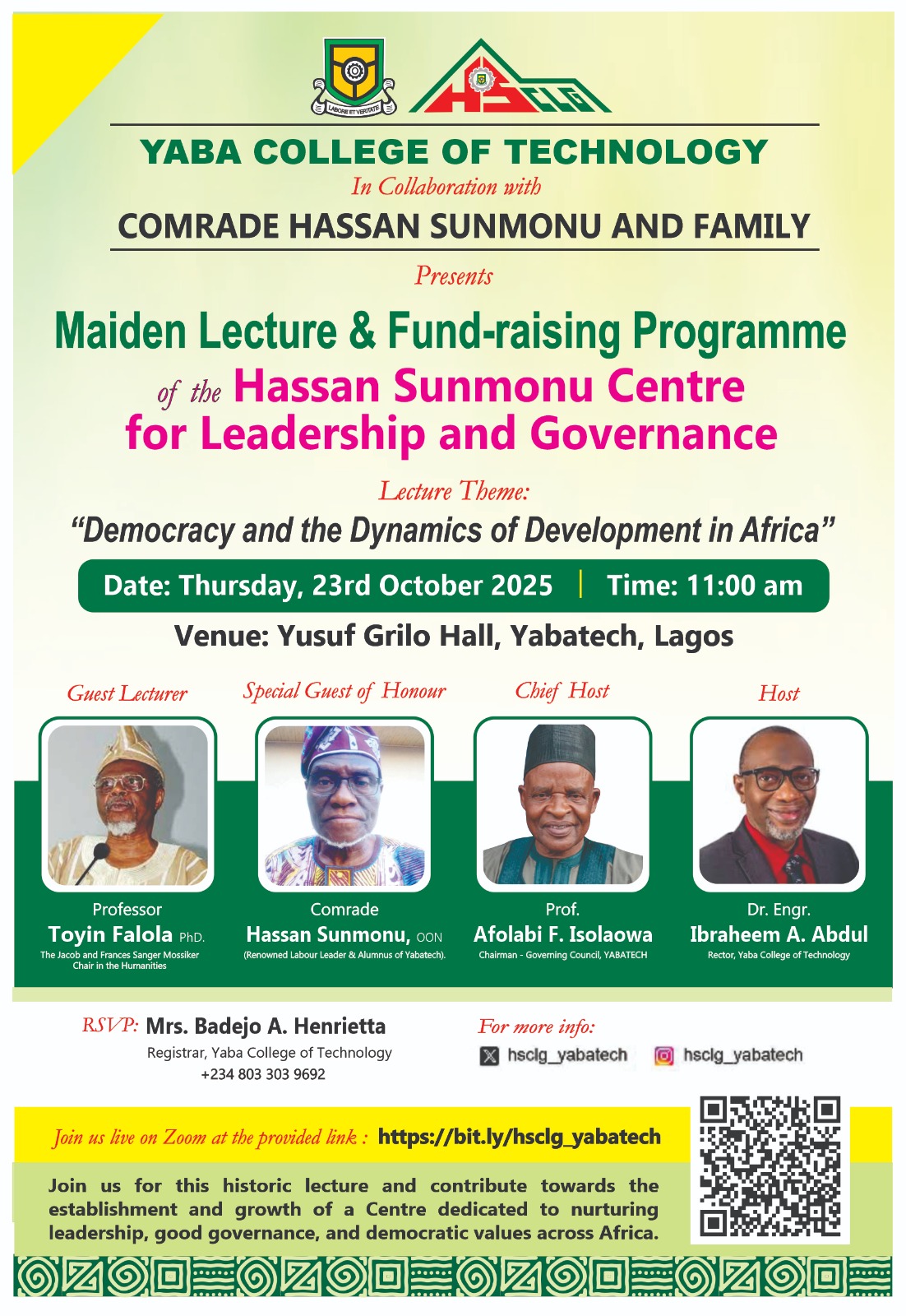

Toyin Falola
The intellectual labor of a single voice is to capture historical moments that illuminate the fractures of Africa and sketch connecting bridges across its scattered futures. My October lectures center on three central topics: democracy, ideology, and ancestor hood as a cluster of new imaginations on African futures. These topics represent pillars of African scholarship and the lived experiences in all sectors of the African society. Together, these lectures form a triad that engages governance, analyzes meaning, and the continued existence of African ancestors as the continent continues to seek pathways to justice, freedom, and survival.
For a long time, democracy in Africa has continued to hang in the balance between promise and disappointment. In “Culture, Democracy, and Development in Africa,” I intend to analyze how the variant of Western democracy was imposed on African states through the colonial encounter. It is important to note that African societies before the advent of colonialism varied in polities, traditions, consensus, and accountability frameworks. These diverse systems were deposed by Western liberal structures that did not organically emerge on the continent. The result, therefore, is a democracy riddled with contradictions: a foreign system rooted in external validation and an internal aspiration for participatory governance embedded in African cultures.
Taking a quick visit to Nigerian history as a case study. Its failure goes beyond corruption or a junta. It also extends to the ideological void created by democracy, which stands as a ritual with no meaning, a contest for access to state resources, and not civic responsibilities. In one of my reflections, “Can Democracy Work in Nigeria?”I emphasize how democracy is unable to succeed in Nigeria if it continues to be hoisted on elite manipulation, ethnic rivalry, and poverty. For democracy to work, it must be decolonized to reflect African reality and be built on the foundation of community, dialogue, and an ethic of responsibility.
I do not advocate for the total rejection of Western-derived democracy but rather for its restructure and reformation. The Africanization of democracy will require disassociation from certain foreign features and its new dressing in African philosophies of governance. The consensus-building traditions of the Igbo, the consultative traditions of the Yoruba, and the deliberative customs of the Akan, should be resuscitated and not deposed as primitive. They constitute genuine African democracy, rooted in lived realities and ancestral wisdom, and not in foreign constitutions.
If democracy is regarded as the theater of politics, ideology then is the script that carries out its performance of power and resistance. In Violence in Nigeria: The Crisis of Religious Politics and Secular Ideologies, I examined how clashes between secularism and religion produce violence in instances where the state fails to remain neutral. In this context, ideology becomes a weapon for mobilization and legitimacy, or a divider of communities and justification of violence. My opinion of African ideology is clear: it is not reducible to the ideas of Marxism or Liberalism, but to lived experiences of practice rooted in our cosmologies, rituals, and cultures.

I have explored how indigenous ideologies are implemented to interpret misfortune, destiny, and justice as principles of existence in Yorùbá Metaphysics: Spirituality and Supernaturality. These cosmological frameworks continue to exist even in the face of marginalization through colonial education, capitalism or foreign religions. They survive and adapt, hybridizing to reemerge in various forms, such as the infusion of drums and dance into Pentecostal Christianity or the infusion of African spirituality into Islam. To this end, African ideology cannot be regarded as static. It is a dynamic element.
The process of ideology in Africa also spills over to the political arena. African leaders such as Nkrumah, Nyerere, and Awolowo, to name but a few postcolonial leaders, were as many adherents of the ideologies of socialism, Pan-Africanism and communalism respectively as they were Africanizing these ideologies through their preoccupation with African histories and cultures. The case of Ujamaa is a case in point. It was essentially an Africanization of an imported idea of socialism through an appeal to African kinship. Ideology might be a problematic affair. At its most repressive, it has been wielded as a weapon of oppression; at its most pernicious, it has been used as the intellectual justification for dictatorship. Ideology can then be seen as a double-edged weapon, just as it is possible to use it as an instrument of either liberation or enslavement. Ancestorology, the third part of my lecture, moves me away from state and ideology into the realm of temporality and imagination. I have noted in Religious Beliefs and Knowledge Systems in Africa that the dead are still in existence as engineers of our survival. Ancestorology goes beyond genealogy in the sense of names and family trees, as it involves placing ancestors as the co-architects of the future.
Several examples, such as the Masai in Kenya’s revival of Olkari land stewardship, remain relevant. Once ruled out as primitive by colonial authorities, the system was reinstated as a water management tool and is now being studied by the UN. The persisting proficiency of the Igbo ogene gong system over colonial written deeds implemented for the resolution of land disputes or the Yoruba Ifa divination system that served as better archives for land ownership records ahead of colonial survey markers – all continue to prove that ancetorology is a protocol of survival and African epistemology is embedded in indigenous rituals, songs, proverbs, and many others.
Colonialism aimed to destroy the temporal imagination of Africa by imposing a linear clock that detached the past, present, and future. It aimed to make Africa ahistorical by deposing the spiral temporality of its cosmologies to justify the looting of Africa’s human and natural resources as civilization. The imagination of Africa’s future without its ancestors, however, can be likened to the state of amnesia. Ancestorology offers resistance to this erasure by reasserting the presence of ancestors as guides in our ecological stewardship, governance, justice, and healthcare.
The combination of democracy, ideology, and anthropology creates a prism through which to interpret current struggles. Without ideology, democracy is an empty ritual of ballots. Without ancestorology, ideology can become alienated from the archives of African wisdom. Without democracy and ideology, ancestorology will be restricted to folklore rather than a tool implemented for governance and transformation.
My lecture triad, therefore, is not just a collection of ideas but a framework for actions. It enables mediation on the fact that the survival of Africa, declaring the emergence of democracy from elitist structures, the harnessing of ideology for liberating and entrenching future imaginations in the spiraled temporality of the ancestors. These remain pressing topics in this era of the climate crisis, the rise of dictatorship, and economic dependency.
The challenge ahead for Africa is to reimagine itself through indigenous intellectual traditions. Its democracy must be forged from consensus and accountability, its ideology must be connected to African cosmologies and material struggles, and ancestry must be reinstated as a living archive for survival. In this context, this triad becomes a call to memory and vision. That is, Africa must make its future a reality through the guidance of ancestors, through contested ideologies, and through negotiated democratic practices.
External factors cannot assess Africa’s destiny. It can only be from Africa’s ability to weld together: the wisdom of the past, contestation of the present, and aspiration of the future. This triad is a meditation and a manifesto that defines democracy, ideology, and ancestors as a single braid of rope which Africa can use to propel itself toward sovereignty, dignity, and renewal. I thank Professors Adelaja Odukoya and Sola Olorunyomi for providing three powerful platforms in three locations to share my ideas and engineering provocations.