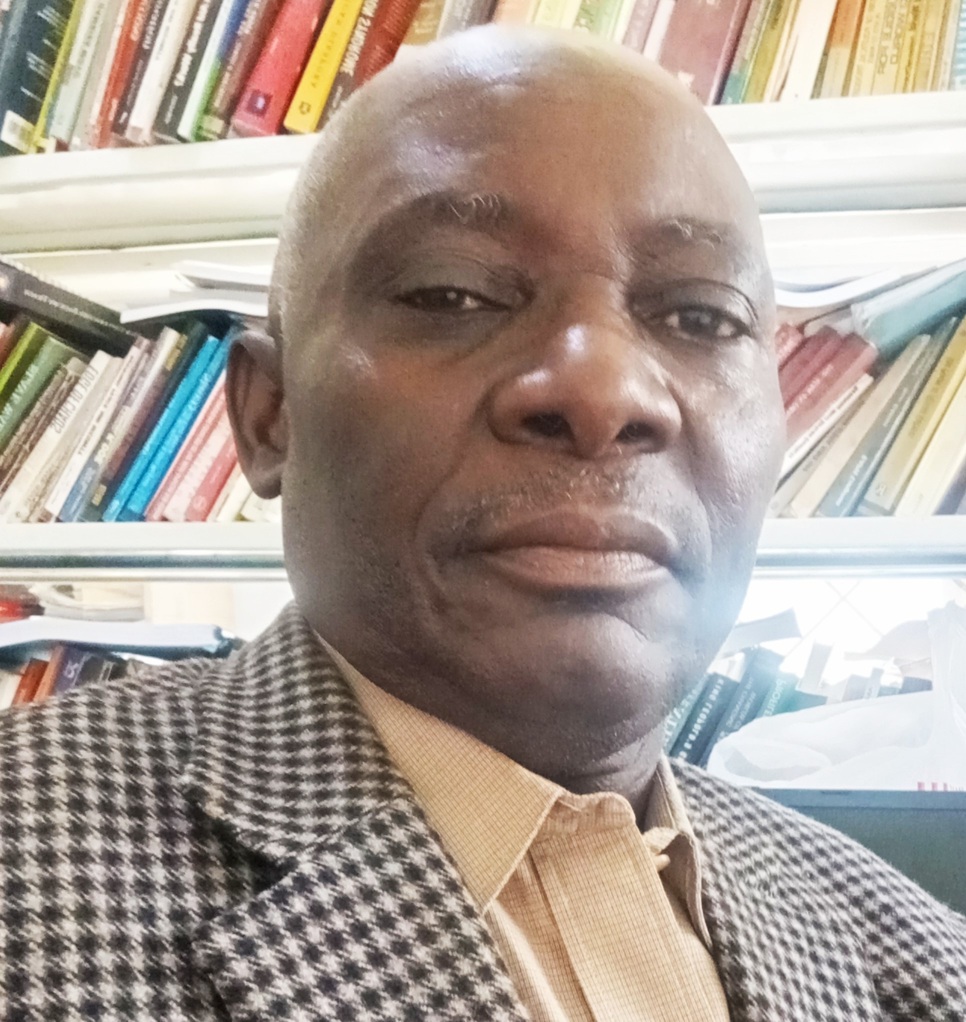

By Professor Sati Fwatshak
During its 40th anniversary convocation ceremony, the University of Jos previously bestowed upon eminent Nigerian historian and African Studies Professor, Toyin Falola, an honorary Doctor of Letters degree. The institution also organized “The Transformation of Central Nigeria: A Conference in Honour of Toyin Falola,” which explored theoretical, historical, and empirical angles on the area.
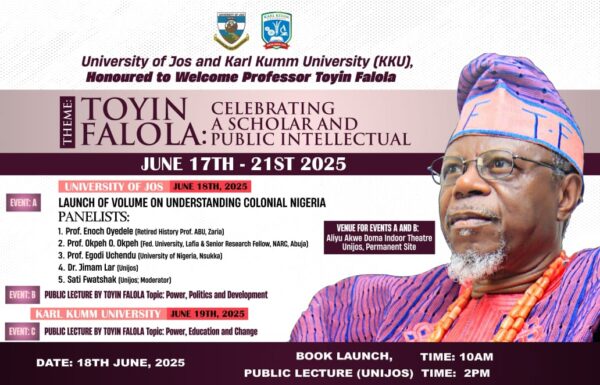
Different academic events honor Professor Falola’s efforts still. For example, Osun State University plans to host the 14th Toyin Falola International Conference on Africa and the African Diaspora (TOFAC) in July 2025. Together, Karl University and the University of Jos are honoring Professor Falola from June 17 to June 20. There will be a book launch, two Falola lectures, and social gatherings among other things.
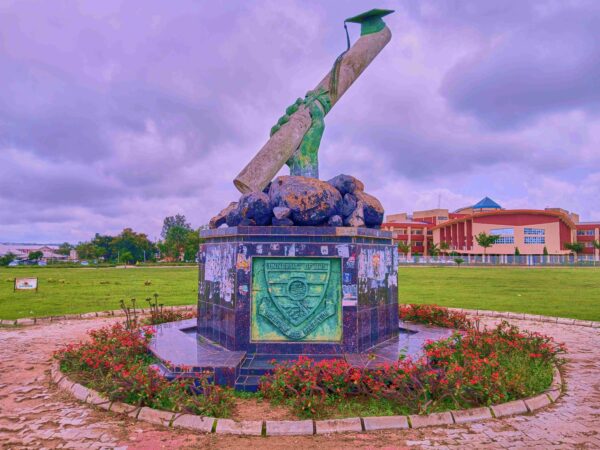
Renowned federal university, the University of Jos is based in Jos, Plateau State, Nigeria. Originally a satellite campus of the University of Ibadan in 1971, it became autonomous in 1975. UNIJOS is today known for its dedication to academic excellence and social impact, nationally and globally. It has thirteen (13) Faculties including the new Faculty of Computing. Together, the Faculties offer more than 50 undergraduate programs, 60 Master’s Degree programs, and 57 Doctorate degree programs. It is one of the most diverse universities in Nigeria in terms of students’ and staff populations.
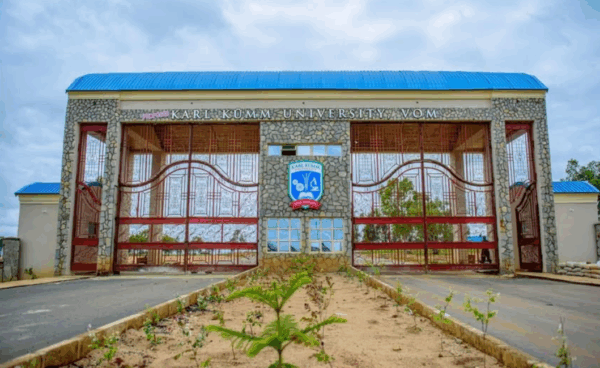
The events honoring Professor Falola will also support Karl Kumm University, a private, faith-based institution housed in Vom, Jos South Local Government Area of Plateau State, Nigeria. Originally founded by the Church of Christ in Nations (COCIN), KKU’s operating license came from the National Universities Commission (NUC) in April 2021. KKU seeks to offer society-positive God-centered education. Emphasizing academic brilliance, discipline, and moral ideals, the university aims to turn forth graduates with both ethical basis and professional ability. The institution presents a range of undergraduate courses spread over several departments. Prospective students might look at courses in social sciences, arts and humanities, as well as sciences. Following rules issued by the Joint Admissions and Matriculation Board (JAMB), admission criteria call for a minimum UTME score of 140 and relevant O’Level credits. Vice-Chancellor of KKU is Professor Audu Nanven Gambo. Through mentoring and cooperation with University of Jos, the university gains from which it improves its administrative and academic systems.
The organizer of the events, currently Professor of African History and former Dean of the Faculty of Arts at the University of Jos, Nigeria, Professor Sati Fwatshak is an eminent Nigerian historian and academic. Having been connected to the university since 1990, he also serves as a Senate representative member of its Governing Council. Scholarly work by Prof. Fwatshak covers pre-colonial, colonial, and post-colonial eras of African and Nigerian history. His studies explore issues including social change, economic growth, government, migration, identity, war, security, and the part Islam plays in Africa. He is Fellow of the Historical Society of Nigeria (FHSN) and a Fulbrighter. Among his important works is African Entrepreneurship in Jos, Central Nigeria, 1902–1985 (2011), which explores the development of commercial practices in a major Nigerian city. Additionally edited Contemporary Nigeria: Transitional Agencies of Change (2016), a series examining post-colonial dynamics of Nigeria. He co-edited Beyond Tradition: African Women and Cultural Spaces (2011) also, stressing African women’s participation in cultural settings. His latest co-edited book, Economic Development of Nigeria Since 1800 (2024), examines the Nigerian economy from the 19th to the 21st centuries, as it explores continuities and change across the broad economic spectrum of the country over the centuries. In 2024, Prof. Fwatshak paid a guest visit to the Institute of African Studies, University of Bayreuth, Germany. Working under guidance of Professor Toyin Falola of the University of Texas in Austin, he worked on a project titled “The Impact of Private Universities on Public Universities in Nigeria,” part of a larger five-African nation study effort. He and his team of researchers have completed a manuscript on the histories of the indigenous peoples of Plateau State funded by a grant from TETFund’s National Research Fund (NRF).