

Toyin Falola
Ọba Dr Adékọ̀yà On Language, Knowledge, and the Power of an Indigenous Alphabet
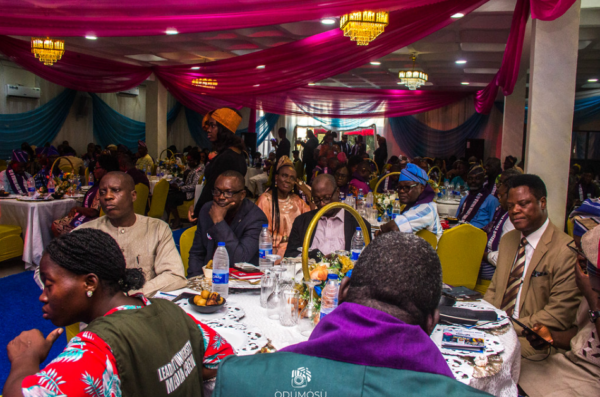
The Toyin Falola At 73 conference is proof of the potency, relevance, and value of knowledge and its persistence through African scholarship. It attests to the fact that life, service, and production are embedded in the archives of African history, culture, philosophy, and activities whose creation and existence span considerable time and are valued for their impact. This conference is a celebration of a newly attained age and a gathering of intellectuals who are heaping intellectual value in its rightful place as a dynamic stake in the field of knowledge production in Africa and in global society.

By hosting this conference, Lead City University situates itself as an active custodian of intellectual tradition, providing a platform where scholarship, culture, spirituality, and innovation can meet without hierarchy. Thus, in this context, the Address presented by His Royal Majesty, Aláyélúvà, Ọba Dr. Adédayọ̀ Olúṣínọ̀ Adékọ̀yà, was titled “An inclusive universal 54-letter alphabet for a multi-culture, multi-religious and hybrid democratic society.”
The conference was an insightful contribution to the Nigerian milieu and the dynamics of religion, culture, politics, language, and so on. Epigraphically, it is, at its deepest stratum, a kind of fundamentally radical and well-thought-out move, which is to say, essentially, the building and use of an inclusive universal alphabet capable of capturing an exact reflection of the phonemic structure and distribution that exist in some hundreds of existing languages in Nigeria, and by extension, in Nigeria’s cultural ecumene as well as in Africa’s as whole.

However, it is more than any simple semantic exercise, especially since it is an epistemological gesture or initiative that is predicated explicitly upon, as well as primarily fixated upon. Therefore, it becomes a matter of recovering and liberating knowledge that is inalienably specific to Nigeria and Africa from the challenges posed by the simple use of colonial phonemic systems.
The embedded knowledge that is to be drawn from the Kabiyesi’s paper is a basic understanding that language is both a cultural carrier and a political tool. Alphabets are not necessarily objective tools. For instance, alphabets shape and control learning and recall, belief transmission, and community vision. Through such a historical development process in alphabets from the Proto-Sinaitic alphabet to that of the Phoenicians, Greeks, Latin, and finally to that within modern Europe, His Majesty depicts African language as struggling within a contemporary global context. The argument of alphabetic writing is probably one that seldom happens, only to get refined and transformed from one civilization to another, subtly disputing a perceived European supremacy and primacy.

Also significant is the acknowledgment of the complexity of Nigerian languages, estimated at 600. The lecture challenges the old practice of imposing alien alphabetization systems that may lack sufficient symbols to represent the tonal complexity, consonant combinations, and vowels of African languages. In this process, the lecture articulates African philosophy on language, which views sound, meaning, spirit, and society as inseparable. This provides a deep insight into the African world of religions, where speech, naming, and conjuring are often creative acts of transformation.
The Dimef Institute/Adekoya 54-letter alphabet arises out of this rich pool of knowledge. The structure of this alphabet, with thirty-six consonants and eighteen vowels, shows familiarity with African phonologies rather than representing a purely theoretical exercise in linguistics. The addition of tone symbols, diacritical marks, and consonant pairings is directly in response to sounds found in Yoruba, Igbo, and numerous other Nigerian and African languages that are inadequately captured in standard writing systems. The new alphabet model, therefore, is a repository of indigenous knowledge organized for teaching, learning, and transmission from generation to generation.

Apart from knowledge, the speech is more about implementation data, which is essential for understanding the initiative’s viability. Over two decades, the alphabet system has been in place and has been actively operating at the Dimef Institute in the city of Odè Ulé. The implementation of the alphabet system in the institute takes the theoretical and makes it practical. More than 1,500 people have been trained in the system, including those who had never set foot in a school. This indicates that the implementation initiative is operational and functional.
The vocational context for this particular implementation is vital. The use of the alphabet to teach vocational skills establishes a link between language reform and economic and social inclusion. The ability to read and write is no longer a process associated solely with educational achievement but with gaining livelihoods and inclusion within society. This concept of knowledge fits well within the indigenous knowledge framework characteristic of Africa.
The practicality of the knowledge offered in the speech has applications in several fields. In education, a universal alphabet can revolutionize learning in early childhood, literacy classes, and the documentation of indigenous languages. When learners are taught using systems of communication like those of their natural speech, comprehension and confidence increase, and alienation decreases, particularly among learners in schools.

In matters of religion, the alphabet provides a means for accurately representing indigenous religiosity. It is a fact that a large part of religiosity in Africa is dependent on accurate pronunciation, pitch, and rhythm. This quality is often lost in inefficient alphabets during transliteration. In this manner, religion can be represented and recorded through an alphabet developed in line with African linguistic systems. This is not a denigration of other faiths but a demand for parity in the representation of knowledge within spirituality.
Politically, the initiative is a move towards a more inclusive democratic culture. Language is a critical aspect of engagement with society. A situation where the languages of governance, mostly colonial languages or standardized languages that are not inclusive of the majority, are the primary modes of governing, results in a scenario that is short of democratic ideals. A shared alphabet adaptable to linguistic diversity can facilitate cross-ethnic communication, rather than forcing a standard dialect on different groups.

The alphabet is culturally significant because it symbolizes defiance against the marginalization of knowledge. It defies the convention that African languages need to be measured against certain norms to qualify as authentic languages. Here, it resonates strongly with the intellectual lifework of African scholars: the preservation and certification of knowledge systems within Africa. The tribute given to him in the speech is far from empty; it is very intellectual and significant. The new alphabet system is another string to the elaborate history of the Africanist process of reinvention that African scholars symbolize.
The Kabiyesi’s speech marks a nod to knowledge production as a human endeavor. This attention to knowledge production confirms that knowledge is intertwined with people and relationships. Through this speech, people can see that intellectual excellence is tied to groups and their historical experiences. This is another way this argument is supported: knowledge in Africa is understood to be embedded in a context of continuity and seniority.
Overall, the Kabiyesi’s paper presents, with bold specificity, a vision of how indigenous knowledge systems might be conceptualized, realized, and harnessed in Nigeria and across Africa. The power of this speech lies in its resistance to misleading divisions that create inadequacies between language and culture; to divisions between theory and practice; and, finally, to utopian dreams. The speech represents both an appreciation of past intellectual achievements and an acknowledgment of future progress. The Kabiyesi challenges all scholars, institutions, and communities to imagine what Africa might look like when it writes itself.
Congratulations to Lead City University for organising this programme. It is a step in the right direction for language learning and development.
Professor Toyin Falola fully concepted the essence of the 54 letter alphabets farther than prior precept, a forward advancing of the frontier of alphabetology, demonstrating the genius mastery touch of intellectul vintage encouraging we, his ardent fans and followers and spiritual bent.