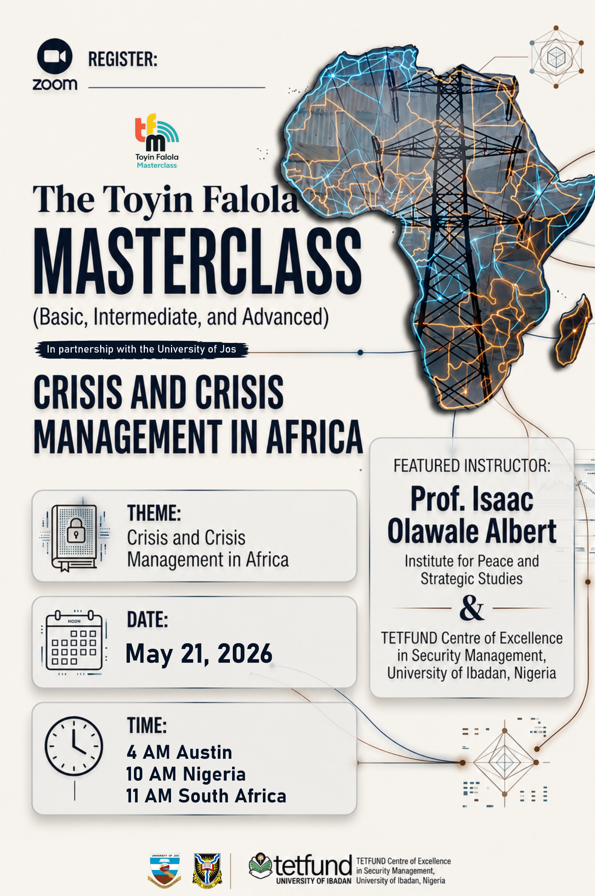

Prof. Isaac Olawale Albert
Institute for Peace and Strategic Studies
& TETFUND Centre of Excellence in Security Management
University of Ibadan, Nigeria
- Introduction and Background
The Toyin Falola Masterclass is a well-thought-out academic initiative aimed at promoting in-depth scholarship. It would do so through its three lecture categories: Basic, Intermediate, and Advanced. This Masterclass hopes to explore how crises began in Africa, how they have changed, and how they are managed.
Has Africa been in crisis? Or has Africa always been in crisis? This has been one of the central questions in. From the slave trade and colonial conquest to postcolonial state-building, authoritarianism, civil wars, insurgencies, communal violence, forced displacement and humanitarian crises – at different times and to varying degrees across the continent – Africa has been fraught with crisis, real or imagined. But Africa’s crises have also been products of longer histories that produced and reproduced them. The origins of many of today’s wars and insecurities in Africa are in longer histories of colonial border-making, extraction and political economies, governance shortfalls, citizenship and identity formation.
Indeed, while Africa’s past is replete with crises, it has also been a history of coping through adaptation and innovation in managing conflicts. During various eras and across different societies in Africa, indigenous institutions of mediation and reconciliation existed and were used by African communities. States, regional organizations, as well as external actors have also tried to manage crises through mechanisms of prevention, peacekeeping and peacebuilding as well as post-conflict reconstruction. Thus, there is a need for historically informed analysis of crisis management that can help us better understand not only the causes and nature of conflict, but also the opportunities and challenges of current responses.
It is within this larger historiographical and policy framework that the lectures should be situated. The goal is to provide participants with a solid understanding of the origins of violent conflict in Africa, the major forms of crisis in the modern era, and the institutions and actors (both formal and informal) involved in managing these crises.
- Rationale
In recent years, recurring crises in Africa have been analyzed and understood mainly from simplified and event-based perspectives. Contextual elements such as the lasting legacies of colonialism, weak state institutions, uneven development, environmental stress and Africa’s integration into global political economy are often glossed over when discussing violent conflicts as well as fragility and insecurity in general. These phenomena tend to be viewed in isolation from longer-term dynamics.
The proposed lecture places history centre stage to redress these trends. It also responds to calls for African-centered and decolonial approaches to conflict and peacebuilding. Locating current debates around crisis management within African Studies allows us to critically interrogate master narratives and bring back local, regional and historical experiences and knowledge. Ultimately, this talk has implications for broader questions around state governance, security, democracy and sustainable peace on the continent.
Structured in three parts, the Masterclass aims at students and scholars from various fields and walks of life and strives to strike a balance between conceptual clarity and analytical rigor.
- Aim
This Masterclass aims to examine the historical evolution of crises in Africa and to analyze the diverse frameworks and mechanisms of crisis management critically developed in response to violent conflict and instability across the continent. - Objectives
This Masterclass aims to: - historicize contemporary Africa’s experience with violent conflict;
- identify the major types, causes and patterns of violent conflict in Africa;
- analyze the roles played by institutional (local, regional, and international) and indigenous conflict-management mechanisms;
- evaluate their successes and failures; and
- encourage reflection on questions of conflict, governance, justice, and peacebuilding
- Scope and Thematic Structure
The Masterclass will be organized into three interrelated tiers, each corresponding to a different level of analytical engagement.
A. Introductory Level: Background to Violent Conflicts in Contemporary Africa
Level 1: Framing Conflict Across Africa will lay the historical and conceptual foundations for our understanding of violent conflict in Africa. We will unpack elements of the longue durée foundations of crisis, including precolonial political formations and their legacy; slavery and colonial ruptures; imposed borders; the hardwiring of divide and rule; and the inheritance of weak/postcolonial institutions. Themes such as the politics of ethnicity, citizenship/exclusion, and questions of legitimacy/state will also be explored as factors in the reproduction of violence.
The goal of this level is to familiarize participants with the precursors to crises and introduce keywords for discussion.
B. Intermediate Level: Violent Conflicts in Contemporary Africa
Conflict presents itself in Africa in various ways. These range from civil wars, coup d’états, insurgencies, terrorism and violent extremism, election violence, communal violence, secessionist agitations, farmer-herder conflicts, natural resources conflicts, as well as human experiences of crisis, which include displacement, refugee experiences, humanitarian collapse, and state fragmentation.
Selected case studies will be used to highlight both thematic and regional variants. Here, we hope to show that African crises are neither monolithic nor ahistorical but contingent upon unique political, social, ecological, and international circumstances.
B. Advanced Level: Crisis Management in Contemporary Africa
Topics covered at this level will critically analyze structures, practices and debates related to crisis management in Africa. This will include traditional practices of mediation, restorative justice and community reconciliation as well as institutionalized state responses and mechanisms by regional and international organizations. Special emphasis will be placed on the activities of the African Union, Regional Economic Communities (RECs) peacekeeping, preventive diplomacy and mediation, negotiation, transitional justice and truth commissions, and post-conflict rebuilding.
Themes will also focus on the problems facing crisis management in Africa such as lack of capacity, lack of political will, dependency, issues of legitimacy and the dilemma of local ownership vs. international involvement. The aim is not only to understand what crisis management is but how it has been applied and what can be considered ‘best practice’.
- Methodological and Intellectual Approach
The lecture will be historical, interdisciplinary and comparative in nature. It will draw on scholarship in African history, political science, peace and conflict studies, international relations and development studies. As for approach, it will be both historical and thematic, with brief case studies to connect larger structural processes to specific political dynamics.
Ideologically, this lecture series will adhere to principles of contextualized interpretation and analysis from the African perspective. It will seek to challenge assumptions that normalize crisis and chaos in Africa, while highlighting the conditions under which crisis emerge and Africans’ agency in coping with, negotiating and resisting various forms of conflict.
- Significance of the Lecture
At least five reasons justify this Masterclass:
First, it historicizes crisis/conflict as events.
Second, it historicizes the multi/trans-disciplinary engagements with conflict, governance and peacebuilding in Africa.
Third, it decolonizes scholarship on Africa by placing African crises/crisis management at the center of knowledge production.
Fourth, it speaks to academics, decision-makers, & peacebuilders interested in conflict prevention, building effective governance institutions and promoting peaceful resolutions to conflicts in Africa.
Fifth, it is relevant to the overall mission of the Toyin Falola Masterclass which is to provide an avenue for top-notch scholars to discuss issues that matter in Africa and the World at large.
- Expected Outcomes
After completing the modules, students should:
- Have an historically informed understanding of the origins of crisis in Africa.
- Be able to identify and discuss the major patterns and causes of violent conflict in modern African societies.
- Critically evaluate different forms and institutions of crisis management on the continent.
- Appreciate the links between history, governance and peacebuilding in African Studies.
- Develop innovative approaches to teaching, research and policy on crisis and conflict management in Africa.
- Target Audience
- Researchers and academics working on African history, political science, peace/conflict studies, international relations and development
- Graduate students and final year undergraduates taking courses in the humanities and social sciences
- College and university teachers and instructional designers
- Policy wonks, diplomats, and others who work in governance and peace-related fields
- NGOs and intellectuals at large.
- Mode of Delivery
The Masterclass will be presented in the three-tier format prescribed by the Toyin Falola Masterclass. Each tier will build upon the previous one, moving from foundational historical explanation to thematic analysis and then to advanced conceptual and policy engagement. The delivery will combine formal exposition with critical reflection, thereby ensuring accessibility, scholarly rigour, and intellectual progression across the three levels.
The talk should interest: - Conclusion
“Crisis and Crisis Management in Africa” will offer scholarly intervention on one of the most debated topics of recent times. Following historical antecedents of crises, discussing the nature of today’s violent conflicts, and questioning efforts to manage them would interrogate the intersections between history, power, crisis, and peace in Africa.
With this, it will also engage with the intellectual goals of the Toyin Falola Masterclass while discussing knowledge decolonization, governance, justice, and sustainable peace in Africa.
The Toyin Falola Masterclass: Crisis and Crisis Management in Africa
This Masterclass aims to examine the historical evolution of crises in Africa and to analyze the diverse frameworks and mechanisms of crisis management critically developed in response to violent conflict and instability across the continent.
Thursday, May 21, 2026
4 AM Austin
10 AM Nigeria
11 AM South Africa
Join Zoom Meeting:
https://us02web.zoom.us/j/88108333362
Register Here:
https://tinyurl.com/tfmasterclasscrismgt
Watch on YouTube:
https://youtube.com/@tfinterviews/live
I want to register the online lectures
I want to jion the online lectures
I want to join the online class