
Toyin Falola
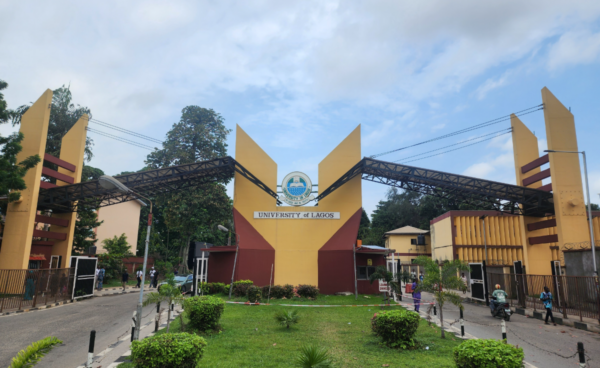
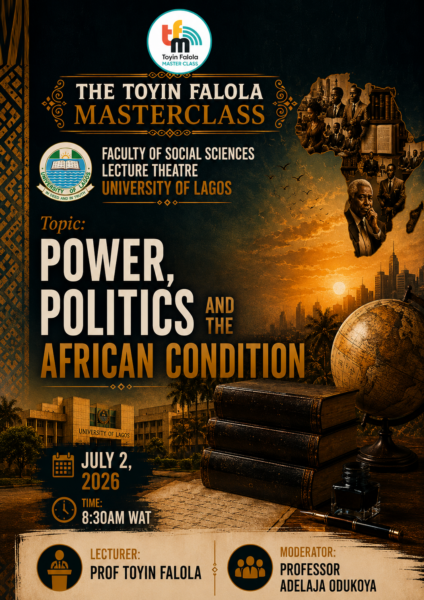
On July 2nd, 2026, the Faculty of Social Sciences, University of Lagos, will host the Toyin Falola Masterclass on “Power, Politics, and the African Condition.” Africa’s future, it may be argued, will depend less on new leaders but more on new ideas, structures, and institutions. In certain periods, each country faces issues where the past demands not only the ability to remember but also the capacity to analyze. Such a period comes for the continent of Africa.
Elections occur periodically on the African continent, economies boom and stagnate under the pressures of global capitalism, coups threaten the democratic system that has been gained over many years, youth find themselves struggling with their identity in the increasingly digital world, and governments try to reconcile development and legitimacy. However, there is one problem that has haunted the above events in the entire history of Africa, from pre-colonial kingdoms to colonized nations, from the struggle for national sovereignty to military regimes, from democratic movements to sustainable development. And this problem is that of power and its politics.
Power could be said to be one of the most poorly understood aspects in debates concerning Africa. From a popular point of view, it appears that power is an aspect that is wielded exclusively by presidents, generals, kings, politicians, or political parties. In truth, power has much wider applications than these. Power can manifest itself through institutions, through history, through economics, through culture, through the production of knowledge, and even through mythology. Politics is simply a medium through which all these other aspects come to play. Thus, when one talks about the scenario in Africa, one is not only talking about identifying the various challenges being faced, which range from corruption, insecurity, poverty, unemployment, weak democracy, and ethnic divisions; these are simply the symptoms.
Africa has suffered enslavement for too long in narratives that were never about it. For example, one such narrative presents Africa as a continent of perpetual misery, where every new misery reinforces already existing stereotypes about its dysfunctionality and every success as an exception. There is yet another story that is as simplistic as the former and presents Africa as the ultimate frontier of Earth, where all opportunities may be found. Either way, it is a story that takes the place of history. Simplification is taking the place of truth. African reality is neither perpetual misery nor certain success. It is a historical process shaped through centuries of political bargaining and interference from outside and from within.

History has always been one of the least understood actors in politics in Africa. History is more than a mere explanation of events that happened in the past; it sets the terms of engagement of the present day. It was not only the process of mapping out territories and replacing traditional rulers with European officials that characterized the colonial process. The entire structure of political authority itself was transformed. Much before the colonial experience, many forms of complex structures of governance had been developed in African societies. In some of the kingdoms, authority was centralized using complex bureaucratic and military structures, while in other places, authority was decentralized amongst councils of elders, age sets, lineages, guilds, and community assemblies.
The impact of colonial rule on such arrangements took place with incredible rapidity. It brought forth an entirely new understanding of the nature of the state, one which was intended to extract rather than represent. Political boundaries were created without consideration for pre-existing associations, making the resulting entities often mere manifestations of colonial convenience rather than reality. Bureaucratic structures were not formed with the purpose of fostering citizenship but instead for the sake of administering tax collection, labour recruitment, economic exploitation, and politics. The colonial state promised order but embodied inequality. The law did not function to deliver justice but served as an instrument of administration. Educations systems served not so much to encourage independent thought but to create mediators. Economic networks connected mines to ports better than villages to markets. The importance of such an inheritance can hardly be overstated. Sovereignty was gained politically, but it could not immediately change systems whose initial aim had never been one of democratic responsibility. New flags were hoisted, new constitutions were drawn up, new national anthems were written, and new governments were established, but much of the bureaucratic practice of empire still lay under the surface of such nationalist enthusiasm. Citizens became electorates, but bureaucracies could remain remote. Governments became African, but the structures through which they functioned often continued to embody colonial ideas of command and obedience.

It is not a case for historical determinism or an encouragement to continue explaining away all problems as a consequence of colonialism. History defines situations, but it does not pardon people from responsibility. In any case, there is always the danger of using history as an alibi in order to explain away every problem without looking at the role of post-colonial leaders and societies in the situation. States inherit situations, but they do not simply accept what is handed down to them, as institutions have developed out of the choices made by political leaders, bureaucrats, judges, businessmen, scholars, journalists, traditional authorities, religious groups, and citizens. The early years after gaining independence saw a lot of hopefulness and optimism in Africa countries. Independence meant political respectability and economic development all over the continent. Those who were leading nationalist movements had created extremely high expectations among the citizens by talking about being sovereign states, industrialized, educated, and unified on one continent. It was expected that independence meant much more than just liberation from the colonial power; it meant the beginning of the African century, where political independence would automatically result in economic prosperity and equality. Opportunities were abundant everywhere. Universities thrived, and civil services hired talented youth.
However, the course of history does not always align with the intentions of its builders. Postcolonial states have been put under pressure that neither old structures nor new governments have been prepared to deal with. Economic reliance on the export of basic commodities left the countries vulnerable to market fluctuations. Ethnic and regional divisions made the task of building nations difficult, often exacerbated by colonial administration. Cold War rivalries turned African governments into valuable allies of foreign powers, which valued political allegiance more than democratic governance. Military organizations, originally built as defenders of sovereignty, became guarantors of the country’s stability. The gap between the euphoria of independence and the weakness of states was bridged very quickly. There may be no place where this dichotomy was more pronounced than in the connection between politics and official positions.
In many cases, access to political power slowly came to mean access to economic opportunity in Africa. The government became the major provider of contracts, jobs, licenses, subsidies, protection, and mobility. As a result, political contestation took on an almost unparalleled degree of ferocity, since victory in politics meant far more than ideology; it meant concrete gain. Politics stopped serving as a means for organizing society; it began to serve as a means of private gain.

This trend cannot be viewed as a moral breakdown. It points to the existence of structural motivations inherent in political economies where the productive parts are less developed, and the state apparatus is endowed with great powers of controlling national resources. Where the state dominates in opportunities for economic activity, being politically active becomes an economically attractive proposition. In this environment, corruption is not only an act committed by a person but a part of the system of motivations structuring the game of political competition. This means that political change involves something else besides the mere substitution of one group of leaders by another. This is the reason why transitions to democracy have frequently been associated with such disillusioning results. Multiparty elections, although a necessary component, do not provide accountability by themselves. The continuation of the process does not rely only on elections, but also on the presence of constraints on power, independent judiciaries that guarantee constitutionalism, professional civil servants who serve beyond one government, legislative branches that can oversee their executives, universities that foster citizenry, and an independent media that can investigate authority impartially. Elections change the government while institutions affect governance.
This contrast will become all the more significant as Africa goes through a period of growth of democracy as well as democratic anxiety. With the revival of military coups in some parts of the Sahel, constitutional changes to increase presidential terms of office, the narrowing of civil society space, misinformation, and decreased faith in elected political bodies, there are many hard choices being raised about the future of constitutional politics in Africa. However, at the same time that such realities are taking shape, there are others that are also coming into play in Africa – the increased politicization, interconnection, and unwillingness to accept authority as a simple matter of right in African societies.
Thursday, July 2, 2026
8:30 AM Nigeria
9:30 AM South Africa
10:30 AM Kenya
2:30 AM Austin
Register Here:
https://tinyurl.com/tfmasterclassafricon
Join Zoom Meeting:
https://us02web.zoom.us/j/87388949922