
Toyin Falola
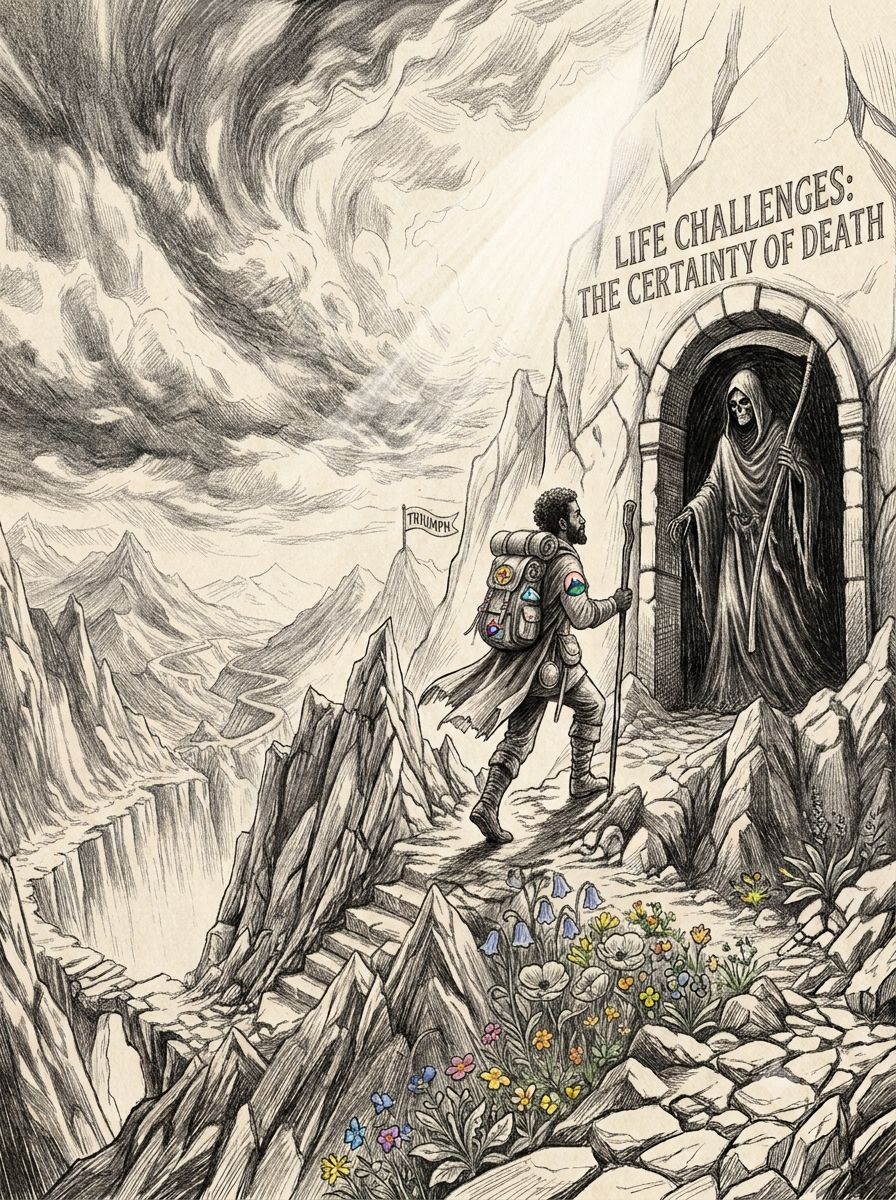
THE CERTAINTY OF DEATH
Poetic Preamble
You will die.
I will die.
When?
How?
Time?
Where?
Don’t ask me
For years, we have continually asked the wrong questions. There have been so many inquiries about why humans die. This is because death has been a faithful companion from the beginning and will likely remain until the end. The most important question now should not be why humans die. A more appropriate question is to ask how societies choose to live knowing full well that they will die. With the right questions, one may begin to understand how we see death.
When Death Forgets to Whisper
Death did not knock.
It knew the door had long forgotten laughter.
It slipped inside like a shadow that had memorized every corner of the house,
Running its cool fingers along the backs of chairs where names were carved,
Counting empty plates for past guests,
Judging silence by the weight of dust.
Morning came, but it forgot how to grow light.
Above the earth, the sun swung like a weary witness,
Unable to convince the flowers that another season was worth blooming.
There is a loneliness.
that even language cannot bury.
It walks barefoot through abandoned rooms,
calling names that answer only with echoes.
The walls remember every voice,
Yet offer none back.
Memory becomes a cemetery.
where every thought is another gravestone.
Hands that rocked futures to sleep
rest quietly at their elbows.
Eyes that held entire universes
have shut, taking nothing with them.
Books remain open,
letters remain unfinished,
dreams remain waiting at stations
where no traveler returns.
The river flows on.
Like it cares for the thirst of those who have died.
Trees raise their arms to the sky
Like heaven cannot hear their questions.
Birds practice their melodies for their ears
That are now unfamiliar with listening.
The wind gathers forgotten footsteps.
and scatters them among fields
where no one remembers who walked there first.
And discover
that grief has learned
to imitate warmth.
Night grows older.
The moon lowers its pale face.
into the black well of the sky,
searching for those
whose names have dissolved into eternity.
Even the stars appear cautious,
as though they fear
that shining too brightly
might awaken another farewell.
In the end,
Death owns nothing; it creates.
It gathers every king and every child,
every poet and every laborer,
yet cannot keep their love,
their kindness,
their songs.
Still, there are evenings.
when the silence is so complete
that the earth itself seems to mourn.
On such nights,
The soul stands at the edge of remembrance,
looking into the vast country of absence,
and wonders
how something as small as a heartbeat
could have held
an entire universe.
Philosophy
No matter what era or period, all human civilizations are faced with one inevitable certainty: death. If we are all going to die, then why do we reach for earthly pleasures knowing that our time will come to an end? Why build empires, have relationships, start families, seek greatness for a temporary life? Africa’s vast number of cultures may not have one definitive answer to what death means. But they do, however, provide one collective consensus; life is about how we choose to react to our mortality. Death is inevitable. In many ways, it’s equally mysterious. But it is our greatest teacher that life is temporary, and we as a generation must choose what we want to leave behind. After all, death is the one thing we can all know for certain. But life is about the decisions you make before death.
As the quality of life gets better by the day, humans have built cities, created empires, and accumulated wealth. They long to keep these achievements and continually amass more. This desire makes them pursue immortality through various means without success. The certainty of death for every attempt eludes their efforts, not merely for biological reasons but as a significant reality of human civilization.
Historically, the awareness of death’s certainty has inspired different responses across African communities. These inquiries have produced philosophies, rituals, and traditionally grounded systems in response to the need to make sense of the mysteries behind human mortality.
Africa is culturally rich in traditions. It would be myopic and misleading to speak of death from a single African philosophy. For a continent with thousands of ethnic affinities, languages, religious practices, and cultural systems, the understanding of mortality differs with little or no similarities in some instances. The Yoruba, for example, share a different notion and approach to death with the Akan, in the same way both systems share a different view from Islamic traditions, influencing major groups in West and East Africa. These beliefs are equally different from ancient Egyptian traditions on the afterlife. Yet, amidst this diversity, there remains a singular recurring theme that connects all: an understanding that death is not a private event. It is a communal event with significance that extends beyond the individual.
This confirmation is important as it bridges the gap between what we know and what modern discussions believe. In recent times, modern discussions have discussed death in isolation, unlike many African traditions that approach the subject of mortality through relationships. The death of an individual when it happens becomes a communal event. It goes down, documented as history, and brings family and friends together. In African societies, the deceased leaves behind a body and numerous obligations, memories, stories, and lessons. This approach shows how African mortality is interconnected with social existence.
The African perspectives of death and what it connotes do not eliminate the tragedy it comes with. It would be naïve to imagine that African societies readily accept mortality with calmness. Death in Africa, just like any part of the world, is accompanied by grief, uncertainty, and fear. The death of a child, a loved one, either as a result of natural or unnatural causes, such as war, famine, disease, and displacement, has left individuals scarred throughout African history. Mortality has reshaped entire communities across Africa massively. The peculiarities of mortality in these instances have pointed out the dynamics of human mortality. Death is not just philosophical. It assumes befitting shapes to prey on human life. The transatlantic slave trade, colonial violence, civil wars, and other human conflicts are reminders that death can arrive violently, to disrupt lives and shatter hopes.
These realities genuinely frustrate any attempt to create it as a mere transition or a tale for caution. We should not forget that death is an interruption. It terminates possibilities and leaves questions unanswered. Many are aspirations that have died over death. Any philosophical enquiry into death requires an honest acknowledgement of its darker dimension. A child who drops out of school over the death of a parent or guardian, or the parent who buries a child, may find no comfort in abstract reflections on nature.
As cruel as it sounds, it is precisely the nature of these dark realities that societies develop coping mechanisms to death. In significant parts of Africa, memory is one means with which humans have learnt to cope with death. Africans find ways to incorporate their deceased into collective consciousness. This they have achieved, through oral traditions, genealogies, praise poetry, and historical narratives, to ensure that those who depart continue to occupy a place within the social imagination.
This approach should not be confused with any claim that remembrance defeats death. It does not. A remembered loved one remains dead. Celebrated heroes and historical figures all remain dead. They do not return. They are only preserved in memory for significance against complete erasure. Memory in this regard is just a means to allow the past to remain connected with the present. This accounts for why the names of great rulers, scholars, reformers, and visionaries remain within contemporary consciousness even in death.
In our time, death has done more in debunking any thoughts of permanence and visibility that digital access promotes. As much as the world celebrates visibility, death serves as a reminder that these presences are fleeting. The applause dies, the camera flickers and stops, wealth changes hands, and successors occupy offices. What remains is the substance of one’s contribution.
This futility may help shed light on why death is a central theme across religious and philosophical thought. Islamic traditions with significant influence on African societies view death as a passage to accountability before God. Traditional cosmologies believe that death brings continuity: reincarnation between generations. Modern thinkers, on their part, hold that mortality gives urgency to human life. When we think of death, we spend time pursuing opportunities, seeking greatness and fulfilment faster. Despite their variations, these perspectives have done something profound. They all lead to a common realization that thinking about death compels a reflection on the essence of life. Perhaps this is humans’ greatest lesson on death.
Death is the perfect demonstrator of the rule of law. It equalizes gently. It takes rulers and subjects alike. It gets to the poor and the rich. However, we should not mistake death’s equality in the same light. Death carries more consequences for some than others. Some have been remembered while others have been forgotten. The distinction lies in what actions they put forward during their time on earth.
Get real. Death is a non-negotiable part of human existence. It requires no proof, and not a single advance in technology and science has found a way to forestall its eventuality. It is so certain that its arrival comes without an invitation. It remains indifferent to the social distinctions and ambitions that characterized the lives of its captives. It has been a part of human existence for generations, finding its way into the existence of new generations who share no similarities with the previous ones. Over the years, death has been confronted as though it were a new revelation instead of the generational reality it is.
A fate worse than death
As bad as your death is, rejoice! You cannot mourn yourself. You are not invited to the funeral ceremony. You are not the archivist of your end. You belong to memory. You live in the fragile hearts of the living who cry for a few hours and move on. You live in the darkness of your grave.
There is a death worse than yours: when you bury your only child and do the grieving and crying. I am afraid I cannot wish you well at this time, as I know people who are walking corpses, praying to die but cannot commit suicide.
Wait!
This is a humbling piece. Yet we see humans who live as if they are immortal. This has significantly enriched my perspective of the temporality of life on this side of eternity. One should always live with eternity in view because the knowledge of when and how death will visit is beyond the comprehension of humans. Thank you so much for sharing this life shaping piece, Sir. More grace as you continue with the enterprise of shaping and reshaping lives. God bless you Sir. Blessed weekend. 🙏
Great! Yes, death is a defining feature of culture. Still, many individuals live in denial or have a partial or perhaps prismatic and therefore idiosyncratic and creative glimpse of the meaning of death in their own culture and what they may this beyond their culture in their own experience. The latter is always a possible feature of diaspora.. – Vik Bahl
Well, death to the indigenous African mind is hardly a defining feature of culture, but the consciousness or verity of “life-after-life” is.
I have just read it. I also read some comments and reactions of the people that read it. It is unique in its poetry, with a lucid philosophical depth. I took my time reading through. Like you rightly pointed out African traditions and cultures are as protean as its many ethnic groups. In Nigeria alone, there are more than 400 ethnic groups, therefore, it cannot be an easy task putting all of them in one basket. However, Africans still, largely, share themes like, worldview, belief systems, and concepts such as life, death and afterlife, myths, legends, contemporary history, all captured in their epic (narrative) poetry, laudatory or praise poetry, dirges and elegiac poetry (a good example is the Yoruba hunters’ “Ìrèmòjé”, a dirge, and a subset of “Ijala”. Your conclusion is that these arts and performances rightly enhance the memorialisation of the departed loved ones, and that they are dead, all the same. To the contrary, I humbly submit that ancestors live forever. I will explain what I mean shortly.
There is no single side to life and death; or mortality and immortality. And it is not peculiar to Africa alone, I believe it has a pluriversal dimension. Humans naturally and generally are animists, but modernity has reduced all that. However, Africans have largely remained animists. Stones, rocks, trees, rivers and animals are believed to have spirits, and are sensitive to their environment. To Africans, LIFE is a Continuum, an endless chain of circle, and cycle: the world of the Unborn children, the world of the Living, and the Ancestral world. Only the world of the Living is tangible, others are not, they are intangible. A spirit child leaves the abode of the Unborn children, and is born into the tangible world of the Living. At death, an old person joins the ancestors in the Ancestral world, and he could be promoted to a deity if he is considered to merit being deified. Africans have the Ancestral cult culminating in “Egungun”-Masqueraders festivals where the ancestors periodically visit and interact with their people in the world of the Living. Should a child die, it is recycled, and returns to the world of the Living, born into a family.
Similarly, some ancestors return to the family with palpable evidence of a “returnee”, with proven signs. For example, the child could display an unusual pre-birth memory, and precociousness associated with the departed father or mother.
In Africa, ancestors are neither extant nor extinct personalities, they are always around, albeit, as spirits, yes. On such occasions when a familiar person dons a masquerade costumes, the primary intention or emphasis isn’t drama, or a bit of entertainment, but rather, the person in the masquerade costumes becomes possessed by the spirit of the ancestor, and he becomes an extra-ordinary man who at that moment embodies the Ancestral spirit. He sees visions and makes prophetic statements. He prays for the people, the barren, the sick, etc., and they have their requests met. And when the festival is over he becomes his normal self, again. The spirits are real, and so are ancestral spirits.. Modern science through technology has been able to track and communicate with spirits (Ref. Paranormal Episodes on the cable channel). Furthermore, a former doctoral student of mine, Dr. Egwu, (currently a faculty member of the University of Nigeria, Nsukka) had worked on Dirges, a funerary poetry tradition in his Igbo community. At a funeral rite, a goat was tied to a tree, and in the course of the invocation that followed the spirit of the departed one manifested Amidst the praise chants and dirges celebrating the man, the goat was visibly weeping with tears running down its face. The spirit of the man was said to have possessed the goat, and that it was the man that was weeping to indicate his painful departure and grief.
To the African, long before the advent of Islam or Christianity, Death, has always been a transition to life-after-life; Death especially of an elderly wasn’t dreaded. People are pained by the transition of a loved one, because he or she has turned into a spirit, and could only be interacted with in dreams, and at uncommon occasions. Death is a translation to the Ancestral world. The indigenous African lives with the consciousness to live a decent, modest life of what the Yoruba refer to as, an Omoluwabi, such that people can be proud of his or her ancestry. This is not peculiar to Africans. The Abrahamic root or faith as we have in Judaism, Islam and Christianity are also associated with ancestral worship, viz Abraham, Isaac, Jacob, and the saints of the Christians are considered as ancestors, that the Catholic, among other Christian denominations, pray to.
The belief in life-after-life, is very much pronounced in ancient Egypt where departed kings and queens were mummified, preserved, deified and their spirits were worshipped. Similarly, in the ancient Oyo kingdom, the Abobaku tradition was very much in practice, where a prominent chief was buried with the dead monarch, so the king could be accompanied in his journey to the Ancestral world. In some ancient East African communities, departed kings were buried with hundreds of cows, and dozens of slaves, golden utensils, etc., to secure a comfortable afterlife, and the retinue of slaves could keep serving him.
The question then is, if the idea of life-after-life is anything to take seriously, why are their decayed remains found in such a rather vain state by archeologists, etc? Well, my response to that is: It is true that archivists, and archeologists might dig up the remains of departed kings and might have things buried with them, their essences, their spirit beings remain, indeed, unreachable and invisible, they’re domicile in the Ancestral realm or world. Therefore, what they dug up and we see are mere relics, the spirits that once inhabited them have long relocated to the Ancestral world.
Finally, the belief in, and consciousness of, life-after-life very profoundly define, determine, and shape the cultures, lives and trustworthiness of the indigenous African, long before the advent of modernity. Death is certainly not a finality. My 2 Kobo. I come in peace. And as we say in my father’s village, TF, e kú isé opolo, well done. Cheers. DAO