

Temitope Fagunwa
What constitutes identity? Under what historical conditions does it emerge? Is African identity an organic inheritance grounded in cultural continuities, or is it a political category fashioned through encounters with power? For more than a century, scholars, nationalists, and philosophers have grappled with these questions. These unsettling yet profoundly important questions are what Toyin Falola confronts in African Identities: Absence, Loss, and the Quest for Self-Definition. In this book, he challenges conventional assumptions about the origins, meanings, and future of African identity, inviting readers to rethink one of the most enduring concepts in African intellectual history.
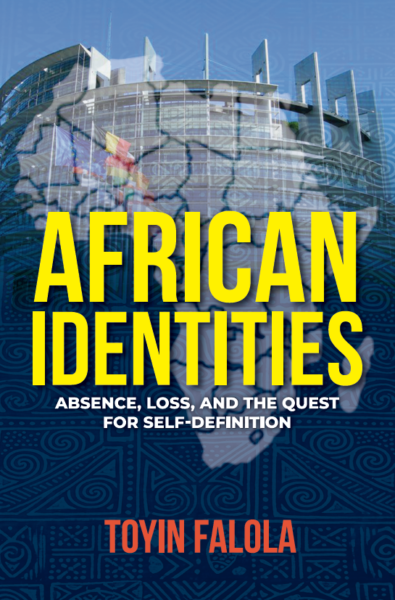
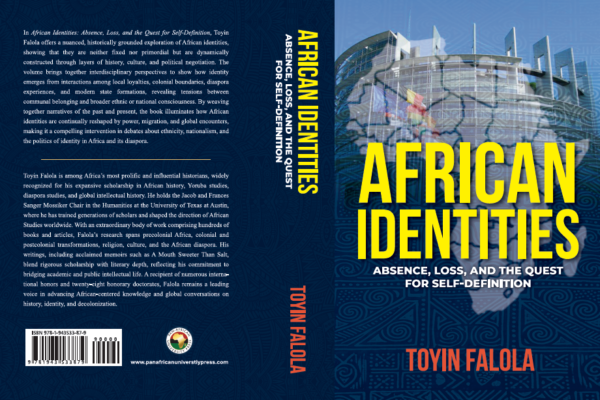
Published by Pan-African University Press, this magisterial 522-page volume unfolds across thirteen chapters and traverses the philosophical archaeology of African identity from early essentialist formulations of “Africanness” to contemporary debates on belonging, epistemic sovereignty, digital identity, hybridity, decolonial humanism, and the challenges of governing diverse societies. Despite its breadth, the book consistently advances the idea that the notion of a singular African identity was forged through colonial encounter. It argues that what is commonly described as “African identity” may never have existed in the coherent and self-sufficient form often assumed in both scholarly and popular discourse. The review that follows examines major intellectual interventions that Falola makes in this important work.
Reopening the Question of African Identity (Chapters 1–3)
The first three chapters provide the conceptual foundation of the volume. Chapter One critically reviews major essentialist formulations of “Africanness”, including Edward Wilmot Blyden’s African personality and Léopold Sédar Senghor’s Négritude. While acknowledging their historical significance, particularly in challenging nineteenth-century racial ideologies, Falola questions whether the cultural affinities and shared historical experiences emphasized by these traditions necessarily constitute a singular African identity. Instead, he finds intellectual comradeship with Paul Tiyambe Zeleza, whose conception of identity as both a state of being and a state of becoming resonates strongly with his own position. Zeleza’s formulation understands identity as historically contingent and continuously evolving, avoiding both essentialist claims of a fixed African essence and purely constructivist accounts that deny historical continuity.
Chapter Two traces the emergence of African identity through precolonial, colonial, and postcolonial contexts. Rejecting claims of a precolonial continental consciousness, Falola argues that colonialism transformed diverse systems of belonging into a singular racialized category, converting identity from a lived and relational experience into a framework for “negotiating authority, legitimacy, and representation rather than a marker for description” (p.40). This invention, as argued, is different from a precolonial logic where identity rested on an individual’s active communal participation and a dynamic relationship between personhood, belonging, moral cultivation, and interdependence. The author notes that many postcolonial identity crises stem from the unresolved contradictions of this colonial inheritance. This argument reaches its most radical expression in Chapter Three (“The Myth of a Nonexisting Identity”), which serves as an important intellectual centrepiece of the book. Here, Falola effectively challenges the assumption that a unified African identity existed before colonialism. While acknowledging Africa’s rich civilizations, networks of interaction, and cultural traditions, he argues that these realities should not be conflated with a unified continental identity, for this was the lacuna propelled by the colonial state. The author thus treats identity as a historical and discursive construction, suggesting that it is not discovered but produced.
Colonialism, Loss, and the Making of Africanness (Chapters 4–6)
Having argued in the preceding chapters that precolonial Africa did not possess a singular continental identity, Falola turns in Chapters Four and Five to the colonial encounter and its far-reaching consequences for the construction of what came to be understood as “African identity”. Chapter Four (“Colonial Encounter and the Creation of Africanness”) examines how colonialism made modern “Africanness” conceivable as a collective category. Drawing on Fanon’s notion of the “zone of nonbeing,” and examples from British, French, Belgian, and Portuguese colonial influences, Falola demonstrates how colonial governments reordered African societies through education, law, religion, cartography, bureaucracy, and linguistic policies. He argues that colonialism was not merely a system of political domination but an epistemological project. As clarified, “The concept of ‘African identity,’ therefore, is itself a colonial artifact. It is a term born in the space where Africa had to explain itself before the tribunal of Europe” (p. 126).

Chapter Five (“The Lost Identity: Cultural and Epistemic Displacement”) deepens this argument by examining the consequences of colonialism for indigenous systems of meaning. Here, Falola moves from the creation of “Africanness” to the problem of loss, as colonialism was charged with the displacement of the linguistic, cultural, epistemic, and moral foundations through which diverse African societies had historically constituted meaningful identities. Particularly significant is his assessment of the question of language, which he describes as “the earliest and most analytically revealing aperture through which the condition of loss may be apprehended” (p. 157). The chapter’s most significant theoretical contribution is the notion of “alienation without origins,” a condition in which Africans were simultaneously separated from indigenous systems of meaning and incorporated into a collective identity whose historical foundations remained contested. Chapter Six (“Postcolonial Fractures: African Identity and the Quest for Decolonization”) then argues that political independence did not resolve this crisis. Drawing on Fanon and Biko, Falola contends that decolonization must therefore extend beyond political sovereignty to encompass the recovery of epistemic agency and the reconstruction of African selfhood. Rejecting both nostalgia and simple cultural revivalism, he presents decolonization as an ongoing project of intellectual, cultural, and existential reconstruction through which Africans may reclaim the authority to define themselves on their own terms.
Identity, Conflict, and the Search for Coexistence (Chapters 7–8)
If the preceding chapters establish that colonialism produced profound disruptions in African self-understanding, Chapters Seven and Eight examine how those disruptions continue to shape questions of belonging, conflict, and coexistence in postcolonial Africa. Chapter Seven(“The Crisis of the Identity Dilemma”) argues that the absence of a coherent basis for self-definition has generated what Falola terms an “identity dilemma”. This is a condition of fractured consciousness in which ethnic, religious, regional, national, and continental loyalties compete for recognition. In solving this contradiction, a form of solidarity, capable of accommodating Africa’s enduring plurality, was favoured over essentialist recoveries of a lost “African essence” and notion of homogeneity. Chapter Eight (“When Peace Is Not Just the Absence of War: Building Everyday Coexistence on the Plateau”) complements this diagnosis by exploring the possibilities of coexistence within societies marked by deep diversity. Marking a methodological departure from the more philosophical discussions that precede it, the chapter adopts a bottom-up and ethnographic approach to examine everyday life on the Jos Plateau through shared economic practices, multilingual interactions, and local peacebuilding efforts. Through this discussion, Falola demonstrates how coexistence is continuously produced through ordinary acts of recognition, reciprocity, and social interaction. At the same time, he shows how identities become sources of conflict when politicized by elites. While Chapter Seven exposes the tensions generated by unresolved identity formations, Chapter Eight demonstrates that diversity need not culminate in conflict.
Reimagining Selfhood: Self-Definition, Future Possibilities, and Decolonial Humanism (Chapters 9–11)
Chapters Nine through Eleven constitute an important philosophical and reconstructive core of the book, where Falola shifts from critique to construction. Chapter Nine (“The Quest for Self-Definition”) distinguishes identity from self-definition. While identity often appears as an externally imposed category, self-definition represents the capacity of Africans to become authors of their own meanings, histories, and futures. As a requisite for identity, self-definition can therefore be understood as a continuous practice of becoming. Chapter Ten (“The Future of ‘African Identity’”) ultimately advances the discussion by examining the ongoing project of African self-definition in an era shaped by globalization, migration, and digital connectivity. Falola submits that the future of African identity should not be sought in claims of cultural purity or nostalgic returns to origins; rather, it resides in the capacity of Africans to envision and construct new modes of being that remain anchored in the continent’s lived experiences while responding creatively to emerging global realities. The philosophical culmination of this reconstruction appears in Chapter Eleven (“Towards a Decolonial Humanism”). Here, Falola moves to reconsider the meaning of humanity itself, presenting decolonial humanism not merely as a framework for African self-definition but as an intellectual and ethical intervention capable of influencing how humanity is imagined globally. He critiques modern humanist traditions for their historical complicity with colonialism, slavery, and racial exclusion, arguing that many universalist claims, like “Enlightenment”, were built upon the denial of the humanity of colonized peoples. Decolonial humanism is presented as an approach to human coexistence that emphasizes dignity, interconnectedness, respect for difference, and shared humanity. Drawing upon African philosophical traditions such as Ubuntu, Falola proposes a vision of humanity that emphasizes ethical coexistence and shared responsibility rather than hierarchy and exclusion.
The Politics of Belonging: Nigeria and the Architecture of Collective Life (Chapters 12–13)
The final chapters bring Falola’s exploration of identity into the realm of political practice. Chapter Twelve (“Managing Nigeria’s Identities for Collective Progress”) uses Nigeria as a case study of the broader postcolonial African challenge of forging unity within diversity. The author unveils how Nigeria’s difficulties stem not from ethnic, religious, or linguistic plurality itself but from the politicization of these identities within unequal institutional structures. Hence, a rejection of colonial assimilationist visions of nationhood was made known through the advocation of inclusive institutions capable of managing diversity. Chapter Thirteen (“The Architecture of Belonging”) serves as the conceptual culmination of the book. Moving beyond identity to the broader idea of belonging, Falola argues that communities are not sustained by shared origins alone but by relationships of recognition, participation, reciprocity, and mutual responsibility. Belonging, he insists, is not inherited but constructed. Rejecting exclusionary notions of community, Falola proposes a vision of belonging that accommodates plurality without sacrificing cohesion. He highlights the importance of dialogue, historical memory, civic participation, and inclusive citizenship in building societies where diversity is embraced as a source of strength rather than division.
Conclusion The book is a deeply provocative and important work. Its central contribution lies in demonstrating that African identity is best understood not as a recovered essence but as an ongoing project of negotiation, reconstruction, and self-definition. The book’s greatest strengths lie in its bold challenge to long-standing assumptions in African Studies and its impressive interdisciplinary breadth, drawing together history, philosophy, political theory, anthropology, cultural studies, and decolonial thought, while moving beyond critique to offer constructive alternatives through the concepts of self-definition, decolonial humanism, and the architecture of belonging. The book also deserves commendation for the clarity with which it situates itself within the constructivist tradition of African identity scholarship. Falola is forthright about working within this intellectual lineage, and the book is strongest as a synthesis of some of its most influential insights. Readers seeking a constructivist critique of African identity will find key theoretical interventions such as Mudimbe’s colonial library, Fanon’s zone of nonbeing, and Mbembe’s reflections on modes of self-writing clearly introduced and integrated into the broader argument. Future engagement could examine Cheikh Anta Diop’s arguments on African cultural unity to further illuminate Falola’s critique of precolonial continental identity. It could also extend the discussion by paying attention to the material economic conditions shaping contemporary African societies, helping to show how the ideals of self-definition and decolonial humanism might be realized in practice. These possibilities point to the richness of Falola’s intervention and the important convers