

Oluwafunminiyi Wasiu Raheem
In the past week, waves of immigration protests have been encountered in some parts of the world. Nowhere has this been very conspicuous other than in South Africa. Many recall how the country fell under apartheid for more than four decades, pushing the black majority population to the background and whose people were treated under some of the most virulent conditions. Although South Africa returned to majority rule in 1994, its persistent (non)violent attacks against fellow African immigrants who have been openly asked to evict or self-deport from the country leave very disturbing concerns for people across the continent and all over the world.
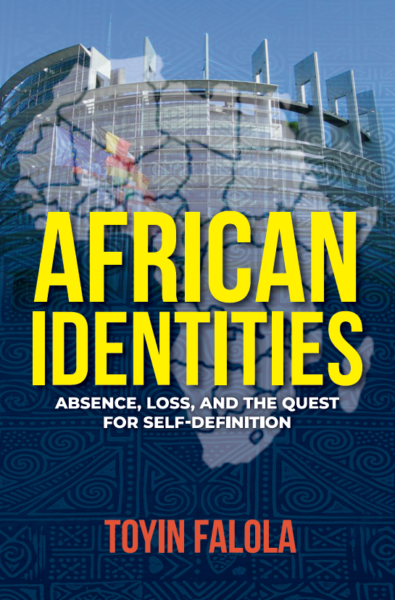
Many questions continue to emerge as to why South Africa chose to go down this path, in what many refer to as xenophobia. This is a very difficult question to answer. While some have blamed decades-long inequality, causing a wide gap between the poor and wealthy as a major factor, others point to several internal security threats South African citizens face daily which they claim are often instigated by immigrants. Whatever it is that has spurred South Africans to take to the streets, calling for the eviction of immigrants/foreigners from their country, the impact will, no doubt, linger for a very long time. This is where Toyin Falola’s book comes to play a very crucial role in understanding the argument or debates around the growing immigrant discontent, not only in South Africa but also in other parts of the world.
In African Identities: Absence, Loss, and the Quest for Self-Definition, Falola comes with a very different scholarly approach to the subject. The author makes the bold claim which suggest that what readers long regarded as “African Identity” does not seem to exist in the coherent and autonomous form it is often conceived of. The author, therefore, provides conceptual clarity based on how it is understood, and then questions whether being African developed organically as a noesis body of autochthony or as a by-product of colonial interactions. How do we explain the absence of African identity? In what way can we claim loss of African identity, and what should be the quest taken for self-definition of the same? These are the questions that Falola’s book tries to explore. The book provides a different historically-oriented framework that demonstrates how African identity is neither defined nor primordial but actively produced based within the domain of history, beliefs, traditions and political mediation.
A book of this nature draws on interdisciplinary views to demonstrate how African identities developed among various experiences and interactions at either the local, national, continental or global/diasporic levels, laying bare tensions between filial relations and broader ethnic or national loyalties.
Discussions on identity formation, belonging and consciousness require in-depth analysis and deeper exploration of the various issues directly or indirectly connected to the continent. This is because Africa, more than any continent, has for much of its post-colonial history encountered some of the most violent conflagrations arising from identity challenges. Whether within a state or between two or more states. The breakup of Sudan into two, and most recently, with Somalia, among other examples of states fracturing within, as a result of various factors.
Since African identity is a very “touchy subject” which often is one of the key reasons for many of the crises Africa encounters today, a book on it requires vast examples that speak to the very core of the whys. The author has, therefore, drawn categorically from what can be considered the mundane and even the ridiculous. African Identity is broken into thirteen chapters of roughly 509 pages which includes a rich bibliography and index.
Chapter One introduces the book with the core argument that the term African identity was a colonial construct that demobilised precolonial operations of how Africans viewed themselves. The chapter took cognisance of the fact that precolonial peoples related based on frameworks that were though independent but also intersect. Homogeneity was not a key signifier but rather belonging was considered relational based on, for instance, spirituality, lineage and communal involvement. By consolidating these experiences into one African identity, the colonial government created an external imposition rather than internal evolution. This would have attendant consequences as African states were ushered into political independence.
Chapter Two takes the reader on an historical excursion on the meaning of the term, African identity. Here, the author shatters the idea of a precolonial Africanness. The chapter situates identity in precolonial times as relational and plural concepts within the framework of communal, spiritual and moral obligations. These were truncated by what the author considered an imposition of racial hierarchies and epistemic violence through a colonial model mediated through language, education, elite politics and nationalism. In Chapter Three, we see the continuation of the argument from the previous chapter which tries to examine whether African identity was a force to reckon with as a unifying attribute before colonial incursion. It interrogates the idea of Africanness and its antecedents. Chapter Four draws its analysis from Okot p’Bitek’s Song of Lawino to explain how colonial intrusion demobilised indigenous selfhood and ensured that redefinition of personhood which replaced communal ideas that symbolised precolonial peoples with what the author referred to as the atomised worldview of Western modernity. Taking a cue from the preceding chapter, the author brings to the fore in Chapter Five the argument that suggests that colonialism birthed Africanness and established its absence which created a fractured notion of identity and existence based on a foreign framework.
Postcolonial sense of identity is explored in Chapter Six through an inherited Western identity system and the quest for authenticity. It argues that this played a key role in the postcolonial conditions found in most African states, where they were locked in perpetual negotiation, where identity is both performed and questioned. Chapter Seven, on the one hand, interrogates the quandary created by the absence of identity and the consequences that arise therein on Africa’s self-conception of the term, while Chapter Eight, on the other hand, draws the reader’s attention to the roots of tension arising from ethnic and religious fault lines in Plateau State. The chapter is a brilliant introspection into how the realisation of the notions of identity, couched in the vexed indigene-settler issue, divided through violence a once historically peaceful, serene and diverse community in North Central Nigeria. Chapter Nine calls for self-identification through the framework of negation which is a search for inclusion and nostalgia which takes cognisance of the precolonial past, where the author calls for an imagined cultural purity as an uninfluenced historical shift. In Chapter Ten, the reader is called to action by the author who suggests a futuristic belief system for African identity that resists reactive ideas and embraces the Afrocentric system that dwells on cooperation and participation.
Chapter Eleven takes the call to action a bit further by proposing a decolonised humanism rooted in African systems. Chapter Twelve draws the reader to occurrences in Nigeria. This is understandable, given its very wide and rich diversity in identity. The chapter points attention to the impact of identity politics on Nigeria which can only be remedied through inclusion, merit and civic engagements. Chapter Thirteen concludes the work by interrogating the architecture of belonging – a system which the author argues is a model of socio-political and digital framework used by Nigerians to interact and belong in recent times. Through a critical reading of AfricanIdentity, one realises that a prosperous and peaceful future in Africa will be determined by the people’s capacity to disaggregate any notion of external loyalties. As the world enters a New World Order dominated by new superpowers, Africa must reclaim its place and space by ensuring that it learns from its historical evolution and uses it to facilitate its own progress and development. If the African identity imposed upon the continent by colonialism has consistently created divisions, it is time to, therefore, take a critical view of it. Falola has given us one of the most compelling works on the subject of identity and an intellectual companion for many years to come.