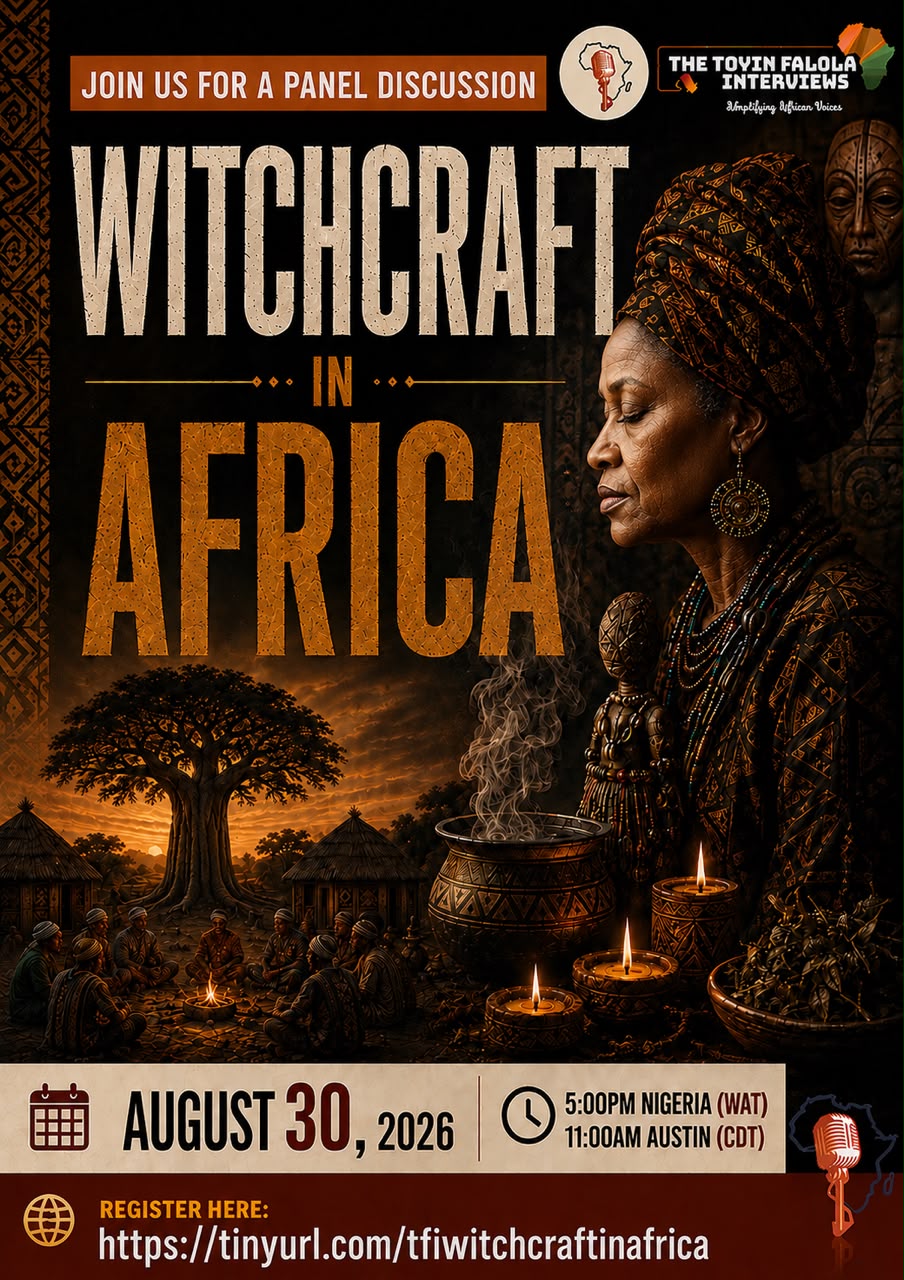

Toyin Falola

A Panel Discussion on Witchcraft in Africa
Civilizations are partly judged by their epistemic constructions and the empires that they built, but also by how they have attempted to unravel the mysteries of how the universe works. There is no civilization which has not grappled with the question of luck and misfortune, of life and death, fortune and disaster, justice and suffering. For some civilizations, they were philosophical; for others, religious; for yet another, scientific; while for others, it was a combination of all these approaches. The intellectual tradition of Africa is that of philosophers, priests, physicians, politicians, artists, and citizens who did not always differentiate between what could be seen and what could not be seen. It was a world in which reality went beyond what could be seen with one’s own eyes, where human existence was defined by a complex interplay between the physical and the metaphysical, the natural and the supernatural, the individual and society.
Among many notions that developed from this enormous cosmological imagination, there are not many that have fascinated scholars in the same way and created controversies and misunderstandings as the notion of witchcraft. The mere mention of the concept conjures up images of something other than Africa, something that is imagined through centuries of European folklore, the behavior of the colonizers, the literature of missionaries, and the pop culture media. The concept of witchcraft in the English language, indeed, is a complicated one that recalls Europe, the Inquisition period, Salem, and Christianity. But Africa’s intellectual legacy cannot be summed up thus easily. The Yoruba speak of àjẹ́, a concept layered with meanings that encompass power, creativity, destruction, secrecy, and social responsibility.
In the case of the Azande, an ethnic group in Central Africa that was extensively researched by E. E. Evans-Pritchard, witchcraft is different from magic and divination. All three concepts have their own place in a systematic theory. In the languages of the Akan, Igbo, Shona, Kongo, Tiv, Nupe, Edo, and many other people, the words for the notion of hidden power show their various histories and philosophies. It is not correct to use one category of the English language to translate all of these complex epistemologies. This is not only a semantic problem but an epistemological problem. It brings up some very basic problems regarding the creation of knowledge, the categories used to create our realities, and how colonizers’ vocabulary continues to influence our interpretation of the African world, as I have always maintained that the study of the African community should be done from their own philosophy and intellectuality rather than those ideas developed by colonialist powers. In my works on the history of Yoruba people, religion, folklore, and indigenous knowledge, I argued that just like Greek metaphysics, European political philosophy, or the religious thought of Asia, African categories deserve the same philosophical regard.
Perhaps few things demonstrate this more clearly than witchcraft. Colonial administrators and Christian missionaries portrayed the belief in witchcraft among Africans as a sign of irrationality. Witchcraft provided colonialists with a way of justifying the civilizing mission, manipulating a symbol through which this could be achieved. The indigenous religions of Africa were considered to be primitive, the native medicine men were dismissed as frauds, and natural phenomena were explained as superstitious. Colonial laws made some practices illegal while at the same time rejecting the African system of solving such accusations and restoring harmony in their communities. However, the irony is that even Europe had a bloody history of witchcraft accusations. Thousands died during the European witch hunts between the fifteenth and seventeenth centuries, yet colonial discourse presented belief in invisible malevolent power as uniquely African.
Anthropology complicated this narrative. As shown in one of the ethnographies of the twentieth century, the worldview of the Azande regarding witchcraft was neither confused nor illogical. Rather, it constituted an intricate system of rationales. The popular narrative of the collapsed granary became legendary. Termites caused the weakness in the structure. It was physics that caused the structure to fall apart. What witchcraft did was make it fall apart precisely when certain people happened to be sitting beneath it. This difference is crucial. Science talks about mechanics. Witchcraft talks about morals. It answers not simply how something occurred but why misfortune visited particular people at a particular moment. In doing so, Evans-Pritchard challenged one of modernity’s deepest assumptions, that rationality belongs exclusively to Western science.
Further research has taken this perspective to higher heights. For instance, John Mbiti made it clear that African religions cannot be properly studied without paying close attention to how they relate to the concepts of time, society, and spirituality. Bolaji Idowu’s study of Yoruba religion helped in showing how profound the philosophies are in the indigenous cosmologies, while I have shown how flexible the African religions have been throughout history. Together, these scholars revealed that invisible realities are not peripheral to African thought; they constitute one of its organizing principles.
The invisible, however, has never stood still. One of the most significant aspects of African history has been the persistence of the language of witchcraft in spite of tremendous changes in society. The colonizers, the urbanization process, the industrial revolution, literacy, democracy, the Pentecostal revival, neoliberalism, new modes of communication, and artificial intelligence have affected almost every aspect of African society. Witchcraft, however, did not go away. On the contrary, in some ways it became even more prominent than it used to be. This persistence unsettled earlier modernization theories, which predicted that scientific progress would inevitably dissolve traditional beliefs.
Peter Geschiere has challenged this assumption. Through his long period of engagement with studies in Cameroon and other societies, he has shown that modernity has neither ended the practice of witchcraft nor exhausted the sources of anxiety, which make an appeal to occultism more and more necessary. The global economy offers unparalleled chances for prosperity, but increasing inequalities accompany it. Democracy offers a chance for the people to control their leaders, but often leads to corruption and frustration. Migration offers opportunities but breaks kinship bonds, which could serve as the means of mediating social conflicts. In such cases, the issues of invisible powers take on new importance. Extraordinary success, unexplained wealth, sudden illness, electoral victories, commercial collapse, or unexpected death are rarely experienced as isolated events; they become occasions for broader moral inquiry.
The Comaroffs further developed this idea in the context of what they called the “occult economies” framework. As the Comaroffs noted, in Africa, times of economic liberalization are times when there is a renewed interest in invisible methods of accumulation. When success cannot be linked to any concrete labor process, people try to find some answers beyond the realm of economic theory. There are stories told about ritual ways of accumulating money, magic contracts, mystic transactions, and hidden power structures. Such ideas, even if not taken seriously, show the fears of people toward inequality and exploitation. Witchcraft, in this sense, becomes less an archaic remnant than a sophisticated commentary on contemporary political economy. However, if we were to view witchcraft purely in economic terms, then we would be reducing its intellectual value. African religious belief systems have always defied the hard distinction between the holy and profane, material and spiritual. The dead continue to take part in society. Divination gives direction where normal observation fails. Healing includes both physical and social aspects. Dreaming reveals truths beyond what waking thought can perceive. Rivers, forests, mountains, and shrines have pasts beyond their physicality. Within these ontologies, witchcraft is a single aspect of an entire universe in which the human being is spiritually interconnected.
The writers of literature have best expressed the richness and complexity. In the novels written by Chinua Achebe, there is an indication of a world where both visible phenomena and invisible moral powers operate without any conflict. The imagination of Wole Soyinka moves beyond the limits set by the division between the living, the dead, and those yet to be born, suggesting that reality is something more than what can be perceived empirically. While Amos Tutuola created the most fantastic world from the folklore of the Yoruba community, Ben Okri’s fiction broke down all the barriers between dream and reality. These authors are not merely imitating the folklore traditions, but they are expressing their philosophical ideas through which the tangible world cannot exist without the intangible world.
This is reflected even in the African oral tradition. Stories, proverbs, praise songs, tales, epics, and ritual performances carry the thoughts of the generations on matters of power, accountability, jealousy, reciprocity, and ethics in society. The character of the witch does not serve the role of a person as much as it serves the purpose of a moral symbol whereby societies try to deal with the threats posed by too much ambition, antisocial tendencies, and failure to fulfil community obligations.
Thus, witchcraft is not only religious, but it also raises ethical issues. History calls for prudence regarding romanticism. Witchcraft allegations have caused a great deal of harm throughout different eras. Older women and men have been banished from their villages. Young ones have been disowned or abused. People who have disabilities, mental problems, or deformities have always been prone to suspicion. Religious businesspeople have exploited fear through dramatic delivery ceremonies, as have political players by means of witchcraft allegations for political purposes. It is important to bear in mind that beliefs are always practical and operate in specific social and political environments. Respect for indigenous belief systems should not be at the expense of injustice.
Gender plays a very special role in this history. In many societies, womanhood has carried both immense spiritual power and immense vulnerability. For the Yoruba, the term àjẹ́ points to an idea in which feminized spiritual power is not intrinsically evil or good, but is rather ambivalent, and may be nurturing or destructive depending on the ethical dimension of that power. This aspect was not always taken into consideration by colonial readings, which tended to reduce these sophisticated ideas to simplistic notions of the evil nature of women. Modern feminist research, for example, has drawn new focus towards pre-colonial perceptions of gendered authority and spirituality.
This is a new chapter ushered in by the digital era. Magic travels via the television screen, Nollywood movies, YouTube, WhatsApp, TikTok, and internet prophecy. It is no longer just rumours spreading in the village, but instantly across continents. Diasporas give a new twist to their cosmologies in the global media. While artificial intelligence heralds an unprecedented advancement in technology, it does not replace humanity’s eternal quest for the supernatural. The symbiosis of smartphones and shrines, biometrics and divination, cryptocurrency and ritual economy reveal how adaptable African intellectual traditions are.
Maybe the endurance of witchcraft is an indication that this practice says more about humanity than anything specific to Africa. It is the case that all cultures create their own languages for discussing the unknown. The ancients had their oracles, medieval Europeans had divine pronouncements, and modern people have unseen forces behind stock market movements, conspiracy theories, or algorithms which are opaque to the common person. Human beings need explanations that go beyond immediate physical sensations. Conversations on witchcraft in Africa constitute part of such a tradition.
Therefore, the challenge for researchers does not lie in validating or refuting beliefs but in understanding them. The study of witchcraft is essentially an exploration of how philosophical, religious, anthropological, political, economic, literary, historical, psychological, and legal perspectives interconnect. Above all, the essence lies in recognizing that African cosmologies are not dead concepts to be transcended but living ways of thought which change over time.
It is within this larger context that The Toyin Falola Interviews will hold the panel discussion on Witchcraft in Africa. The conversation will attempt to shed light on one of the longest-running and most contentious topics by means of thorough historical analysis, philosophical consideration, and interdisciplinary discussion. Not attempting to confirm stereotypical beliefs and sensational assertions, the discussion invites its participants and viewers to consider the topic as a problem of intellectuality and history.
Indeed, debates on witchcraft are not only about invisible forces. It is about visible societies. It is about the ways these societies define what is just and unjust for them, interpret success and suffering, manage fear and hope, and keep their systems of knowledge through numerous generations. It is impossible not to acknowledge that studying witchcraft means studying the long and everlasting dialogue of Africa with itself, a dialogue which has gone through conquest, conversion, colonization, globalization, and the progress of modernity, yet remains a challenge for scholars reconsidering the concepts of knowledge and reality.
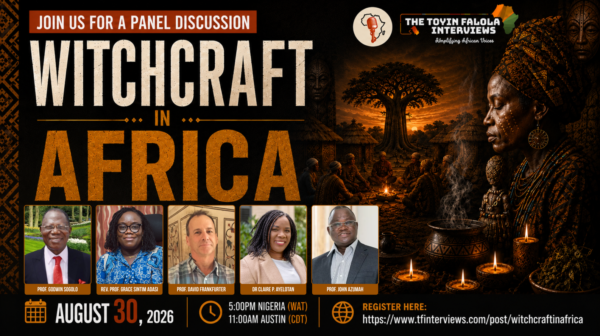
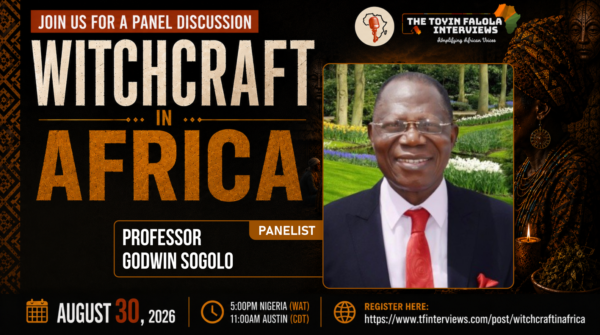
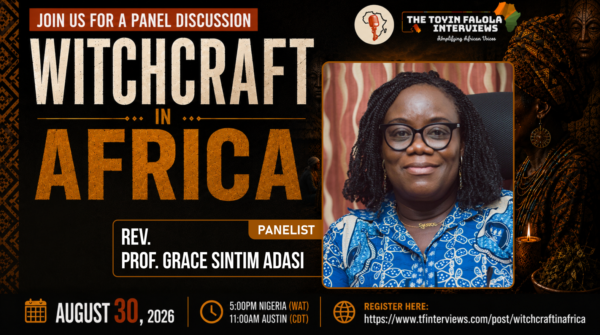
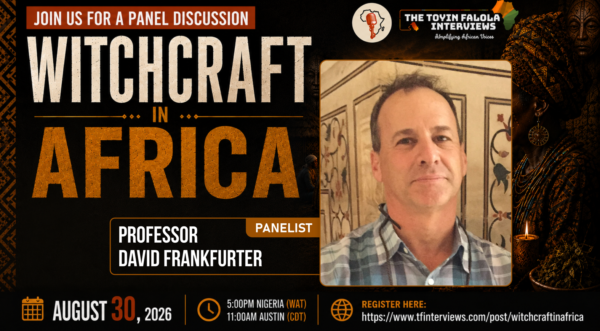
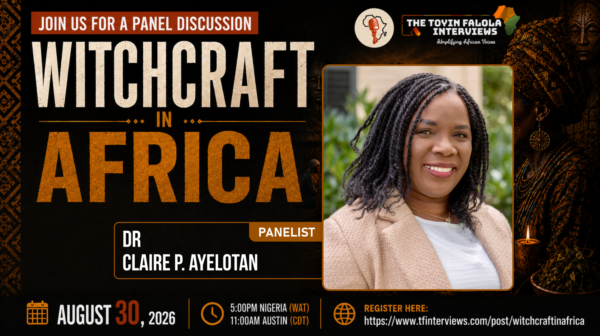
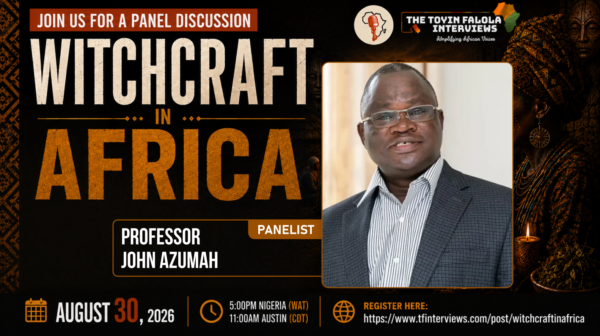
Please join us for a panel discussion with our distinguished panelists, Professor Godwin Sogolo, Rev. Prof. Grace Sintim Adasi, Professor David Frankfurter, Dr Claire P. Ayelotan, and Prof. John Azumah, who will be sharing their expertise on “Witchcraft in Africa.”
Sunday, August 30, 2026
11 AM Austin
4 PM Ghana
5 PM Nigeria
6 PM South Africa
Register Here:
https://www.tfinterviews.com/post/witchcraftinafrica
Join via Zoom:
https://us02web.zoom.us/j/84764707402
It’s been nice acquiring your teachings