
Oluwatoyin Vincent Adepoju
Compcros
Comparative Cognitive Processes and Systems
https://uwpress.wisc.edu/Books/I/Ifa-Priestcraft
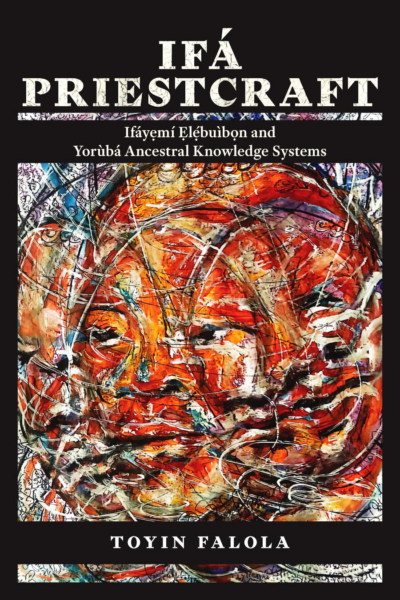
Ifá Priestcraft: Ifáyemí Elébuìbon and Yorùbá Ancestral Knowledge Systems, by Toyin Falola
Product details
Publisher : University of Wisconsin Press
Publication date : July 21, 2026
Language : English
Print length : 420 pages
ISBN-10 : 0299357104
ISBN-13 : 978-0299357108
Dimensions : 6 x 1.1 x 9 inches
Table of Contents
Preface
Note on Translation
Introduction: Cosmologies in Global Historical Context
- Ẹlẹ́bùibọn: The Preternatural Voyage of a Mystic
- Being: The Immaterial Beginning
- Human Actions and Destiny
- Sacrifices and Sacred Communications
- The Invisible Hands
- Ọbàtálá and His Children: Constructing a Functional Society
- Ọ̀rúnmìlà and Akápò: Conflict Management and Resolution in Ifá
- Inclusivity and Gender in Ifá
- Sacredness in the World
- Àśę: The Performative Force of Ìwúre
- Ẹlẹ́bùibọn: Ifa Epistemologies and Yoruba Cosmologies
Conclusion: Ẹlẹ́bùibọn and Cosmologies in Contemporary Society
Acknowledgments
Notes
Index
Book Description
Born in 1947, Ifáyẹmí Ọ̀ṣúndàgbonù Ẹlẹ́buìbọn descends from a long line of Yorùbá healers, philosophers, and priests. A fervent disciple of Ifá from age four, Ẹlẹ́buìbọn grew to become both a living moral exemplar and an internationally recognized face of his religion. The first scholarly work to connect the biography of a devout Ifá practitioner to broader intellectual conversations around pluriversalism and Indigenous knowledge systems, Ifá Priestcraft analyzes the complexities of Yorùbá philosophy and religion and their lasting cultural impact in Nigeria and throughout the diaspora. Toyin Falola, a world-renowned scholar of African studies, employs a phenomenological approach that recognizes and solidifies the voice of the “guru” as an organic and authentic source of knowledge. The result is a wholly original and uniquely interdisciplinary study of Yorùbá spirituality and an extraordinary contribution to the field of ancestral studies.
Reviews
“A lavish invitation to discover Yorùbá cosmology through the lens of Ifá, a spiritual system of knowledge and divination. Falola offers critical insights into Yorùbá spirituality and cultural continuity—essential for scholars of African studies and diaspora histories.”
— Akinloye Ojo, University of Georgia
“Falola explains the complexity, profundity, and relevance of the Ifá divination system through the lens of a great philosopher-priest of Yorùbá traditional religion. This is a major work that will change how scholars understand African indigenous philosophy.”
— Nimi Wariboko, Boston University
About the Author
Toyin Falola is a Distinguished Teaching Professor and Jacob and Frances Sanger Mossiker Chair in the Humanities at the University of Texas at Austin. Falola is the author or editor of more than 150 books on African history, politics, and society. He is the recipient of twenty-eight honorary doctorates from around the world, as well as more than forty lifetime achievement awards.
Abstract
This essay develops the anticipatory review as a form of speculative hermeneutics—an imaginative and critical exploration of a book’s intellectual possibilities before a complete encounter with its argument. Taking Toyin Falola’s Ifá Priestcraft: Ifáyemí Elébuìbon and Yorùbá Ancestral Knowledge Systems as its focus, the essay examines the work’s promise as a rare biographical study of an accomplished practitioner of an indigenous African spirituality.
It explains why the book will be a landmark study of the life, thought and spiritual vocation of one of the most prominent contemporary practitioners of Ifá as an indigenous Yoruba knowledge system. Reading the book’s chapter architecture as an intellectual map, the essay examines its promise to unite the biography of the distinguished babaláwo-adept in Ifa’s esoteric knowledge- Ifáyemí Elébuìbon with sustained inquiry into Yorùbá metaphysics, cosmology, epistemology and social philosophy.
This essay situates the book within the sparse literature on individual adepts of indigenous African spiritual systems and examines biography as a vehicle for understanding spirituality as lived experience. The discussion ranges across cosmology, metaphysics, destiny, sacrifice, invisible agency, social ethics, gender, sacred presence, àṣẹ and Ifá epistemology. It also places the projected study in conversation with comparative religion, phenomenology, science, computing, Buddhism, Christianity, Hinduism, Fulani spirituality and Western esotericism.
The essay argues that Falola’s conjunction of biography and cosmology may illuminate not only Ẹlẹ́buìbọn’s life but also the distinctive ways in which Ifá unites knowledge, practice, personhood and society, presenting the African spiritual practitioner as a thinker, interpreter and living source of knowledge as it demonstrates how a human life can become a lens through which an entire universe of thought comes into view.
The main text of the essay is punctuated by images, often complemented by commentary, through which I expand the essay’s referential and evocative force, developing my philosophical and mystical aspirations in Ifa, in relation to other African and global cosmological traditions, as a means of exploring the essence, structure and dynamism of existence.
These images adapt the Igbo concept ”mgbọrọgwụ”, roots, metaphorically understood, which Zzadora Izuogu and Chiagozem Orji develop in terms of a quest for cultural and metaphysical roots. This expansive evocative range is suggested by pictures of the awesome nature/human creativity synthesis that is the Ta Prohm architectural complex in Cambodia, where the ruins of an abandoned Buddhist temple have become a home for massive trees dramatising the myriad dynamisms of plant life.
The idea of the human being, in particular, and existence, in general, as ”rooted” in a fecundative source, an image correlative with the symbol of the cosmos as a tree developed particularly in the Norse Yggdrasil and the Jewish/Western esoteric Kabbalistic Tree of Life are evocative possibilities in terms of which I understand these pictures, correlative with the Ifa image of the Odu Ifa, Ifa’s organizational system and cosmological architecture, as a tree ( Wande Abimbola, An Exposition of Ifa Literary Corpus).
Contents
Book Announcement
Abstract
Why Write an Anticipatory Review?
Image and Text: Quest for Cultural and Metaphysical Roots
A Landmark Study of an Adept in an Indigenous African Spirituality
Image and Text: The Metaphysical Moment
Biography as the Phenomenology of Spirituality
The Babaláwo at the Intersection of Spirit and Matter
The Introduction: Cosmologies in Global Historical Context
Chapter One: “Ẹlẹ́bùibọn: The Preternatural Voyage of a Mystic”
Image and Text: An Autobiography of Yemi Elebuibon
Chapter Two: “Being: The Immaterial Beginning”
Chapter Three: ”Human Actions and Destiny”
Image and Text: Emergence
Chapter Four: “Sacrifices and Sacred Communications”
Chapter Five: “The Invisible Hands”
Chapter Six: “Ọbàtálá and His Children: Constructing a Functional Society”
Chapter Seven: ”Ọ̀rúnmìlà and Akápò: Conflict Management and Resolution in Ifá”
Image and Text: The Illumination
Chapter Eight: “Inclusivity and Gender in Ifá”
Chapter Nine: “Sacredness in the World”
Image and Text: Cosmic Plenitude
Chapter Ten: ”Àśę: The Performative Force of Ìwúre”
Chapter Eleven: ”Ẹlẹ́bùibọn: Ifa Epistemologies and Yoruba Cosmologies”
Conclusion: Ẹlẹ́bùibọn and Cosmologies in Contemporary Society
The Promise of Ifá Priestcraft
Image and Text: The Hunger for the Absolute
Why Write an Anticipatory Review?
Why not read a book before writing a review of it? Why write a review examining what the book may contain? Is that not a contradiction, since reviews are conventionally understood as composed in response to a creative product one has fully encountered?
An anticipatory review is an opportunity to navigate the universe constructed by the book before reading it. One thereby savours its ideational delights, like delicious biscuit crunching under delighted teeth, even as the mind races forward to further immersion within the cosmos unleashed from within the borders shaped by the book’s opening and conclusion, a world leaping into existence from within the solidity of the front and back covers of the citadel of wonder that is one of humanity’s greatest achievements, fixing the topographies of speech into scribbles on a surface which may be carried compactly from place to place, and even more compactly translated into an invisible form that opens to sight when certain keys are touched-the digital text.
Image and Text: Quest for Cultural and Metaphysical Roots
”… the roots move like fluid, sheltering different patterns representing the preservation [ and exploration] of one’s heritage.
[ The roots also [ embody [the Western esoteric Hermetic] saying “As above, so below.”
“As above, so below” means that the patterns of the universe are reflected in all aspects of life, from the vast cosmos to the smallest details on Earth.
It suggests that the spiritual and physical worlds are interconnected, and what happens in one realm influences the other. This idea is often used to explain harmony, balance, and the principle that understanding the small can reveal the nature of the great.”
Chiagoziem Orji, Mgbọrọgwụ.
A Landmark Study of an Adept in an Indigenous African Spirituality
Toyin Falola’s Ifá Priestcraft: Ifáyemí Elébuìbon and Yorùbá Ancestral Knowledge Systems isperhaps the second book on a babalawo, adept in the Yoruba Ifa knowledge system, in Nigeria, the first perhaps being by Elebuibon on himself.
Falola’s study promises to go beyond the wonderful work of Henry Drewal and Margareth Thompson Drewal on the babalawo Kọ́láwọlé Ọ̀ṣítọ́lá in ”An Ifa Diviner’s Shrine in Ijebuland” and taken further by Margareth Drewal in Yoruba Ritual: Performers, Play Agency.
It may also be the most recent major book devoted to an adept in an indigenous Nigerian spiritual system. The first such study known to me is Ulli Beier’s The Return of the Gods: The Sacred Art of Susanne Wenger, followed by other books by and on Wenger, whose life and work were shaped by the indigenous Yorùbá spiritual and philosophical tradition, as Ẹlẹ́buìbọn’s have been. Ifá Priestcraft therefore belongs to a small but vital body of writing on accomplished practitioners of indigenous African spiritual systems, both within Africa and beyond it.
Accounts of personal spiritual and philosophical exploration in indigenous African traditions have often been obscured by the limitations of oral transmission and by the relative de-emphasis on individual spiritual identity in many classical African art forms. In this respect, the situation differs from Buddhism and Christianity, for example, where extensive traditions of biography, autobiography, hagiography and spiritual testimony preserve the paths of individual seekers and adepts.
Image and Text: The Metaphysical Moment
Finding myself stranded on this sphere in space,
I wondered why I am here, where I am coming from and where I am going to
Is my life a story I am telling or a story told by others, others unknown to me?
Or is it something of both?
Ifa operates through a narrative epistemology in which the meaning of existence and its possibilities are explored through narrative, an
understanding focused in the lines above through Falola’s description, in his Yoruba Metaphysics, of life as narrative as understood in Yoruba cosmology.
Owusu-Ankomah’s figure in Ovalon suggests a moment of acute sensitivity between existence and meaning in which the structural concentration of the kneeling figure, amplified by the visual structuration centred by the enclosing circle, the entire composition suffused by a deep crimson vitality galvanizing the stillness of the kneeling figure, evoke a person humbled by sensitivity to what Stephan Korner in Kant describes as ”the metaphysical moment”, where the mystery of existence collides with sensitivity to one’s taken-for-granted existence, resulting in prayer, profound thought, creative expression or some other possibilities.
Biography as the Phenomenology of Spirituality
Why are writings about accomplished people within spiritual systems significant?
They are valuable particularly because they demonstrate the lived experience, the phenomenological realities of that spirituality. They dramatise its significance beyond theories, theologies and institutional structures. Religious systems crystallise aspiration and experience into doctrines, rituals and organisations, but such structures reflect the experiential dimension with varying degrees of luminosity—brilliantly in some instances, dimly in others. At times they elevate those who identify with them; at other times they restrict them.
The life of an adept can disclose how inherited structures are inhabited, interpreted, tested and transformed by a particular person. Biography thus becomes a meeting place of doctrine and experience, community and individuality, tradition and innovation. Through it, we may see how a spiritual system actually works within a human life.
Falola’s book may therefore be expected to offer a survey of Ẹlẹ́buìbọn’s life and thought in the context of the knowledge systems in which he works-Ifa and the larger body of classical Yoruba thought, written in Falola’s characteristic blend of simplicity and ideational range.
The Babaláwo at the Intersection of Spirit and Matter
What might a book about a babaláwo, an adept in the esoteric knowledge of Ifa, reveal about Ifá that a more general study cannot? Might it illuminate the intersections of spirit and matter, the exploration of which is central to a babaláwo’s vocation?
Might it examine ideas of time that are thought to enable a babaláwo to predict the future accurately, as I have witnessed at first hand? Could it show how divination links cosmic pattern, personal circumstance and practical decision?
Looking through the description of the book, it seems Falola bridges biography and cosmology, rooting both in the social contexts fed by Ifa and which Ifa feeds.
It would appear he is making another ambitious push, as he did in Yoruba Metaphysics, to achieve something unique in Yoruba thought. In this instance, correlating biography with a dense study of a knowledge system and its social expressions, using these in shaping the new field of study he is developing, African Ancestral Studies, a rich manifesto of which could be his essay ”Ritual Archives”.
The Introduction:Cosmologies in Global Historical Context
The title of the introduction, ”Cosmologies in Global Historical Context” is deeply promising. It suggests that rather than simply focus on his subject and its immediate ideational contexts, the author seeks to contextualise it in relation to its global cosmological frame, a planetary field of possibilities. He would thereby map Ifa as one node in a vast network of similarities and differences, permutations akin to the patterns of divergences and convergences, the Odu Ifa, in terms of which knowledge of Ifa is organized.
This being a very broad subject, how will the author go about it? Which cosmologies will he privilege since he will need to make selections? Will he address the West African divination network to which Ifa belongs in terms of cosmological, structural, practical and at times symbol similarities-from the Igbo Afa, to the Benin Oguega, the Dahomean Fa and the Ghanaian Afan, if I recall the last name correctly, and ranging even further to the Chinese I Ching?
How does the binary organisation of these systems relate to binary order as fundamental in nature and in how it has been developed in various ways down to the information management system represented by computing as Olu Longe pioneered the discussion in his ”Ifa Divination and Computer Science”?
Or will Falola use a more expansive approach in discussing global cosmologies? The wording of the introduction evokes the infinite possibilities of this zone of study, which protean scholars such as Mircea Eliade in Patterns in Comparative Religion and Cosmos and History and Rudolf Otto in The Idea of the Holy have grappled gamely with, exploring the cosmological hunger of the human being, with other scholars, such as Paul Davies in The Mind of God and other works exploring this cosmological imperative of the human being even in the context of the sciences.
The title of the introduction, ”Cosmologies in Global Historical Context”, is therefore most ambitious, and for a book on Ifa, such an expansive framing may well be unique.
Chapter One: “Ẹlẹ́bùibọn: The Preternatural Voyage of a Mystic”
Chapter One would certainly narrate and examine Elebuibon’s journey into his sacred calling. Will it extend the account he has already given in his autobiography? Will Falola reinterpret the events of that life through the larger philosophical architecture of Ifá?
Image: An Autobiography of Yemi Elebuibon
Biographies of spiritual adepts can be very thrilling. A stairway of growth is unveiled of expansion of awareness beyond the conventional and of efforts to harmonise such awareness with one’s everyday reality. A sense of vocation blossoms-”the orientation of a person’s life and work in terms of their ultimate sense of mission” ( Webster’s).
The Buddha’s withdrawal into solitary meditation for years to discover the meaning of existence after his shocked awareness of mortality represented by old age, sickness and death; Ignatius of Loyola discovering his vocation during confinement for injuries received as a soldier, a period fundamental for his founding one of the greatest of Catholic Orders, the Jesuits; Ramana Maharshi’s meditation for years in isolated places through which he came to understand the power of his divine, inner self, the essence of the human being as perceived in Hindu thought; developments of relationships with spirits through plants as recounted by shaman Manuel Córdova-Rios, these and more constitute frontiers of human being and becoming, explorations measuring human potential against the human condition, as stated by Arnold Toynbee of the drive that moves people towards the more extreme of spiritual quests in withdrawal from society.
Chapter Two: “Being: The Immaterial Beginning”
Chapter Two promises an engagement with the metaphysics underlying Ifa as an exploration of the intersection of ”Being”, the ultimate ground of existence, and its expression in terms of the multiplicity, dynamism and order of the universe.
Does the universe have a centre of meaning, direction and creation? What is the source of the capacity to perceive possible futures, which the babalawo may demonstrate ?
Wande Abimbola describes Odu Ifa, the organizational categories of Ifa, the system in terms of which ese ifa, Ifa literature, is organized, as akin to chapters of a vast book of unknown scope, as the number of extant ese ifa is unknown. Yet, unlike a conventional text, these organizational structures, the Odu Ifa, are also depicted by him as spirits, sentient entities ( An Exposition of Ifa Literary Corpus). The Odu Ifa are thereby depicted as multi-ontological, self conscious entities expressed in varied forms, as spatial patterns and numerical combinations
Babalawo Joseph Ohomina goes further to depict the Odu as
…the names of spirits whose origin we do not know. We understand only a small fraction of their significance. They are the power behind the efficacy of whatever we prepare. They are the names of all possibilities of existence. Abstract and concrete, actual and potential. Concrete forms such as rain, water, land, air and the stars, abstractions such as love and hate, situations such as celebrations and conflict, all have their spiritual names in the various Odu.
( Oluwatoyin Vincent Adepoju, ”Cosmological Permutations : Joseph Ohomina’s Ifa Philosophy and the Quest for the Unity of Being” )
Ghanaian Efa practitioner Nyornuwofia Agorsor depicts them as angels ( Oluwatoyin Vincent Adepoju, ”The Metaphysics of Language in the Yoruba Origin Ifa System of Knowledge in a Comparative Context“).
What could Elebuibon’s views on this be? What may be his experience of the spiritual dimension of Ifa, the aspect that goes beyond conventional awareness into relationships with forms of existence ordinarily inaccessible to human senses or mind?
The chapter on Being is one of the richest in Falola’s Yoruba Metaphysics. Will a comparable depth and scope emerge in this chapter of Ifa Priestcraft? More particularly, will abstract metaphysical questions be illuminated through Ẹlẹ́buìbọn’s experience, so that ontology is presented not only as an intellectual construction but also as a lived orientation?
Chapter Three: ”Human Actions and Destiny”
This chapter would engage the question of the relationship between fate and free will at the centre of Ifa divination. To what degree is the course of human life the outcome of a person’s actions and to what degree is it shaped by destiny?
The circumstances of our birth juxtaposed with the outcomes of our actions, the inevitable progression towards biological maximisation and eventual decline, ultimately leaving the world in spite of all actions to stave off this degeneration, all foreground the question of the convergence of factors that shape human life.
Is the human being an actor in a cosmic drama designed by more powerful entities, as Falola states in Yoruba Metaphysics, the scope of action possible to those actors circumscribed by the boundaries of the drama, boundaries ultimately structured by the inflexibility of space, time, biology and the variability of social contexts?
A babalawo may or may not be a philosopher critically probing such questions, but ese ifa, Ifa literature, contain texts engaging such issues through narratives.
How do particular babalawo respond to the ontology of ese ifa? How do they engage the intersection between the imaginative character of the texts and their use as what is understood as divine insight enabled by Orunmila, the orisa or deity of wisdom, described as the founder of Ifa?
Perhaps the book will explore Elebuibon’s views on this subject, taking forward Noel Armherd’s examination in Reciting Ifa of the situational implications of the use of ese ifa in divinatory contexts.
Image and Text:Emergence