
Toyin Falola
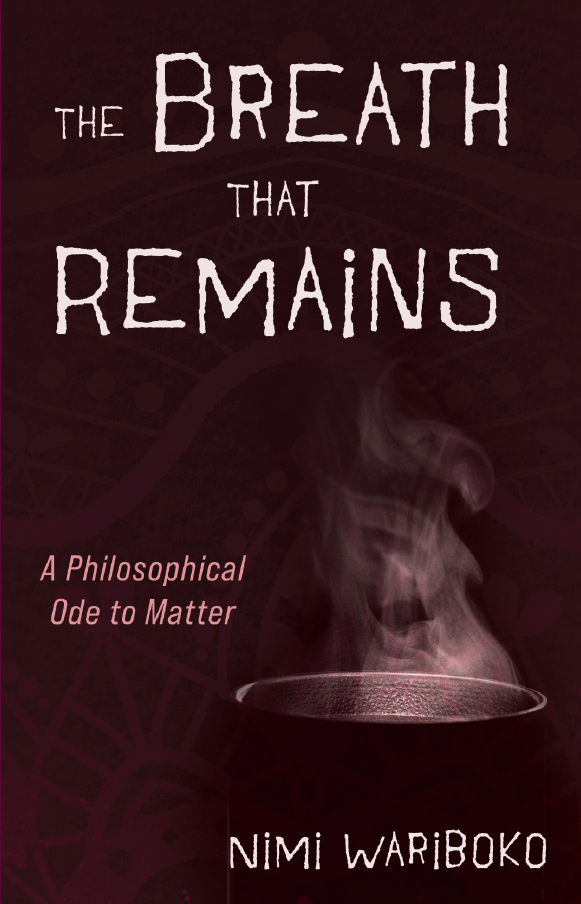
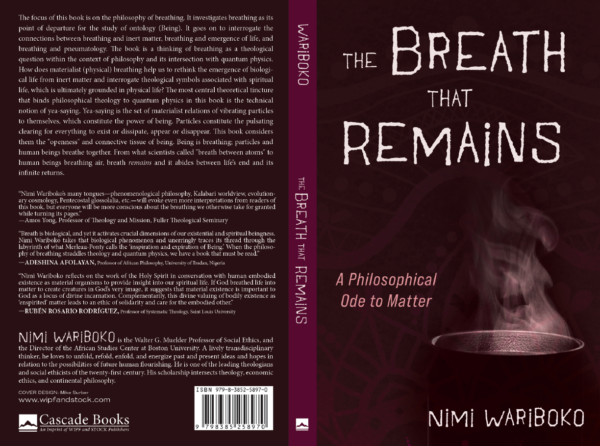
Nimi Wariboko’s book, The Breath That Remains shows an ambitious and deliberately unsettling literary work. It is one of those masterpieces that resists the conventional philosophy structure in its arguments and style. Rather than taking after the usual, the book takes to a linear styled thesis development. And through man-encompassing thought, the book stands out as a sequence of meditations. It acts like fragments from a whole, that revolves around a central theme without exhausting it. The book takes a spiral form that reflects the author’s unyielding claim that matter itself is dynamic, recursive and incapable of being restrained by myopic explanatory frames. He argues that any attempt to think matter, must first, mirror its instability.

At the very beginning, the preface creates the tone with notable clarity. “Breath” is introduced as a biological function that performs, at the same time, as an ontological metaphor capable of traversing philosophy, theology, and quantum science. At the center of this movement is the idea of the “breath-that-remains,” it is regarded as a residual force that persists across the transitions from inert matter to life and from life to spirit. In this assertion, lies the author’s bold move in rethinking the relationship between matter and spirit away from traditional dualisms. However, beneath this thoughtful endeavor, is a poignant question the book fails to fully resolve. The author’s ambitious move and methods raise concern whether such conceptual elasticity can sustain coherence across multiple disciplines.
As a result, the introductory part is tense. This is where Wariboko challenges the inherited theological claim that the Holy Spirit is the “giver of life.” This he does by drawing on contemporary scientific perspectives with which he reframes life as an emergent result of interactions between matters, rather than a distinct metaphysical category. Conservatively, the author affirms that no spirit could act as an external cause for life if matter precedes life. Instead, the spirit is reconceived as imminent or as he names it “yea-saying,” described as the generative openness within matter that allows it to extend itself. This assertion stands as one of the book’s most compelling interventions even though it demands a level of conceptual precision that is not always maintained in what follows.
The book’s early essays on “Conceptual Clarifications” attempts to strengthen the foregoing argument through striking but demanding analogies. An illustrative comparison of the “breath-that-remains” to the null set in mathematical theory is profound. Here, human existence is mirrored from absence, with being emerging from a productive void. The claim is philosophically suggestive. However, it reveals a recurring difficulty in the book’s tendency to layer metaphors faster than they are stabilized. By implication comes an intellectually stimulating discourse that is at times resistant to sustained clarity. The reader may follow and still lose comprehension.
Wariboko’s treatment of universality and particularity laid more ground for a tensed and deep argument. He presents each instance of life as both singular and structurally continuous with all others. His assertion that “each matter’s life is life’s life” places him along the paths of a relational ontology that resists reductionism. Even at that, the claims fall short as its conceptual weight could not be matched by any analytical rigor. The book’s language leans heavily on abstracts that occasionally obscures the distinctions it seeks to illuminate. Whatever the author accomplishes through philosophical reach is sometimes lost in the argumentative precision.
In search for greater balance, the book finds equilibrium in its middle movements, particularly in its reflections on the “holiness of matter.” Here, Wariboko’s prose becomes more grounded, and his claims more forcefully articulated. By placing holiness within the concept of matter itself, based on its capacity to generate, sustain, and reorganize life, Wariboko demystifies traditional theological propositions that place the sacred above the material. This reframing has shared philosophical and theological significance. It redefines the material world without collapsing into naïve naturalism, offering instead, a vision of matter as inherently expressive and creative. In these sections, the author is able to achieve a clarity and force that elsewhere remains aspirational.
The later essays, especially those centered on contradiction, takes to a more demanding philosophical register. They draw relevance from dialectical traditions, where Wariboko presents matter as internally divided and never fully identical with itself. In this phase, life emerges not from equilibrium but from this internal tension to “risk” itself beyond its own limits. These claims provide a powerful insight that aligns the book with a long philosophical lineage that reinterprets it through contemporary scientific language. However, the little sense of satisfaction here dies over a critical question on how the invocation of scientific concepts clarify the author’s argument and does this invocation function primarily as metaphor? The variation is not always clear, and the absence of any methodological transparency weakens the interdisciplinary claims.
Above all, the engagement with multiple intellectual traditions ranging from African indigenous thought, Western philosophy, and Christian theology, is one of the book’s most ambitious features. Wariboko seeks a platform that stages a transversal dialogue across these domains. The idea is to resist any form of superiority and dominance of any single framework. While this approach is commendable, it remains unevenly distributed. In some instances, the transitions between traditional philosophies feel more associative than rigorously argued, placing the reader in an uncomfortable situation to supply for themselves cogent connections that the text does not fully articulate.
In the end, the concluding movement returns to the central metaphor of the “breath-that-remains” as an asymptotic concept that can be approached but never fully comprehended. At this point, the refusal of closure is no longer alien; it forms the consistent style of the book from its introduction. The consistency in leaving matters open-ended without the proper closure recalls another evaluative question whether the open-endedness of the arguments contain therein represents any philosophical depth, or just an unresolved tension at the heart of the project? The answer to this, most definitely, may be found somewhere in between the lines.
Distinguishably, The Breath That Remains is defined accurately not by the definitiveness of its assertions but the significance and weight of its ambition. Wariboko attempts to rethink fundamental categories of life, matter, spirit, at a period where such rethinking is both necessary and fraught. This project is timely and essential particularly in an intellectual climate like ours that is increasingly characterized by scientific reductionism and uncritical spirituality. Wariboko’s work sits at the intersection of these two fundamentals. Even though the book does not always succeed in sustaining the coherent expectations of its scope, it consistently provokes high level thoughts.
In summary, this is not a book that offers easy conclusions. Reading through requires unmatched patience, critical engagement with the lines, and a willingness to stay within conceptual uncertainty. The book’s value can be felt more in the solutions it provides than in the questions it insists we continue to ask in the important categories of life and their peculiarities.