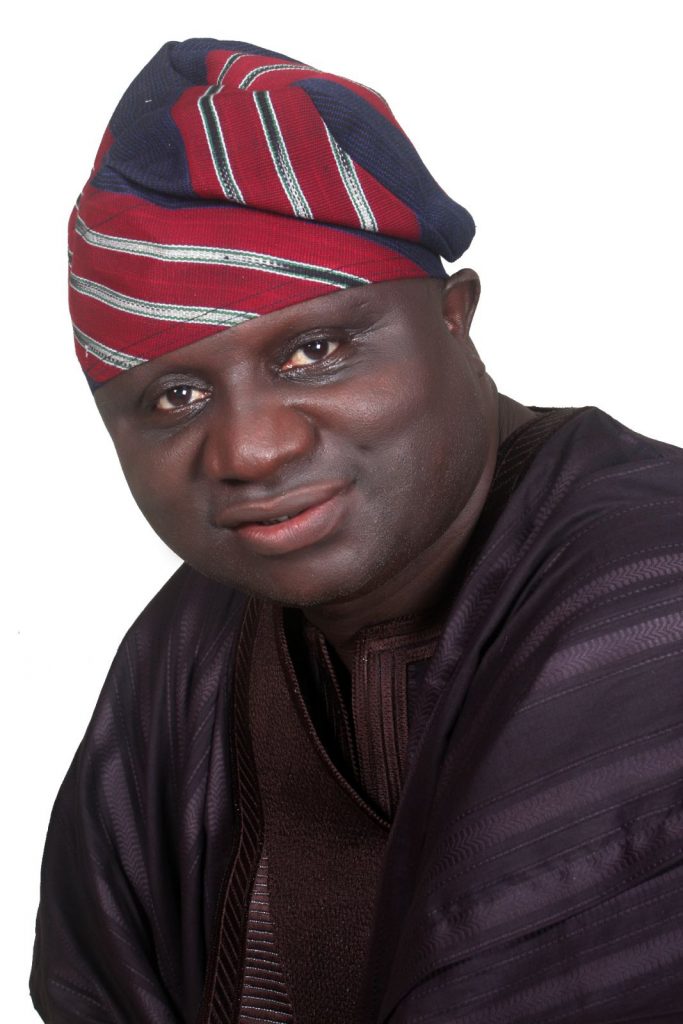

Toyin Falola
From one end of the continent to the other, it has now become normal for African people to deal with questions of crises that would affect their politics, society, and morality as nations. Whether we are talking about war, violence, conflicts among groups, electoral violence, or displacements, being African in this millennial age cannot help but be a question of crisis. It is therefore appropriate that the next Toyin Falola Masterclass on May 21st be on the topic of crisis and crisis management by none other than Professor Isaac Albert, the global guru on this important subject.

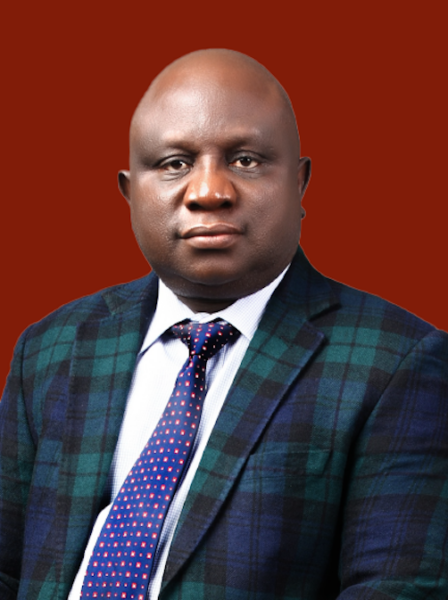
Professor Albert is one of the most distinguished African scholars who have changed the way that peace, conflict, and security are approached intellectually from something abstract to a social science discipline that is rooted in history. As a historian, peace researcher, institution builder, and intellectual, Isaac Albert has worked for years researching the origins of violence in Africa even as he has researched the ways to bring about peace in the continent. From his pioneering contributions at the Institute for Peace and Strategic Studies, University of Ibadan, to his various engagements in conflict management, Professor Albert belongs to a category of scholars who realize that crises are never solitary events but rather the result of historical development, institutional breakdowns, identity conflicts, economic disparities, and political struggles. The hallmark of his scholarship is always the need-to-know Africa’s history before understanding its crises. Considering this, it is only appropriate that the next session will have him as the sole scholar for an intellectual discourse titled “Crisis and Crisis Management in Africa.”
Since the start of Toyin Falola Masterclass, this intellectual exercise has become one of the innovative steps taken in the direction of nurturing Africa and the Global South research. This is an academic exercise aimed at bringing people together intellectually through education, and it is divided into Basic, Intermediate, and Advanced levels. The aim of this academic exercise is not to see it as just another meeting. On the contrary, the objective is to create an intellectual platform where issues concerning Africa can be critically analyzed. Those who complete the three levels will receive a certificate.
One guiding idea in the proposed Masterclass is the necessity of the historicization of the crises in Africa. Whether it is the legacy of slavery and colonization or the experience of postcolonial tyranny and the lack of governance capacity, there are many factors in Africa’s past that have created insecurities in its present reality. Not to talk about colonialism, the artificial borders, economic exploitation, and governance failures when talking about violence in Africa is to ignore the root of the problem. It is at this point the intellectual capacity of Prof. Albert becomes important as a historian and peace researcher since he does not consider the conflict as an action but as a process that allows him to demonstrate adequately how the process of building up violence happens within institutional structures, memory, inequality, exclusivity, and vulnerability. Therefore, one may not only get rid of superficial analysis but will be able to dive deep into the political and historical context of the conflict. It is against this background that this class will be conducted in clear thematic phases. In the first phase, the historical development of the concept of violence will be introduced. These aspects will be the following ones: precolonial state creation; slavery and colonial processes; disruption by colonization; frontiers created arbitrarily; ethnicity; citizenship; legitimacy; and governance. It will also be demonstrated to the students during this stage that conflicts are not something that occurs suddenly. The importance of this historical background is critical since modern-day Africa can hardly be understood apart from the colonial infrastructure under which it was created. Many African states inherited borders that ignored cultural and political complexities. These institutions were established not with the aim of serving their citizens’ well-being but for extraction. Therefore, post-colonial societies ended up with structures that are weak and unable to handle diversity, economics, and politics.
At the intermediate level of the Masterclass, there would be manifestations of violent conflict in contemporary Africa, such as insurgencies, terrorism, communal violence, electoral violence, civil wars, farmer-herder conflicts, secessionist movements, and humanitarian crisis. One unique aspect of this approach is that it does not homogenize the issues at hand. Crises in Africa do not occur in a uniform manner. Conflicts in the Sahel region cannot be compared to those in the Horn of Africa. Elections in one area generate violence differently from those in other regions, where insurgency takes place. Professor Albert does not rely on generalizing in his approach but seeks to understand situations on their own terms. This approach to African studies is associated with Isaac Albert and Toyin Falola.
The high level of sophistication of the Masterclass is exemplified through its engagement with one of the most pressing issues: crisis management. The history of Africa can be described as a history of violence, but it is also a history of survival and adaptation. For hundreds of years, indigenous practices and institutions have existed within African societies that help to mediate disputes, reconcile the community, and restore justice. Professor Albert will critically engage with the discussion of these indigenous mechanisms together with the response of contemporary state institutions, peacekeeping institutions, African regional institutions, and the African Union; mediation, negotiation, peacekeeping, diplomacy, and post-conflict reconstruction, among other topics. This dimension of the Masterclass is particularly pertinent because conversations around peacebuilding in Africa are characterized by Western approaches that overlook the importance of the history and experiences of Africans. Often, sustainable peace involves an element of historical and local legitimacy. This Masterclass will add to scholarly projects that seek to decolonize peace studies in the region. The Masterclass carries with it an ethical commitment as well.
These problems are not merely theoretical in nature. Instead, they concern the very fabric of our being. Whether or not people survive or succumb, thrive or struggle, depend on education or displacement camps, are protected or victimized all depends on effective management of the crisis. Such management of crises also implies addressing issues of justice, governance, citizenship, democracy, and humanity in general. It is for this reason that the contribution of Professor Albert cannot be overemphasized. He has always been committed to the belief that scholarship should not alienate itself from society. Universities should neither isolate themselves in ivory towers nor should their work be irrelevant to what is going on around them. It is this belief that explains how he has managed to stay relevant both in academia and among policymakers, diplomats, and people involved in the governance process. The initiative is designed not only for historians or political scientists but aims to appeal to graduate students, NGO representatives, diplomats, teachers, peace builders, policymakers, and intellectuals in general.
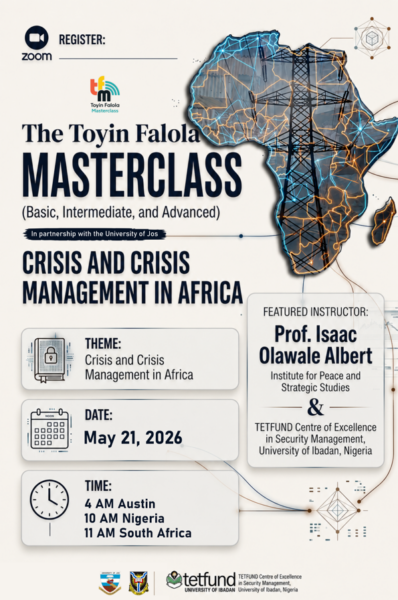
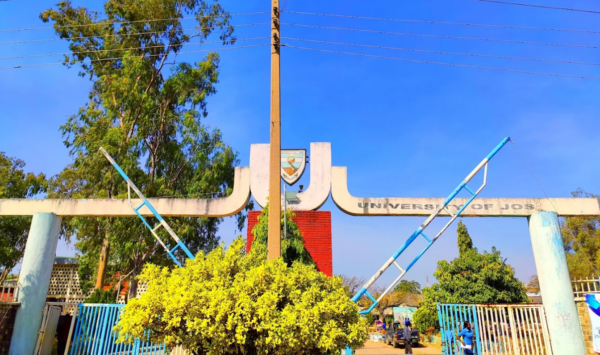
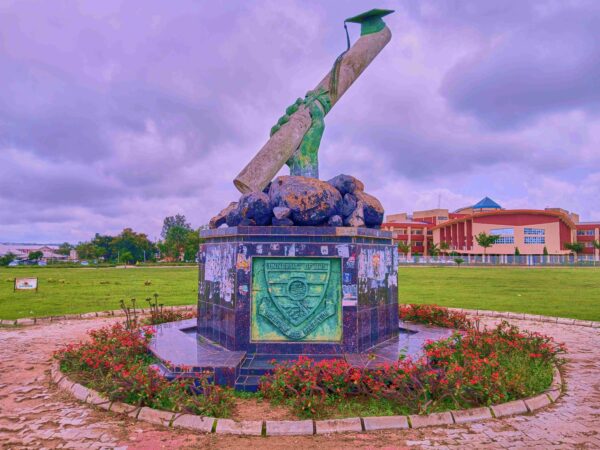
I thank the University of Jos for serving as the main platform where over a thousand students will listen to the set of lectures.
Register Here:
https://tinyurl.com/tfmasterclasscrismgt
Thursday, May 21, 2026
10 AM Nigeria
11 AM South Africa
4 AM Austin
Join Zoom Meeting
https://us02web.zoom.us/j/88108333362
Fantastic! Ó dáa jù!!
Looking forward to this
Please what historical development would you say led to the crisis happening in Nigeria today most especially plateau state
Please what historical development would you say led to the crisis happening in Nigeria today most especially plateau state
Thank you for making historians more aware
Interesting…..
Will like to join
Looking forward to this great educative interaction.
I can’t wait to gain more knowledge on this🤲🙏
Glad to be part
River Nile as the gift of Egypt
Interesting
Interesting
Interested
God bless you sir
History is greatly felt today ,because of your Iconic presence and contribution,I know I’ll love this! Looking forward to a wholesome knowledge.
Looking forward to this
Fantastic job
History help one to be educative
Together we shall stand
This is great, Looking forward to more
Anticipating
Glad to be part
I can’t wait to gain knowledge on this
I’m so glad to be part of this, i can’t wait to gain more knowledge, thanks for the opportunity.
Very interesting…..
Great piece
I want to join now
Can’t wait to gain knowledge from this experience
I’m happy to be part of this
This is amazing
Great!
Great!
Happy to be part of this.
So amazing