
Toyin Falola
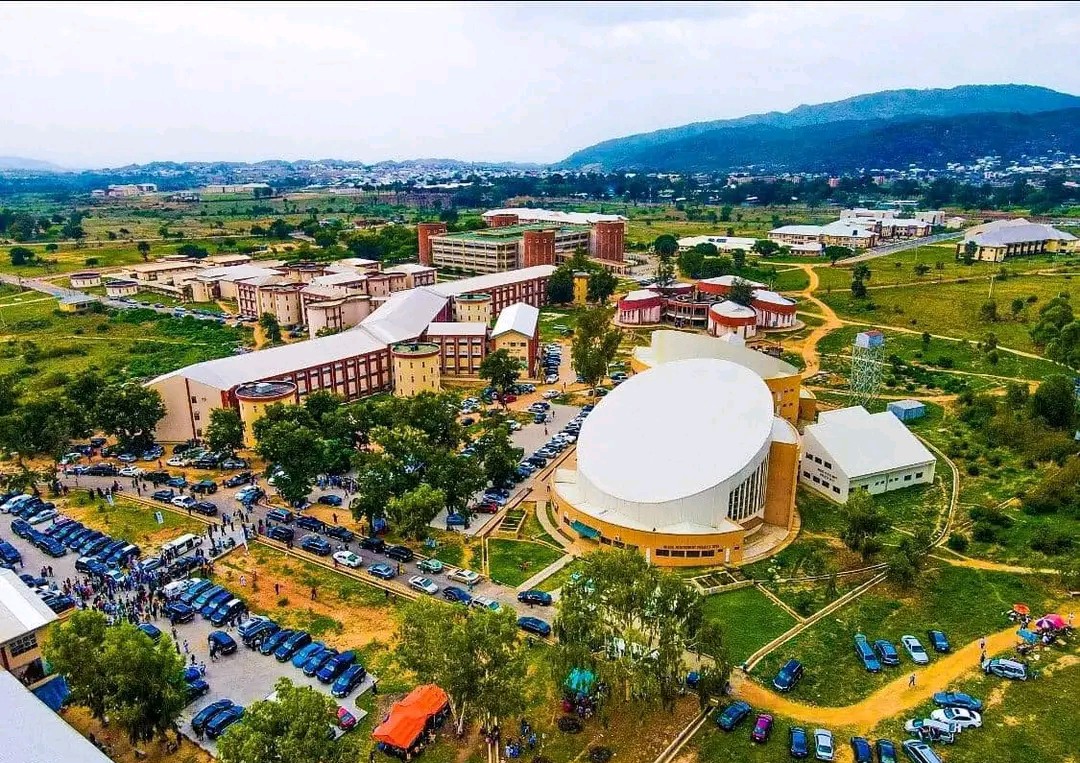
TOFAC is a platform for scholars to come together and have progressive discussions about Africa. Its 2026 edition is scheduled to hold from 7th to 10th of July at the University of Jos. Its main theme, Identities in Nigeria, is a topic that has now become more popular, especially with its connection to the country’s complex history and present-day challenges. With its focus on this theme, TOFAC 2026 allows scholars from different institutions to illuminate the diverse media through which Nigerian identity is being constructed, contested, and reimagined. I am a guest of TOFAC, although the conference is named after me, initiated by Emeritus Professor Ademola Dasylva of the University of Ibadan. I have not missed a single TOFAC since its inception.
With the main theme being identity in Nigeria, the presentations at this event form parts of several other subthemes. For example, under the subtheme of “Identities – Concepts, Theories,”Shul-Nom et al., will contribute to the examination of how burial practices of the Ham people have evolved, especially with the influence of Christianity and Islam, whilst this culture of the Ham people still maintains elements of African Traditional religion. Through this work, they will be able to reveal how external influences cannot fully erase inherent traditional practices and how these forces can fuse to reshape how core beliefs are being preserved. Still under this subtheme, there will be other presentations like that of Mathew Nimba, who will be speaking on how Criticology can be implemented as a theory to validate African epistemology systems.
Another subtheme that will provide a source of debate is that of “Ethnic Identities in Nigeria.”Here, Terese Akera will present data from the Tiv Resistance to colonial rule, revealing how the Tiv’s resistance to colonial rule was prompted by foreign provocation, which allowed the Tiv to establish a unified identity as a tool for resistance. On this same subtheme, Ajiji will lecture the audience on how resistance and the quest for self-determination can become drivers of identity formation, especially in systems where minorities are faced with repression.
The next subtheme features identity in Nigeria from the perspective of religion. Here, scholars like Bernard and Selbong combine to discuss the Sara-Suka among the Muslim Hausa communities in Jos North Local Government Area, circa 2017-2025. Their presentation will reveal how criminal gangs emerged from specific religious backgrounds and how socio-economic conditions and identity can fuse to create insecurity. The complexities of identity around religion will be further discussed by Ugah et al., with their paper on religion and ethnic identity politics, where they will provide arguments on how the politicization of religious and ethnic identity has become a serious obstacle for the development of national unity and the development of democracy.

Another subtheme of identity that will be discussed will emerge from the perspective of occupation. Madu Gana and Ahmed Garba will explain how the absence of unity among labor unions leads to the rise of inequality and reduces their power of collective bargaining. Adekunle Amos, on the other hand, will lecture on the importance of education for the sustainment of cultural identity. His argument will develop around the notion that the integration of indigenous curricula serves as preservation of cultural heritage and the promotion of cultural pride.
Gender dynamics is an important topic that gets discussed as a subtheme. Dongkek will discuss the structural barriers limiting women’s participation in politics using Mikang LGA circa 2015-2024 as a case study. Also, there will be a discussion around “Gender and Women’s Identity in Nigeria” with a focus on how the Tiv ethnic group preserved the female child’s virginity and protected their women from abuse. Through this presentation, there will be revelations of how challenges and cultural frameworks shape women’s identities in Nigeria. There will be discussions around the subtheme of “New and Emerging Identities in Nigeria,” where a topic that investigates the negative impacts of Artificial Intelligence tools on students will be analyzed by Suleiman and Ibrahim.
Identity will also be assessed from the perspectives of politics. This subtheme will feature topics such as the “Contested Identities and Political Resistance,” where Dr. Makai will focus on the manifestation of consciousness in Nigeria’s Middle Belt by tracing how regional identity morphed into a tool for resistance to marginalization. This paper will also take another turn with its investigation of the ‘majority-minority’ identity dichotomy – another subtheme of this event, as scholars like Ufana Mathew, with his focus on Benue state, will assess how demography can influence political control at the expense of minority inclusion. The indigene-settler dichotomy is another perspective of identity that aligns with both of the aforementioned subthemes. Under this section, Ayanda Abraham and Azubuike Nnamdi will explain why the reimagination of citizenship beyond ancestral affiliations can become a long-term solution to the identity crisis that currently plagues Nigeria.
Going further, the “Politics of Place Names in Nigeria” will also be assessed as a subtheme. Longman will explore how the naming of some communities in Plateau state’s lowland communities reveals how “naming” as a culture becomes a tool for identity assertion and territorial claims. The intersection of identity and security also constitutes a subtheme to be discussed through the efforts of scholars like Mohammed and Emmanuel with their argument on how the division of identity weakens institutions and entrenches conflict. There is also the investigation of the subtheme of urban-rural identity dichotomy, where Linus et al., through their research on community conflict, cite issues like competition for resources in fusion with identity politics as the main causes of violence, especially in the Middle Belt region of Nigeria.
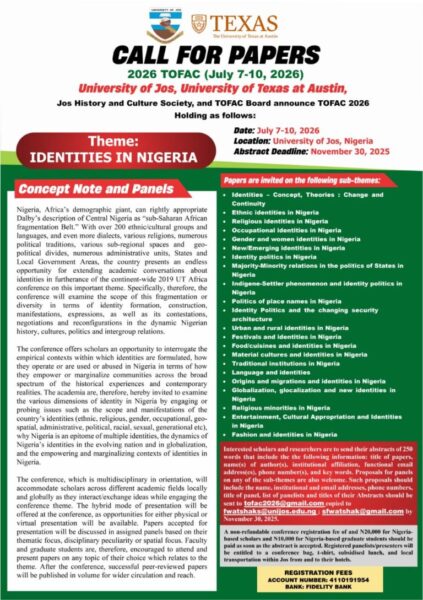
Several other subthemes that bordered around; culture, food, materialism, traditional materialism, globalization, entertainment and others; will be featured at this year’s event. Each of these subthemes presents platforms for scholars to dissect identity in Nigeria. While a few of these topics have been mentioned above, there are still several other topics, as well as scholars, that will provide lectures at this year’s event. TOFAC 2026 will last for three consecutive days; thus, there is enough time for these lectures with breaks at intervals to allow participants to refresh themselves and better assimilate the proceedings of the event.
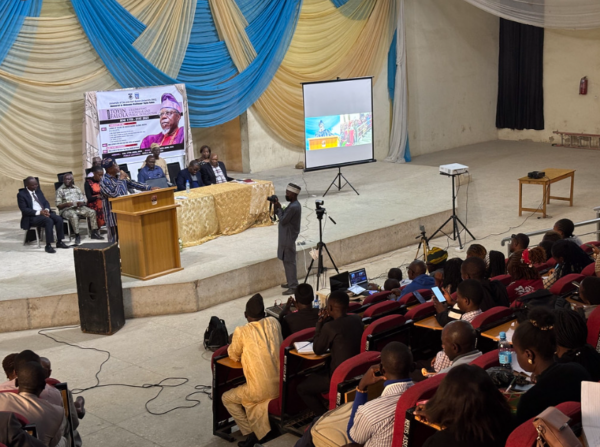
I look forward to the selections from over a hundred papers.
I’m interested reviews