
Toyin Falola
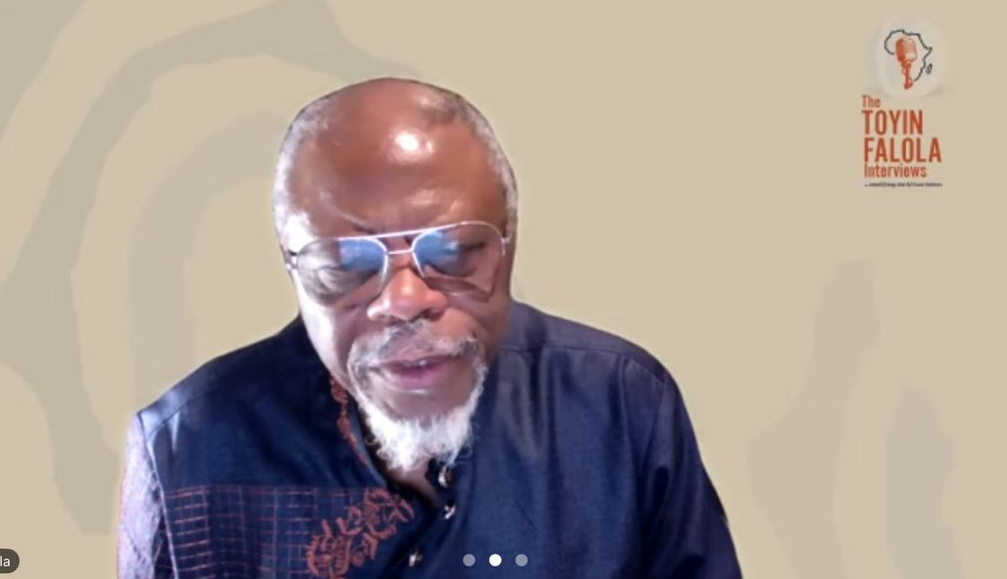
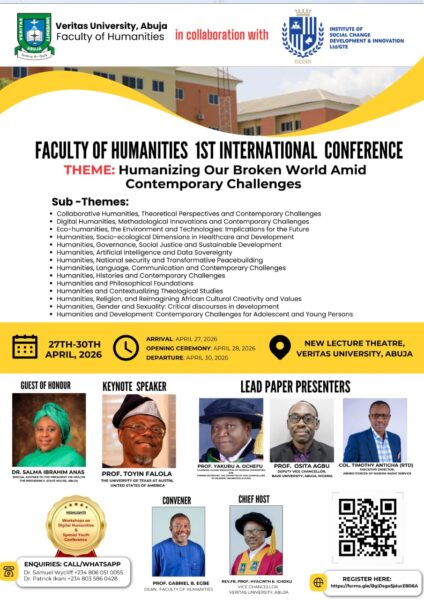
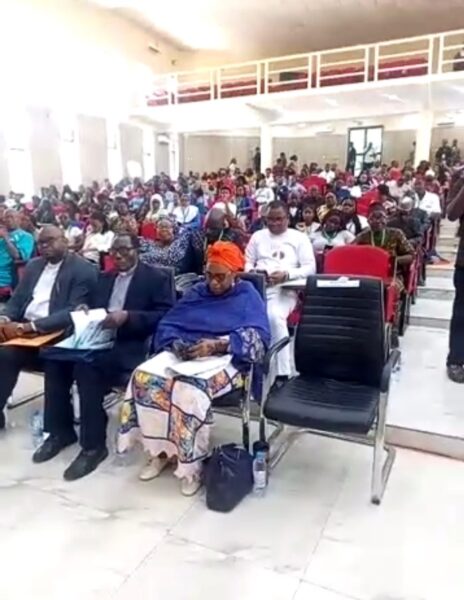
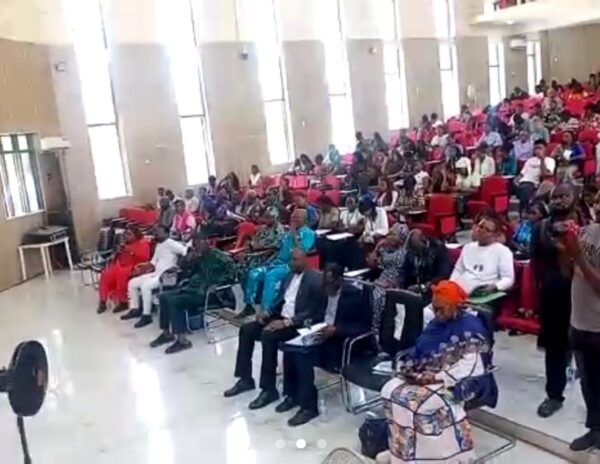
It is a great honor to have given the Keynote Address at the Faculty of Humanities First International Conference, Veritas University, Abuja, on April 28, 2026. I spoke about the theme of dignity in the context of a world that is in a deep crisis. I congratulate Veritas for holding a successful conference. Dr. Samuel Wycliff, the contact person, is a highly committed scholar.
There are moments when issues escalate very quickly, prompting us to call them a crisis. On the other hand, there were times when the experiences we went through were not just a crisis but a true rupture in our lives. The situation we are facing now is one such case of a rupture. Not only because the world is unstable, but also because the discourse we use to describe the instability of the world has become unstable as well. Such instances can be found anywhere, whether it is the persistence of war, the increasing gap between rich and poor, the constant movement of people from one place to another, or issues related to their identity and belongingness. Nevertheless, this is not a solitary event but only a manifestation of a greater fear about humankind and its responsibility toward other people. Hence, when one thinks about dignity in today’s world, it is not something settled anymore.
However, from an African intellectual perspective, there is a need for a different approach to starting the discussion, unlike the approach adopted by many philosophers of modern times, which starts from the person; the African intellectual starts from the network of relations that facilitate human existence. The African view, captured in the Ubuntu philosophy, which states that “one is a person because of others,” is not merely rhetoric. It is a philosophical stance. Dignity, according to this perspective, is not a quality that one possesses. It is either confirmed or denied in the company of others. Therefore, there is undoubtedly something quite alarming about the present situation that we face. The more interconnected we become, the more unable we seem to maintain ethics in the relationship. Certainly, globalization brought about the opportunity for various cultures to interact, but it never necessarily implied any contact at all. This means proximity and no understanding of each other. This may only be explained through taking us back into history, as an analysis tool, not nostalgia. All the fractures of our contemporary existence did not come up instantly.
History reveals that they are complex. For example, colonialism was more than just a rearrangement of maps; it was the restructuring of knowledge as well as the disruption of traditional modes of authority. In many parts of Africa, the issue of dignity was one that had to be fought for in an environment that did not understand dignity. The reason for studying history is thus that we will not mistake long-term structural issues for temporary difficulties.
At the same time, philosophical traditions have tried to give us tools. Enlightenment thinkers, particularly Kant, insisted that human beings should never be treated merely as means. That insight remains important. It helped shape modern discussions of rights and justice. However, this still fails to conclude the discussion. It informs us about the value of human life, but at the same time, it doesn’t provide us with the knowledge of how societies can be structured to preserve the value of human life. Anthropology helps us to understand that morality is not something abstract that stands above society. The sense of justice, honor, dignity, etc., depends on the historical, linguistic, ritual, and practical background of people’s lives.
Nevertheless, that doesn’t mean anything goes. Ethics needs to take into consideration different cultures and societies and their values. Here arises one of the major contradictions of today. Human nature strives for dignity, but there is no universal form of it.
The issue is not to make such differences disappear, but to address them without succumbing to either relativism or domination. A closer look would reveal that many of the world’s problems today can be traced back to the difficulty involved. Economic disparity is one of them. But it goes beyond money; it is the freedom to live a life worthy of respect. Where there is a lack of educational, health, and political opportunities, dignity is threatened.
Disparity is also an issue of representation. Who gets to speak for whom? Whose insights matter? Whose perspectives inform policymaking? For years, the intellectual contributions of Africa and other nations in the Global South have been dismissed and disregarded, rendered secondary or informal at best. There are no innocuous forms of marginalization – they always carry moral implications. The discussion becomes a central part of the process – but it must go beyond simple talk. I am talking about the form of dialogue that takes time and requires one to be attentive, respectful, and open to self-challenging. Discussions of Africans about various matters represent the perfect example of how insights into ethics emerge through dialogue, not orders.
Education must also carry this burden. It cannot simply churn out technically competent individuals devoid of morals. On the contrary, it must bring out individuals who can think in terms of history, discern injustice, and act with responsibility. The same applies to institutions, because when institutions forget their ethical considerations, inefficiency follows alongside alienation. It could not be clearer than the example of the postcolonial experiences of various African nations. For example, many nations of Africa realized that the systems established by the departed colonizers were in no way compatible with the concepts of responsibility and justice. There have been new challenges in recent times. One example could be how artificial intelligence brings about a range of ethical issues. Who makes these technologies? What moral implications do they carry? Technology can extend us, but it might also perpetuate an old order in a new form.
Another frontier of ethics concerns climate change. It obliges us to address issues of uneven distribution of responsibility and suffering. It is usually those communities that have been least destructive to the environment that suffer the most from this phenomenon. Hence, in this case, we cannot separate dignity from justice. Then, the obvious question is: Does anything need to be done to address this problem? There is obviously no quick fix available for this issue. Certain things can certainly be done, nonetheless. One thing we need to consider is the importance of culture in our ethical thinking. We must create venues where various societies can discuss each other on equal terms. However, above all else, we must avoid reducing dignity to a purely theoretical issue. Dignity is something that manifests itself in practice, in how people can express themselves, in how people can take part in decision-making processes, and in how people can be respected.
PS: This represents the thrust of the Keynote Address
This is insightful. Thanks Prof
The hypocrisy of European human rights advocates has been highlighted in the case of Gaza.Dignity and respect were defined opportunistically to fit their own
selfish goals.
It seems to me that, without power to advance, defend, enforce, and promote culture, ethics, and struggle, the three entities are mere talking points that are void of effect. Machiavellian principles trump ecumenical principles in the world of perpetual conflict.