
Toyin Falola
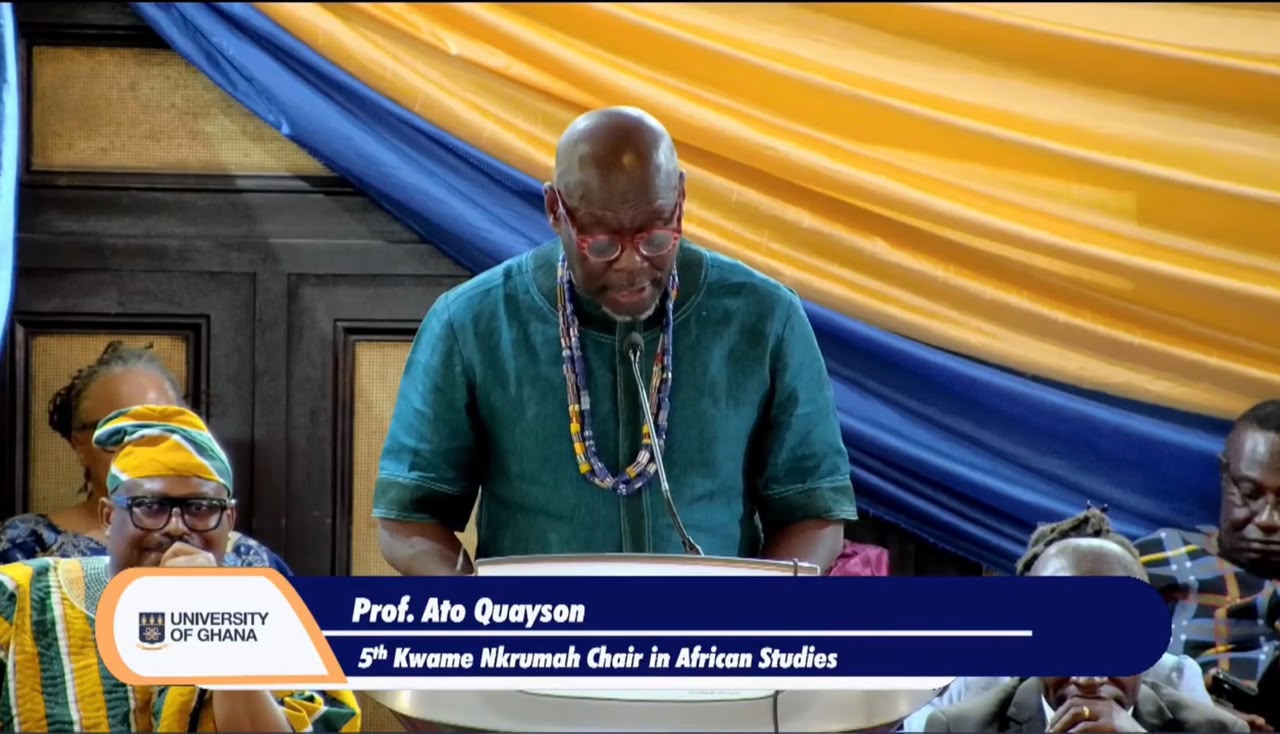
At the inauguration ceremony of the Kwame Nkrumah Chair in African Studies at the University of Ghana, Professor Ato Quayson discussed the curiosity that shaped his scholarly life, as well as issues of nationhood, environmental destruction, the diaspora, and African scholars’ responsibility to society.
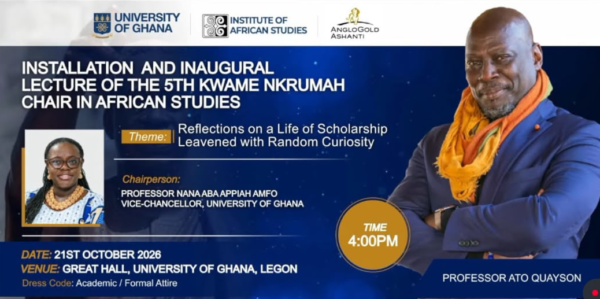
At the opening ceremony held on October 21, 2026, in the Great Hall of the University of Ghana, Professor Ato Quayson delivered his inaugural lecture, “Reflections on a Life of Scholarship Leavened with Random Curiosity.” Beyond the story of a successful distinguished academic life, the lecture focused on developing intellectual curiosity, the complexity of studying society, and the need to generate new ideas capable of interpreting African experience. As the fifth holder of the Kwame Nkrumah Chair in African Studies, Professor Quayson connected his personal story and experience to the major problems the nation now faces.
First, he explained the origin of the curiosity that became the basis for his scholarship. Growing up in Accra in a household full of books, newspapers, novels, and other kinds of literature, young Ato developed a taste for knowledge that went beyond school lessons. His intellectual curiosity grew through stories and his father’s unusual questions, including how the stone became the earth and how volcanoes appeared. The influence of his mother, who was trading at the Kaneshie Market and giving him various rumors and gossip, was also important for Ato’s development. These stories show that intellectual development can happen at the intersection of formal schooling, folklore knowledge, storytelling, and everyday events. Therefore, intellectual curiosity is not the wish to accumulate knowledge, but the ability to find unusual meanings in common things.
This curiosity also explains the enthusiasm with which Professor Quayson studied at secondary school. He used to sneak away from Apam Secondary School to go to Accra libraries, even hitchhiking on cargo trucks because he lacked the money for transport. One day, he wanted to understand the novel This Earth, My Brother by Kofi Awoonor, so he went to the University of Cape Coast to ask the author some questions and waited for several hours to do so. It means that curiosity involves going beyond the boundaries of the immediate environment. Unlike staying within those boundaries and learning passively, it involves seeking information in books, people, and their opinions. It gives reason to ask what educational institutions do: train people to reproduce knowledge or teach them to ask and solve their own questions. It also makes sense to create comfortable conditions for learning: accessible libraries, responsive teachers, and a rewarding academic environment.
However, curiosity does not explain the emergence of this notable scholar, the pride of Africa. Professor Quayson’s reflections on his university years at Legon and his further studies at Cambridge University show the importance of mentorship, discipline, and constant study of ideas. He especially highlighted the contribution of Aloysius Denkabe, whose lessons in practical criticism spurred him to study language and literary structure. Through long conversations, chess games, and discussions, he learned to value intellectual apprenticeship, understood as ongoing dialogue between an experienced scholar and his junior follower. Thus, knowledge is not only received in lessons or in printed form, but it is passed through intergenerational conversations. However, the question of how it is possible to maintain such a kind of communication in modern universities under the pressures of administration, teaching, and research arises. Professor Quayson believes that apprenticeship can still be a good way to pass on knowledge despite the difficulties of this situation.
Furthermore, his experience at Cambridge taught him that curiosity must be paired with discipline and courage to push beyond one’s boundaries. He remembered his doctoral supervisor, Tim Cribb, and described a writing process that required him to write long essays every fortnight. Such discipline helped him develop the necessary writing and research skills. At the same time, it relates to his father’s idea about the importance of both the content and the form of written work. His father’s lesson teaches that seeking knowledge means overcoming the fear of ignorance, since students often hesitate to ask questions to preserve their dignity. According to Professor Quayson, overcoming this fear is necessary to become a good scholar. In this case, it becomes possible to develop curiosity and perseverance and then apply them to other disciplines—urban studies, diaspora studies, disability studies and so on.
This interdisciplinary perspective is reflected in the study of Oxford Street, Accra, one of the most recognizable parts of the capital. Oxford Street is not just a commercial artery; it is a way to reconstruct the city’s historical, social, economic, and cultural aspects through its inscriptions, leisure activities, architectural organization, and diverse communities. In general, it means that African societies have a lot of intellectual resources in their ordinary spaces and everyday practices. In this case, a street, a marketplace, a transport system, or a neighborhood can become an archive that helps investigate the connection between historical change and modern life. Thus, the assumption that knowledge cannot be developed in African reality based on foreign experience is false.
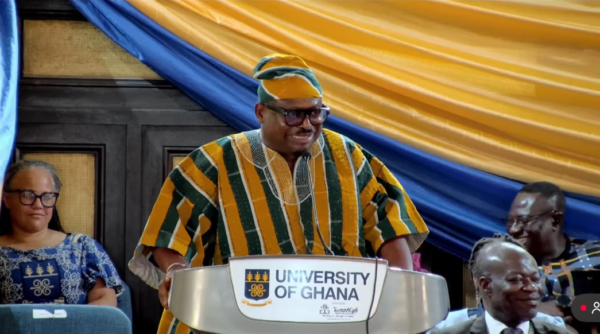
This intellectual perspective allows us to consider the more political questions Professor Quayson will examine in the context of the Kwame Nkrumah Chair. His research, proposed as “Kwame Nkrumah and the National Longing for Form,” will examine the relationship between nation and state after Ghana’s independence. Professor Quayson argues that independence did not create a nation-state. Nkrumah inherited territories with different systems of administration and social structures shaped during the colonial period through the division of nations. It meant that nation-building implied not only independence, but also the process of forming the national identity and institutions capable of integrating inherited fragments.
This perspective helps us reconsider the experience of post-independence Ghana. Professor Quayson suggests reading periods of its political life not as separate chapters on government successes and failures, but as different historical contexts that raise new questions about the relations between the state and society. He calls them “problematics” instead of “problems,” emphasizing that they require continuous reconsideration and not single solutions. For example, discussing Rawlings’s epoch, he emphasizes the retreat of the developmental state in welfare provision due to economic pressure from the IMF and the increased role of market-based value evaluation. The question is whether the state can realize its national duties when its ability to provide welfare is limited. Thus, placing economic policy in the historical context of nation-state formation, he asks us to reconsider how political and economic decisions shape citizens’ expectations and identities.
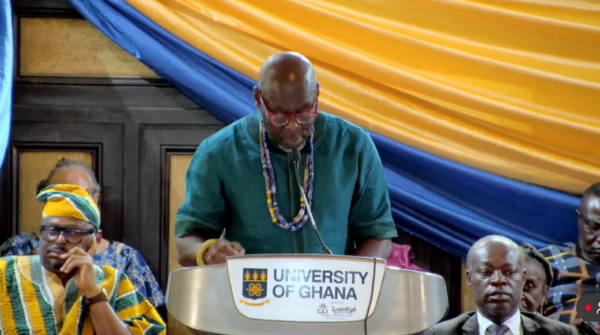
From this perspective, Professor Quayson identifies two problems in Ghana’s current national experience: illegal small-scale mining, widely known as galamsey, and the need to redefine relations with the Black diaspora. He sees galamsey as an existential problem, meaning environmental destruction should be considered in a broader context than economic criminality. This topic raises questions about the state’s ability to control natural resources, protect people, and align economic interests with environmental protection. By situating galamsey within his research on Ghana’s national experience, Professor Quayson notes that environmental destruction should be understood in light of the institutions, economic structures, and political decisions that shape the relationship between the state and citizens. This means that it is necessary not only to notice the problem but to understand the deeper conditions that create difficulties in solving it.
Importantly, he proposes developing a new Pan-African discourse that includes not only Ghanaian or African emigrants, but the whole Black diaspora. He draws a line between visiting Ghana and settling there and argues that the interest of people with African ancestry in settling on the continent requires serious consideration. The Inaugural raises questions about how to understand people’s sense of belonging, and how they can influence business, social integration, and national identity. These considerations complicate the narrative of the diaspora’s return by showing that belonging presupposes more than lineage, tourism, or symbolism. The Pan-Africanist project should consider the expectations of existing communities and the conditions that allow people with multiple national affiliations to participate in society. In this sense, the issue of diaspora becomes part of a larger issue of forming the national community.
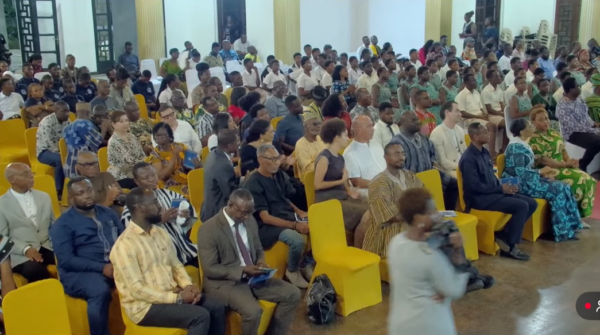
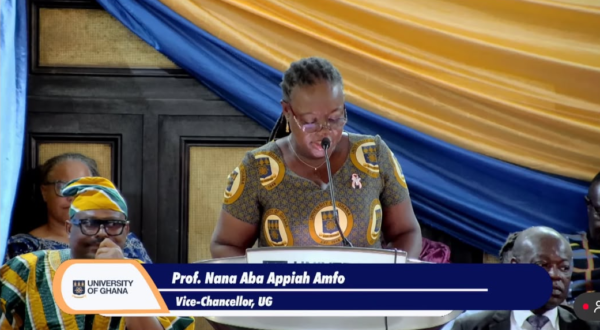
Professor Quayson connected these problems with his intention to train a new generation of African scholars. He is going to create a mentoring scheme for graduate students and early-career academics with the help of the Interdisciplinary Research and Mentoring Unit at the Institute of African Studies. This initiative reflects the core idea of his scholarship: intellectual development occurs when curiosity is encouraged, discipline is cultivated, and older scholars engage with younger scholars. In addition, it helps put the ideals of the Kwame Nkrumah Chair into practice. As Vice-Chancellor, Professor Nana Aba Appiah Amfo noted in her concluding remarks, curiosity and persistence were Professor Quayson’s main qualities. In this way, the importance of his appointment depends not only on his ideas, but also on his research conversations and mentoring connections.
In conclusion, Professor Quayson’s lecture on his return to his alma mater is more than a presentation of an outstanding academic. He offers a vision of scholarship that begins with curiosity about the world, continues with discipline, and ends with society’s problems. By connecting childhood stories, literary criticism, urban life, and historical analysis to intellectual formation and questions about the nation, he shows the importance of seeing ordinary realities from unusual perspectives. In this way, Ghana and the wider African intellectual community face the challenge of preserving intellectual curiosity and building institutions capable of translating knowledge into practice. In the modern world, where debates about identity, economic development, environmental sustainability, and global belonging shape the nation’s future, Africa needs scholars who can reconsider existing ideas and interpret their society’s experience.

Dear Ato, Congratulations! I remain jealous of your accent as I listened to the entire lecture, glued to your genius at crafting extraordinary sentences.