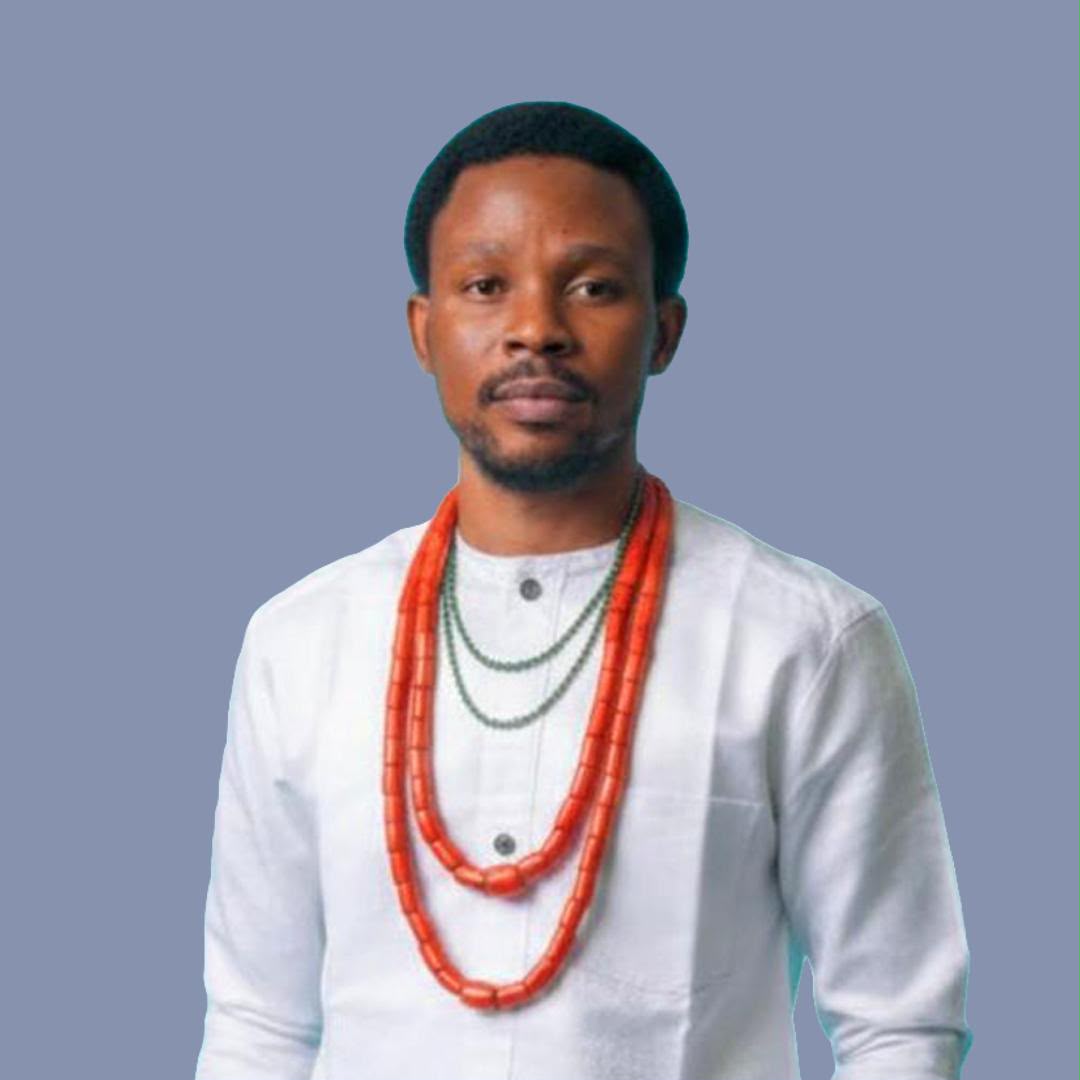

Majekodunmi Oseriemen Ebhohon
Writer | Playwright
Author, The Great Delusion
ANA 1ST Prize, 2025
How do you measure a man who has spent decades turning fragments into forests? Inni Essiet’s documentary, The Genius of Toyin Falola, answers this through the life and work of its subject. The film presents Falola’s intellectual career as a record of sustained production, proving that the true stature of an intellectual is measured not by the height of their personal pedestal, but by the depth of the shade their canopy provides for others.
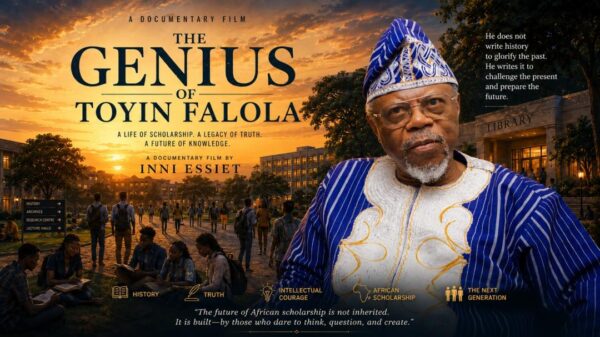
The film grounds this trajectory in Ibadan, presented as an intellectual ecosystem of markets, hills, arguments, and restless improvisation. It was here that Falola learnt that history lives in names, proverbs, and the narratives of family compounds. His entry into global scholarship began with close attention to the local. Ultimately, his work reaches beyond its immediate setting, acting as an amplifier for an Africa that speaks through its own sovereign histories, concepts, and experiences. The local becomes his point of departure for understanding the broader human and geopolitical conditions.
This expansive reach, however, relies on an arduous liturgy of daily labour rather than intuitive epiphany. Working against institutional deficits, fragmented archives, and geopolitical publishing inequalities, Falola pioneered a model of generative resilience. He learnt, in essence, to sow on stones—undergirding his public recognition with the grueling, invisible mechanics of exhaustive archival retrieval, cross-continental lecturing, and structural field-building through founding book series and convening conferences.
This sustained labour fuels a systemic reversal of narrative dispossession. For centuries, external theorists treated African experiences as mere raw data for validating exogenous frameworks. Falola reclaims Africa as an active subject, a sovereign voice that remembers, theorizes, and articulates its own conceptual categories. By integrating indigenous Yoruba concepts such as Àyànmọ́ (destiny) and Ọmọlúàbí (ethical social personhood) into mainstream academic discourse, his work positions African thought at the center of global knowledge production rather than at its margins.
Consequently, his most significant text remains unlisted in bibliographies, but is a human document written across generations of students and colleagues. Where academic cultures organized around scarcity encourage intellectual hoarding, Falola cultivates abundance, enabling emerging scholars to find their own analytical footing.
Yet, the depth of this scholarship also appears in its refusal to romanticize the continent. The work directly confronts authoritarianism, inequality, violence, and institutional failure across Africa. It is a harsh mercy to criticize most deeply what one refuses to abandon; his scholarship balances rigorous critique with the tangible work of rebuilding the very structures he analyzes.
The documentary concludes by arguing that the appropriate tribute to a life spent cultivating knowledge is to pick up the spade to examine our own institutions, produce useful scholarship, and transform the luxury of our analysis into the labour of indigenous reclamation.
Indeed, the documentary aptly reflects on the scholar who is more than a generational talent.
This is good. Writing on Prof.Toyin Falola ‘s scholarship is a great service to our country. Folola is one iconic cultural ambassador of our much troubled Nigeria. How do we get this s documentary?