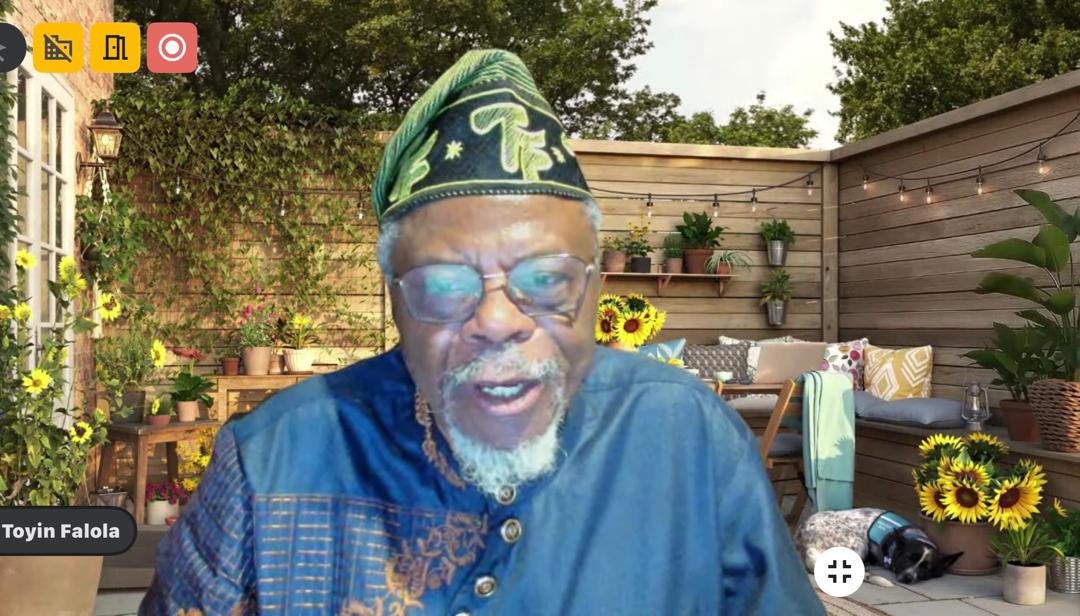

Toyin Falola
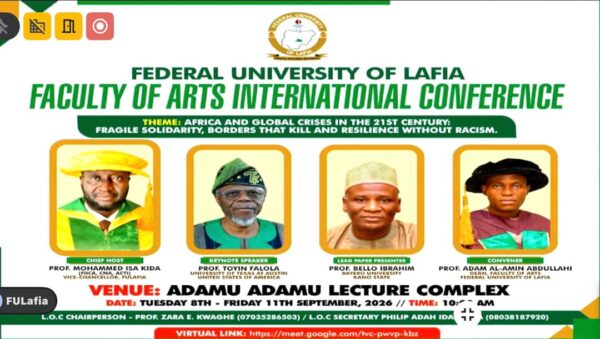
I appreciate the invitation from the Federal University of Lafia to give a Keynote Address on September 9, 2026, on the theme of “Africa and Global Crises in the 21st Century”. I thank the organizers and contact persons, most notably the Convener and Dean of Faculty, Professor Adam A. Abdullahi, Professors Zara E. Kwaghe, Dr. Philip Idacaba, and many others behind the scenes.

Something occurred in the townships of Johannesburg and Durban in May 2008 that should have been inconceivable. South Africans turned against their fellow Africans. Shops were ransacked. They burnt houses. More than sixty persons were killed. This was the Nation of the Rainbow. The grand emancipation tale of the continent. The nation of Tanzania, Zambia, Angola, Zimbabwe and Mozambique had harbored, trained, supported and bled for throughout the long years of the anti-apartheid war. When apartheid finally went out in 1994, the continent regarded it as a common achievement. That thankfulness didn’t last long.
The assaults in 2008 were not a unique incident. They came back in 2015. But they have persisted in less visible forms ever since, with Nigerian businesses burnt down, Zimbabwean workers beaten up, Somali businessmen expelled from communities they developed over years. Every time, the South African government has denounced and investigated. Reports filed. Essentially, not much is different. The first reason for starting with South Africa is not because it’s the worst instance of intra-African antagonism on the continent. That is because of the philosophical importance of what South Africa is. No African nation owes a greater evident debt to solidarity on the continent. When the loan was due, something else was paid.

Pan-Africanism was always premised on a promise that a common history of slavery, colonialism, and racial oppression had established a brotherhood of African peoples that transcended the boundaries imposed for us by others. It’s a tremendous concept. It sparked movements for independence. It offered generations of Africans a vocabulary of pride and resistance. But that gap between what that idea promises and what actually happens when an African from an African home tries to find work in Johannesburg, or when a West African trader tries to build a life in Côte d’Ivoire, or when a sub-Saharan migrant tries to pass through Libya, that gap is the subject that Pan-African discourse has not been honest enough about for long enough.
It is important to grasp the foundational intellectual heritage of Pan-Africanism distinctly since it influences the character of the solidarity it develops. Pan-Africanism did not initially originate in Africa. W.E.B. Du Bois, Marcus Garvey, C.L.R. James, Henry Sylvester Williams, diaspora leaders, individuals of African heritage living in America, the Caribbean, and Britain, wrestling with the specific shame of hearing from nations that vowed equality that they were worth less. Their Pan-Africanism was formed as a response to exclusion, to the feeling of being defined by what was done to us. That’s an essential aspect. It was the unity that it created, the solidarity against something, against colonialism, against white supremacy, against racial hierarchy. That form of togetherness is strongest when the shared adversary is in view. That was the rhetoric when Kwame Nkrumah said at the foundation of the OAU in 1963 that Africa could only withstand neo-colonialism if it were unified. That rhetoric was at work when the frontline African governments sacrificed their people and their economy in favor of the ANC’s liberation movement.
But the continental effort was fractured almost immediately by the Cold War. From the Western side, Kenyatta’s Kenya looked on warily. At Addis Ababa, Nkrumah’s push for political unification was turned down in favor of a looser club of sovereign nations based on the concept of non-interference. That concept meant the OAU couldn’t openly criticize what African governments did to their own people: not Idi Amin’s deportation of Uganda’s Asians, nor Mobutu’s pillage of the Congo, nor the famines and civil wars that followed. African unity was not a real continental goal but a club for state sovereignty institutionalized. The African Union, which succeeded the OAU in 2002, has been more aspirational in its terminology and has made some headway on economic integration via the AfCFTA, but the great majority of Africans still require visas to go to most African nations. The gap between the professed principles of Pan-Africanism and the practical reality of real Africans migrating across the continent has never been honestly filled.
Scar tissue is the symbol for Pan-African unity. When the body is badly injured, it doesn’t just recover to the way it was. It creates fibrous, functional, imperfect scar tissue. Scar tissue closes the wound. It keeps the body alive. But it’s not the same as what was there before. It is less adaptive. doesn’t always see things the same way. It is at normal pressure, but it may snap with new sorts of force. And importantly, scar tissue does not heal. Here the wound is the Atlantic slave trade, which took an estimated twelve million people off the continent, purposefully destabilized African political structures, and set African polities to compete to provide captives. It is colonialism that drew nine thousand miles of new boundaries without consideration for where people really lived. It is colonialism that constructed administrative systems structured for extraction rather than development, that left behind institutions calibrated for control. Pan-Africanism is the body’s answer to such wounds. It is true It’s done some genuine work. But it is composed of the substance of grief, and the solidarity it creates is stronger when turned outward.

The problem with intra-African is some inborn African tendency of ethnic warfare that modernity has not yet eradicated. It is problematic because it distracts attention from the structural circumstances that genuinely explain the things that we experience, and it reproduces the colonial tale that African social problems are failures of character rather than outcomes of history. It all really starts with those nine thousand miles of boundaries. At independence, the OAU made a sensible choice to maintain colonial borders rather than battle to alter them. But that choice locked African governments into establishing national identities on false grounds, and set up institutions not for the welfare of their peoples but for the administration of extraction. As researchers of African political economy have shown, the upshot was a political culture in which control of government meant control of patronage, of contracts, licenses, resources. In such an environment, the language of national interest is a resource of political contention. You organize your constituency against other people. You attribute your shortcomings to external dangers. You make the migrant a scapegoat.
In this scenario, the IMF and the World Bank’s Structural Adjustment Programs, forced on most African countries in the 1980s and 1990s, are seen as being correct. To secure finance during financial crises, African governments were forced to decrease public expenditure, privatize state firms, liberalize trade and eliminate subsidies on vital items. For urban inhabitants, this was a catastrophe. Jobs evaporated. Schools and hospitals broke down. The informal sector grew to take in people who could no longer find jobs in the official economy. The cities to which intra-African migrants moved in the 1990s and 2000s were not unfriendly spaces per se. These were sites of created scarcity, where a certain set of policy choices made in Washington had torn down the infrastructure that would have taken up movement without anger. In the struggle for existence, humans compete with the nearest person. The migrant is present and economically visible. The international financial institution that set the terms of the competition is remote and abstract.
Young black South Africans are still faced with devastating unemployment. The township economy is an area that is fiercely competed with very scarce resources. Intra-African migrants join this region with a lower reservation wage, i.e., they can exist on less, typically because they are sending money back to family in countries with lower costs of living. Politicians have used this economic truth all along, time and time again, to spin a yarn: it was the migrants’ fault that you’re poor. Economists who examine South African labor markets tend to find a neutral or modest impact of migration on employment. But the tale has been told so many times that substantial portions of the urban poor have absorbed it. This is even more acute with social media. During the violence in 2019, videos of attacks on Nigerian-owned businesses circulated rapidly on WhatsApp and Twitter, some of which were later identified as unrelated footage from entirely different contexts, and provoked retaliatory responses in Nigeria that threatened to tear bilateral relations apart altogether.
The most striking example is what occurred in South Africa in 2008 and beyond, but the trend applies throughout the continent. Following the fall of the regime of Muammar Gaddafi in Libya in 2011, sub-Saharan African migrants have been detained, exploited, and in recorded instances enslaved. In Côte d’Ivoire, the official ideology of ivoirité in the 1990s and early 2000s used the issue of migrant heritage to exclude those born in the country from political involvement, and ultimately generated political violence that killed hundreds. In 1983, Nigeria deported around two million West Africans, giving them two weeks to depart the country. Ghana had done something similar in 1969. Both expulsions included founder members of ECOWAS, an organization whose charter itself guaranteed unrestricted mobility. There was a building. Economic pressure killed the will to keep it.
The philosopher Achille Mbembe has argued that the slave trade and colonialism have had the lasting effect of making African subjectivity primarily a response to negation, defined by what was taken, denied, destroyed rather than by positive self-creation. It’s important for solidarity because solidarity against something is a whole other thing than solidarity for something. The first, only an adversary in common. The second demands a real identification with those different from you, who are in economic competition with you, who are not part of the national narrative that underpins your feeling of entitlement. That’s a tougher job. The Nguni concept of ‘I am because we are’, commonly translated as the Ubuntu philosophy, was widely referenced in post-apartheid South Africa as the intellectual basis for a new sort of society. It didn’t stop the 2008 or 2015 assaults. Not because Ubuntu is empty as a philosophy, but because philosophy has to work in circumstances. Ubuntu demands enough homes, enough work, enough security, enough community not under excessive strain. And when the scar tissue is stressed sufficiently again, something else takes control.
It’s important to be honest about the fact that this is all gendered too. Intra-African migrant women are doubly vulnerable to general animosity against migrants and the special dangers of relocation, sexual abuse and exploitation in domestic labor markets, and increased precariousness when children are illegal. Such weaknesses have been progressively down-weighted by a Pan-Africanism that is rooted in the unity of male political leaders and freedom fighters. The scar tissue fails not just in its outward extent.
At this stage, the issue of what real solidarity would need is not a purely philosophical one. It’s an issue of policy, a question of institutions. Freedom of movement throughout the continent is not a luxury that can wait till African nations get wealthy. Labor mobility is one of the better productivity and growth generators. It is a prerequisite to make them wealthy. African states still have visa regimes with one another that are not safeguarding their residents. They preserve the elite’s control over patronage and labor markets. The African Union’s free movement protocol is there and has been broadly supported in concept but has stalled in ratification. Moving it ahead requires political will, and the most probable source of political will is consistent pressure from civil society, from the legal and academic communities, from media organizations that take the continental enterprise seriously as a practical rather than a ceremonial commitment.
We are having these arguments in 2026, and the urgency is not just rhetorical. If we don’t build up solidarity and the institutional structure before those pressures come, we will be attempting to develop them in a crisis situation. Pan-Africanism is not a hoax. It prompted decolonization. It supported freedom movements. It provided us with institutions, if faulty, which we would not otherwise have had. We have traditions of intellectual richness and continued relevance: Fanon, Nkrumah, Nyerere, Cabral, Mbembe, Mamdani. These are actual accomplishments. But solidarity born of common traumas alone is fundamentally constrained in ways we need to acknowledge honestly if we’re going to develop something more permanent. The scar will not heal by itself. It can be improved in function by conscious, continuous effort, but only if we are honest about what it is we are treating. If you behave as if the scar has healed, or that it is not there, then it is guaranteed to break the next time great pressure is applied.
The rationale that the Zimbabwean in Soweto deserved less protection than the South African next to him is the same logic, dressed up differently, that formerly thought that the African in the colony was less worthy of consideration than the European settler. Pan-Africanism was particularly founded on opposing such rationale. It cannot just sit back and accept this now because the persons doing the exclusion are black and the categories have altered. The Africa we really have needs to be constructed from the realities about the Africa the continental project claims it desires. There is no alternative.